
Please find resources for this session below. To return or share this page, use the link:
https://tinyurl.com/fbaucai

Slides
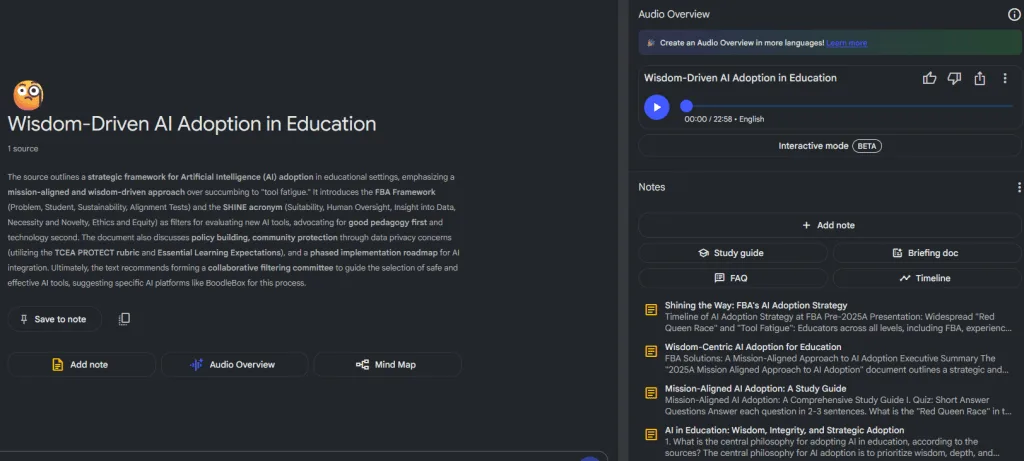
Listen to Deep Dive Podcast
This is a 22 minute exploration of the presentation by Google’s Notebook LM Deep Dive team (Gen AI generated). Great for review of the original presentation or to get a big picture overview.

Miscellaneous Documents
Get access to Study Guide, FAQs, Timeline, and the Google Notebook LM
Questions?
Share your questions in this Padlet.
AI Tool Comparison
AI Tool Comparison
Feature / Consideration
BoodleBox Unlimited
ChatGPT Edu
Claude Team
Gemini for Workspace
Core Philosophy & Strength
Orchestration & Collaboration: A secure platform to access, manage, and stack multiple best-in-class AI models (like those from OpenAI, Anthropic, Google) in one collaborative environment.
Versatility & Ecosystem: A powerful, all-purpose tool from OpenAI, known for its strong reasoning, creative generation, and wide range of applications.
Safety & Nuance: A model from Anthropic with a strong emphasis on safety, ethical considerations, and nuanced, reliable writing and summarization, especially with long documents.
Scale & Integration: A powerful model from Google that excels at processing massive amounts of information (very large context window) and integrating deeply with the Google Workspace ecosystem.
Data Privacy (Training)
Your data is not used to train any models. BoodleBox acts as a secure gateway to the underlying model providers, all under enterprise agreements.
Your data is not used to train OpenAI’s models. This is a core feature of the Edu and Enterprise plans.
Your data is not used to train Anthropic’s models. Claude’s enterprise offerings are built on a foundation of data privacy.
Your data is not used to train Google’s models. It is kept private to your organization’s Workspace instance.
Data & IP Ownership
Your organization retains ownership of all inputs and outputs (prompts and generations).
Your organization retains ownership of all inputs and outputs.
Your organization retains ownership of all inputs and outputs.
Your organization retains ownership of all inputs and outputs.
Copyright Stance
You own the output, subject to the terms of the underlying model used. The copyrightability of AI output is a complex legal area.
You own the output you create. OpenAI assigns you all its rights, title, and interest in the output.
You own the output you create. Anthropic’s commercial terms grant you ownership of the output.
You own the output you create. Google’s terms specify that they do not claim ownership of your prompt or the generated content.
Best For…
- Securely comparing different models for the same task. - Collaborative projects involving multiple people and bots. - Centralized knowledge management and AI usage oversight.
- General-purpose content creation and brainstorming. - Everyday personal and team assistance. - Generating comprehensive reports with specific recommendations.
- Professional writing and editing. - Working with sensitive information where safety is paramount. - Summarizing and reasoning over long, complex documents.
- Analyzing extremely large documents or datasets (e.g., long PDFs, codebases). - Tasks that require deep integration with Google Docs, Sheets, and Gmail. - Processing video or multi-modal inputs.
Policy / Trust Center
C.A.R.E. Framework Evaluation of AI Platforms
C.A.R.E. Principle
BoodleBox Unlimited
ChatGPT Edu
Claude Team
Gemini for Workspace
C - Critical Awareness
Score: 4/4 **Rationale:** BoodleBox is architected to enhance critical awareness. By allowing users to stack and compare different models (@claude, @gemini, @chatgpt) for the same prompt in one chat, it inherently reveals that there is no single “correct” AI answer. This process naturally exposes the unique biases, tones, and blind spots of each model, forcing the user to be a critical evaluator rather than a passive consumer.
Score: 2/4 **Rationale:** As a single-model experience, ChatGPT Edu relies almost entirely on the user’s pre-existing critical awareness. While the model has safety guardrails, the platform itself does not have features that inherently encourage the comparison or critical evaluation of different AI perspectives. The user must bring their own skepticism.
Score: 3/4 **Rationale:** Claude’s underlying “Constitutional AI” design is built to be more cautious and to refuse inappropriate requests. This design choice frequently makes the user *aware* of ethical boundaries. By explaining *why* it won’t fulfill certain prompts, it actively teaches and reinforces critical awareness of potential harms.
Score: 2/4 **Rationale:** Similar to ChatGPT Edu, this is a single-model experience where the user must supply their own critical awareness. Its strength is integration, not critical comparison. The user must remember to question the outputs without a built-in mechanism to encourage it.
A - Applied Purpose
Score: 4/4 **Rationale:** The platform’s structure around knowledge management, collaboration, and specific BoodleBots encourages intentional, goal-oriented work. It’s designed for organizational workflows, pushing users to define a clear purpose for their AI use rather than aimless exploration.
Score: 3/4 **Rationale:** ChatGPT is a highly versatile “Swiss Army knife.” It can be used for high-value, augmenting tasks, but also for simple replacement. The platform’s design doesn’t inherently steer the user toward a specific applied purpose; its application is entirely user-defined.
Score: 4/4 **Rationale:** Claude’s strengths, particularly its large context window for analyzing long documents and its prowess in professional writing, naturally guide users toward high-value, specific purposes. Users often choose Claude *for* a specific, augmenting task (e.g., “summarize this 100-page report”).
Score: 4/4 **Rationale:** Gemini’s deep integration into the Google Workspace ecosystem (Docs, Sheets, Gmail) is its defining feature. This design inherently links its use to a clear, applied purpose within an existing productivity workflow, such as “help me analyze this data in Sheets” or “draft a reply to this email.”
R - Responsible Practice
Score: 4/4 **Rationale:** BoodleBox provides a centralized, secure environment with enterprise-grade controls. Features like shared folders and transparent chat histories allow for oversight and accountability, which are key to responsible practice. It ensures all AI use happens within a managed, policy-driven space.
Score: 4/4 **Rationale:** The “Edu” tier provides the necessary enterprise-level controls: data is not used for training, the institution owns the data, and an admin console allows for user management. These are the foundational technical requirements for responsible practice in an organization.
Score: 4/4 **Rationale:** The “Team” plan offers the same critical enterprise controls as its competitors (data privacy, ownership, admin console). Its additional emphasis on safety in the model’s behavior adds another layer of support for responsible use, particularly in avoiding the creation of harmful content.
Score: 4/4 **Rationale:** As part of Google Workspace, Gemini benefits from Google’s robust, mature enterprise security infrastructure. It provides all the necessary admin controls, data privacy, and compliance certifications (e.g., SOC 2, ISO) that organizations require for responsible deployment.
E - Evaluative Outcome
Score: 3/4 **Rationale:** The collaborative features (shared chats, folders) make it easier for teams and managers to review and evaluate AI-assisted workflows. By making the process visible, it supports the evaluation of outcomes. However, the evaluation itself is still a human-led process.
Score: 2/4 **Rationale:** The platform does not have specific features designed to facilitate the evaluation of outcomes. An organization would need to build its own separate processes (e.g., surveys, review meetings) to assess the impact of using ChatGPT Edu.
Score: 2/4 **Rationale:** Like its direct competitor, the Claude Team platform does not have built-in features specifically for evaluating the impact of its use. The organization is responsible for creating its own reflective and evaluative processes.
Score: 3/4 **Rationale:** The integration with tools like Google Docs (with version history and comments) can make the evaluation process more seamless. A manager can more easily review the AI’s contribution and its impact on a final document, providing a clearer path to evaluating the outcome.
Total Score
15 / 16
11 / 16
13 / 16
13 / 16
TCEA AI in Education Journey
Other Quotes and Links Mentioned
Learning is an active process of making sense that creates a personal interpretation of what has been learned, rather than a perfect representation of what was taught. It involves not just creating a perfect representation of facts and ideas, but thinking then in a way that relates ideas to other ideas and to prior learning, and so creates meaning and understanding. We do not passively record what we hear but interpret it in unique ways, make meaning for it, and encode it in our brains
- Geoff Petty, Evidence-Based Teaching
- Paulo Freire’s Pedagogy of the Oppressed
- Jane Tompkins’ chapter, Pedagogy of the Distressed, in the book that Richard L. Graves edited, Writing, Teaching, Learning: A Sourcebook. You can read it yourself here.
- A SOLO Taxonomy: A Path to Deeper Learning
- ChatGPT Study Mode
Turn It In Stats
Be sure to apply FLOATER and/or SIFT Method to verify the validity of the claims made.
Variable Tool Effectiveness: The success of AI detection tools is inconsistent, with performance varying widely depending on the specific tool used (such as ZeroGPT, GPTZero, or Writer AI) and the complexity of the AI-generated text being analyzed.
• Significant Bias Concerns: A major issue is that detectors like Turnitin’s can be biased, disproportionately flagging text written by non-native English speakers and other demographic groups, which has led institutions like Vanderbilt University to disable the feature.
• Promising but Imperfect Accuracy: While one study found Turnitin’s detector had an 86% success rate, it is intentionally designed to be cautious and favor human writers to minimize false positives, meaning it can miss some AI-generated content.
• Controversial False Positive Rates: Turnitin initially claimed a 99% accuracy rate with a 1% false positive rate, but these figures have been met with skepticism and are a primary reason for the cautious or discontinued use of the tool in academic settings due to the high stakes of a wrongful accusation.
• Expert Recommendation for Caution: The consensus is that these tools should not be used as the sole basis for academic integrity decisions. Experts advise using them as one of several indicators, emphasizing the need for human judgment to mitigate risks of inaccuracy and bias.