
MyNotes: Free eBook on #STEM #STEAM Learning
Wondering how to get started with STEM/STEAM? You may want to check out The Big Guide to STEM. This 16-page guide is available at no cost online.
Here is some info about it from their website (linked above):
A focus on STEM learning is necessary in order for students to be competitive in the future job market. STEM occupations are growing at a rate of 17%, compared to 9.8% in other professions.
It’s time to make STEM a priority for all students. In this guide, we dive into the many ways to incorporate STEM learning into the classroom. Download your copy today for:
- Best practices to engage students in STEM.
- Top 10 STEM resource lists to help you do everything from finding the perfect math app or funding opportunity to staying inspired with STEM blogs and online communities.
- A how-to guide for creating hands-on STEM lessons.
- And much more!
Simply fill out the form to download the STEM guide!
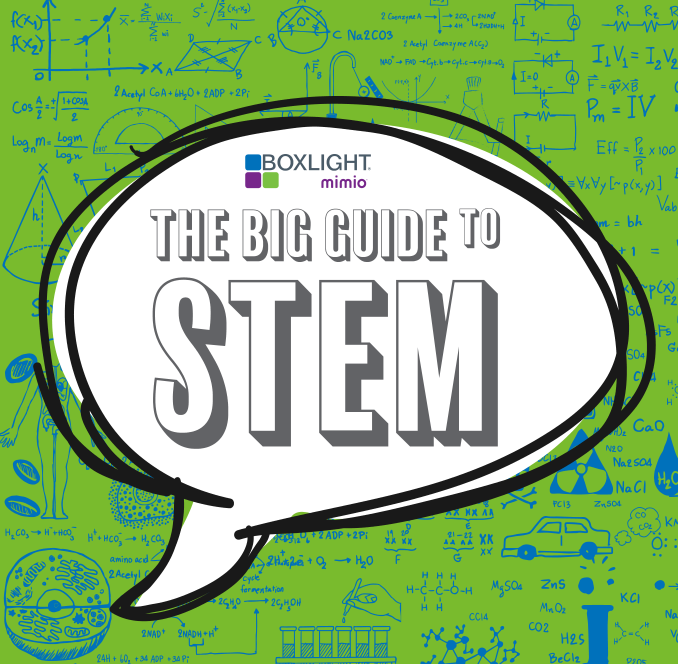
The guide also contains a collection of top 10 STEM lists:
- Top 10 STEM apps
- Top 10 STEM tech products
- Top 10 STEM blogs and online communities
- Top 10 STEM websites
- Top 10 STEM events
- Top 10 STEM Software Solutions
- Top 10 Resources for STEM Funding
- Top 10 STEM Resources for Girls
MyNotes
Some of my takeaways from the guide include the following:
-
STEM Acronym:
-
SCIENCE: The study of the natural world.
-
TECHNOLOGY: One surprise: The STEM definition for technology includes
any product made by humans to meet a want or need. Under the STEM definition,
a chair is technology—and so is a pencil. -
ENGINEERING: The design process students use to solve problems.
-
Art/Agriculture: New to this mix is the addition of “A” for art or agriculture in the classroom to create STEAM, by which the power of learning is enhanced (much like water is changed to steam, creating energy). After all, art makes you think, look, and feel—all of which are needed for innovation. Why agriculture? Because we need it to survive, of course! If you eat, you need agriculture. If you wear clothes, you need agriculture. If you take medicine, live in a house, or write with a pencil, you need agriculture
-
MATH: The language of numbers, shapes, and quantities that seems so
irrelevant to many students. -
A September 2017 presidential memo is cited…
-
It states that nearly
-
40% of high schools do not offer physics and
-
60% of high schools do not offer computer programming
-
Only 34% of African American students and 30% of rural high school students have access to a Computer science class
-
Dept of Commerce estimates that STEM occupations are growing at a rate of 17%, compared to 9.8% in other professions
-
STEM professions earn 26% more than non-STEM professions
-
There are 26 million STEM jobs in the United States
-
20% of all US jobs are STEM-based jobs
-
STEM occupations are projected to grow faster than the average for all occupations and wages in these occupations were generally higher than the median for all occupations
-
Sixty-five percent of today’s primary school students will be at jobs that haven’t been invented yet
-
Girls and women in STEM
-
A woman makes just 77 cents to every dollar her male counterpart earns
-
More single parents are mothers
-
Women make up less than 25% of the workforce in STEM professions
-
74% of middle school girls express interest in STEM
-
Only .4% of high school girls choose to pursue STEM in college
-
The 2015 results of the Programme for International Student Assessment (PISA) indicate that the US ranked 38/71 in math and 24/71 in science
-
STEM covers a multitude of skills, such as:
-
hands-on
-
critical thinking
-
problem-solving
-
student-driven
-
creativity
-
innovation
-
collaboration
-
inquiry
-
leadership
-
teamwork
-
STEM integrates the curriculum
-
For example, kinders are learning about structure and design through literature such as The Three Little Pigs.
-
The story is read, students ask questions such as how could those little pigs have built a more secure structure so that nasty wolf coudn’t have blown down those poorly constructed houses?
-
Then, students design and build their own structure and the big bad wolf tries to blow it down.
-
All content areas are needed for this unit:
-
Reading and writing are required for the basic premise/design
-
Math is needed to calculate measurements or supplies,
-
Soft skills such as collaboration and communication
-
Technology can be used to document the process (or use Minecraft and Coding)
-
Benefit of STEM education is brain development. The brain needs to…
-
make connections,
-
socio-emotional and
-
cognition to function
-
STEM Blogs and Online Communities (more are listed in the guide than shown below)
-
Top STEM events:
-
A whole list of resources for STEM Funding
-
Crafting STEAM lessons:
-
To start down that path of innovation, I assemble my students into cooperative groups of no more than four. Their task is to define innovation in one of the following ways: a sentence, a list of ten words, a pictorial representation, or another way of their choosing. This way, they work as a team (tip #1), control their way to solve the assignment (tips #2 and #3), and include creativity (tip #6) immediately. Each group then displays their work in a “gallery” for the entire class to view during a “gallery walk” to see what the other groups developed.
-
Next, the students view a video about innovation. During the video, I have the students write down each innovator’s name, what they do, and something they said that engaged them. Did any of what the innovators said match your students’ gallery walk of ideas? Probably. I then ask students to share what innovations in biology, ecology, or any topic they can name. You are now on your way to engaging STEAM into the classroom.
You can follow the authors of the guide on STEM online:
- Kristy Nerstheimer - Email: bnersth@smsd.org
- Kelly Bielefeld - Twitter: @kellybielefeld
Everything posted on Miguel Guhlin’s blogs/wikis are his personal opinion and do not necessarily represent the views of his employer(s) or its clients. Read Full Disclosure