
The short version
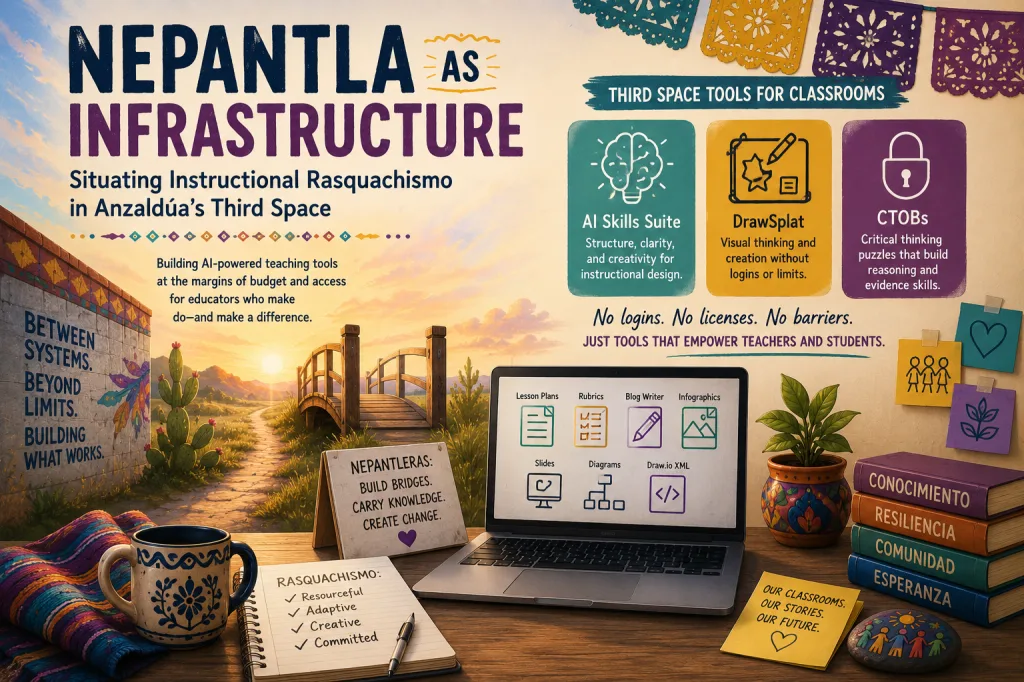
Instructional rasquachismo builds dignified, practical teaching tools from limited resources, while nepantla is the transformative in-between space those tools bridge between enterprise technology and under-resourced classrooms.
Welcome to session resources for Instructional Rasquachismo: Building AI-Powered Teaching Tools at the Margins of Budget and Access
Session Abstract
Rasquachismo, that Chicano aesthetic of making do, of ingenuity born from scarcity, describes more than art. It captures the daily reality of instructional designers and educators in under-resourced schools, many of them serving Texas border communities where technology budgets are thin and professional development is infrequent. This poster presents a suite of free, open-access AI-powered instructional design tools built for exactly these conditions.
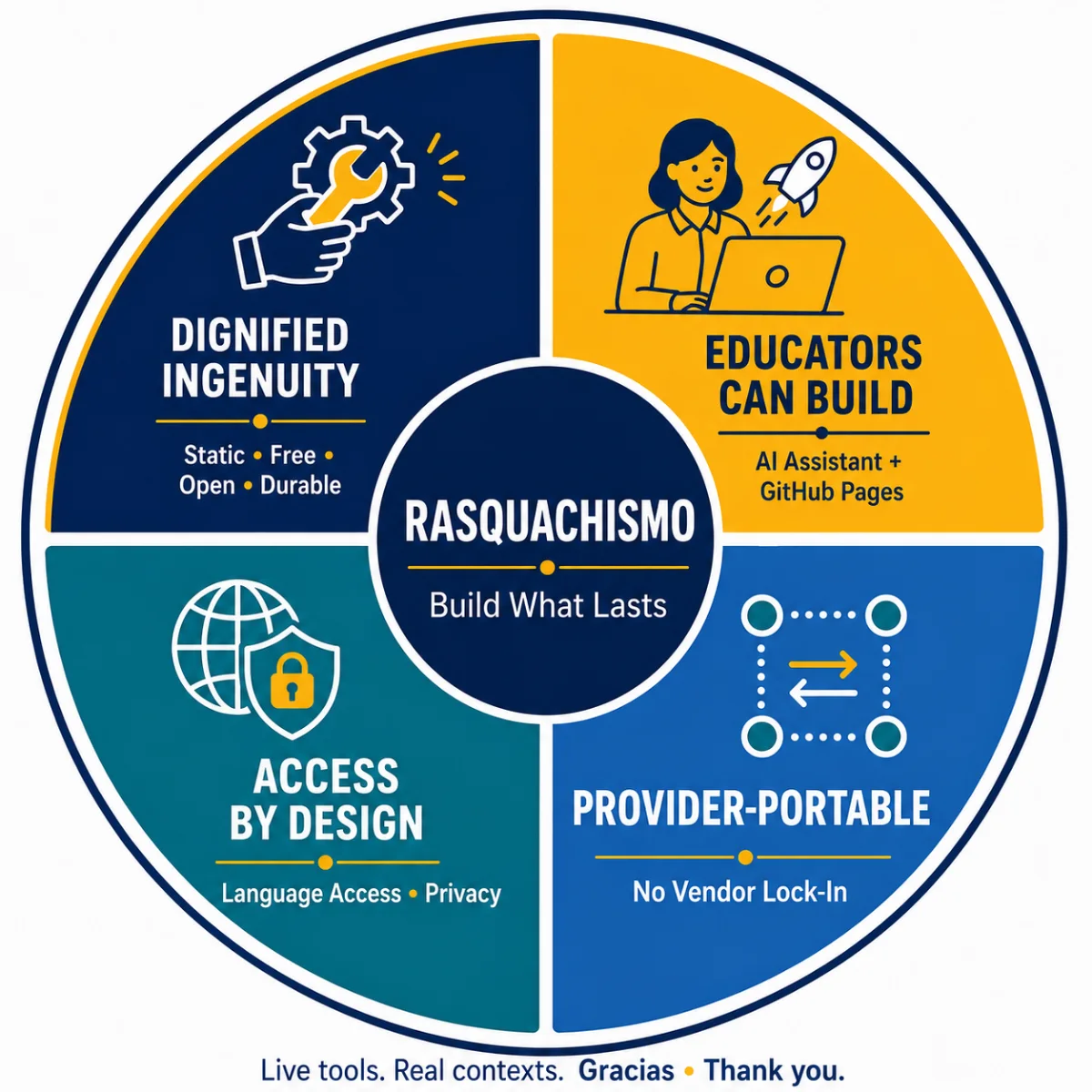
These are deployed as static, no-dependency web applications hosted on GitHub Pages. Each tool is designed to require no institutional license, no login, and no specialized hardware. Educators access them through a browser. The design philosophy prioritizes function over form: every tool produces classroom-ready outputs with minimal configuration. These tools were built for and with K-12 educators, instructional coaches, and professional development facilitators across Texas, many of whom work in districts along the border where Spanish-English translanguaging is everyday practice and where AI tool access often means whatever is free. The poster documents the design process, the tool architecture, educator feedback gathered during professional learning sessions, and the deliberate ethical choices made around data privacy and accessibility.
Framed within Gloria Anzaldúa’s concept of nepantla, these tools occupy a third, liminal space. That is, between enterprise AI and the classroom, between the polished and the practical, between scarcity and possibility.
Resource Links
Slide Deck and Tools
- View slide deck
- View two-page printable handout (PDF)
- Bingo Game
- Play Spy the Idea - Match the clue to the concept from Nepantla as Infrastructure. The better you read, the higher your bridge-builder rank.
Prompt Libraries
- MGuhlin’s Portfolio of Creations - A collection of prompts and skills you can adapt and use
- The Prompt Library - A collection of over 300 prompts
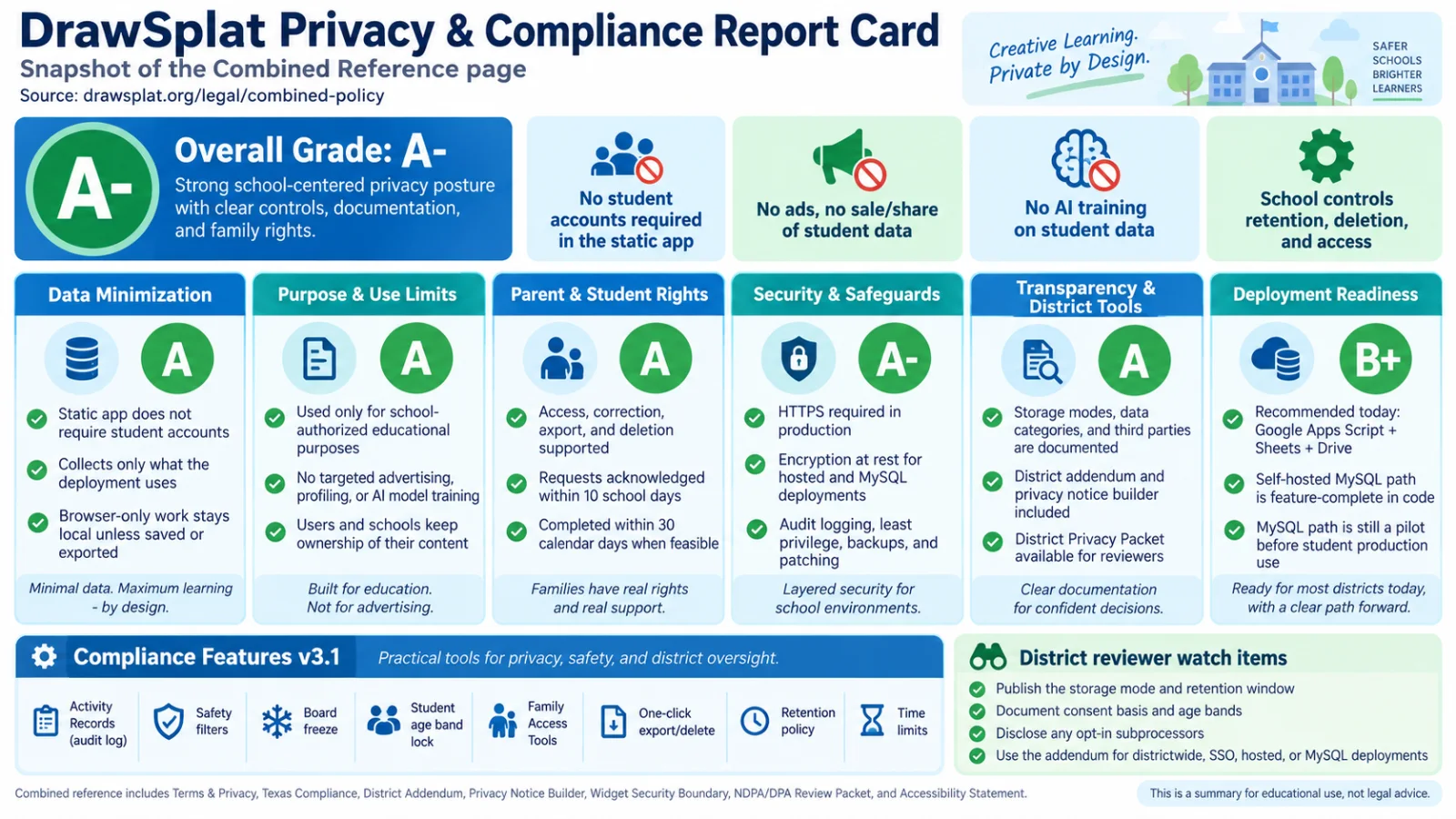
DrawSplat and SplatWorks - Free AI-Free Tools for K-Adult learners
- DrawSplat interactive whiteboard,
- DrawSplat Tools, and
- DrawSplat Widgets
- SplatWorks (an office suite for children)
- Games including typing games, boxes and lines, and more
Critical Thinking Online Breakouts (CTOBs):
A suite of Critical Thinking Online Breakouts. Students read clues, reason through four locks, and learn to think — not just click — online. Multilingual, and it runs entirely in the browser.
- CLEAR Critical Thinking
- Digital Citizenship CTOBs
- Generative AI Literacy
- Science for Grades K-8
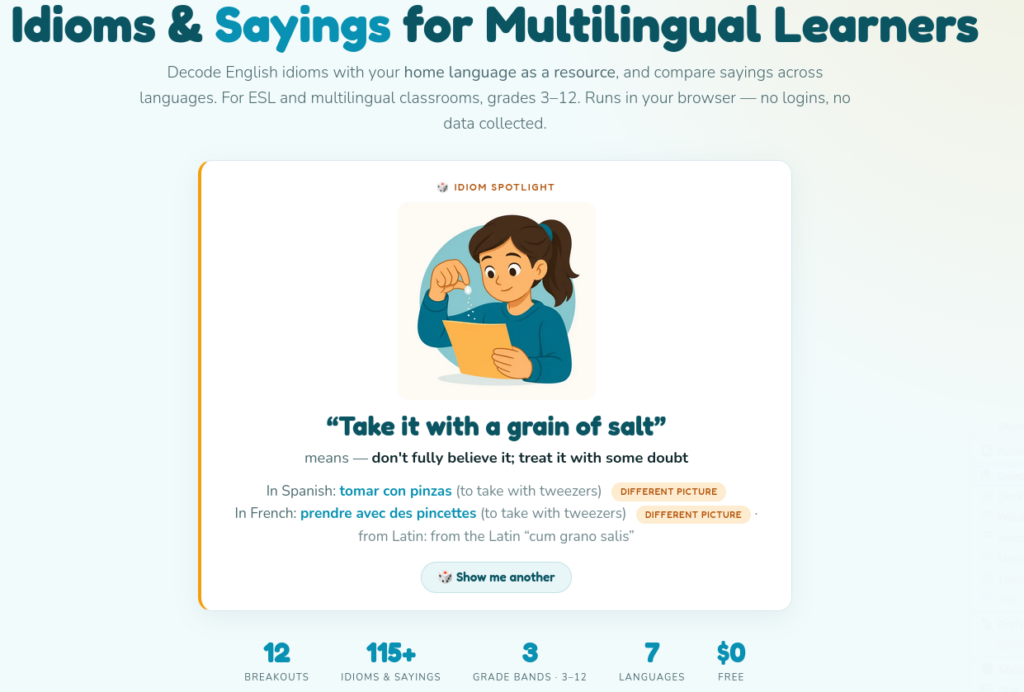
- Idioms and Sayings
- Bible as Literature
- July 4th and 5th Observance
Teacher Printables
- Science Supplemental Aids - Start with the all-strands overview or the set of formula triangles, then jump to the strand you’re teaching. Each strand leads with a one-page sheet of five cue cards, followed by individual concept cards you can pull on their own. Most concept cards also offer a 4-page activity packet (Retrieve · Apply · ACE · teacher key).
- Phase Change Station Lab - Seven hands-on stations that move students from something obvious — an ice cube melting — toward changes they have to explain with evidence and particle models. Free to use, print, share, and adapt.
Learn More via TCEA.org Blog Entries and External Courses
Blog Entries
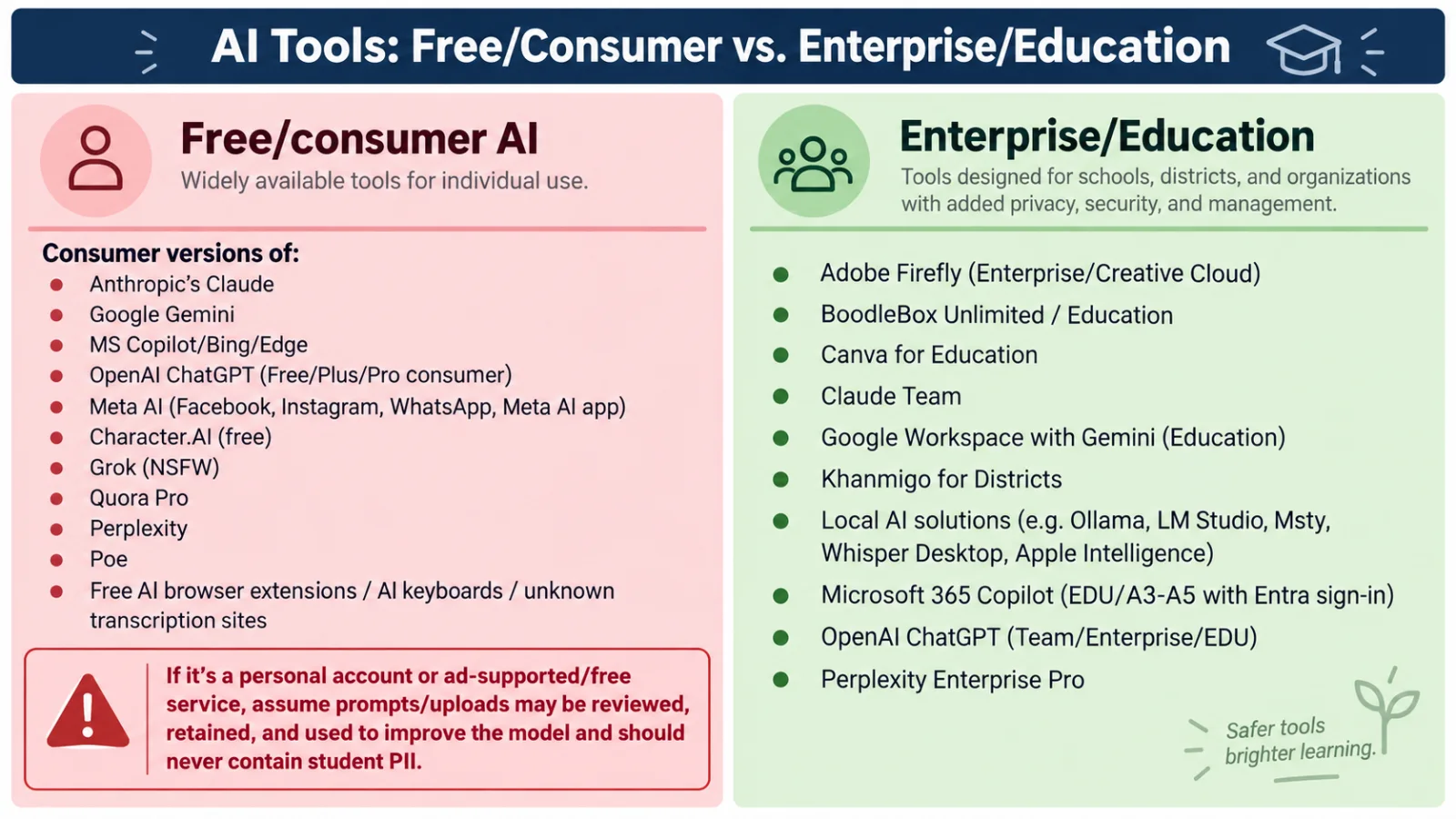
- Augmented K-16 Framework for Gen AI Usage - Six tools that address privacy and safeguarding data when using Gen AI, as well as assessing Gen AI tools for use in the classroom.
- Idioms and Sayings for Multilingual Learners
- Critical Thinking Online Breakouts for K–12 Classrooms: Bible as Literature
- Vibe-Coded Solutions for Educators with Companion Website
- Make Data Displays Without Writing Code
- Drop the Subscriptions: Vibe-Code Your Own Library Tools
- Turn Literature Study into an Investigation with PlotPoint
TCEA Courses
- TCEA AI Essentials for Educators
- Sign up for random drawing - Sign up for door prize drawing of the AI Essentials for Educators course

Anthropic Courses and Use Cases
BINGO Game
Play BINGO by listening to the session presenter.
Paper
Nepantla as Infrastructure: Situating Instructional Rasquachismo in Anzaldúa’s Third Space
Miguel Guhlin
Prepared for the LACDH–TBDH Symposium, Transfronteras: Third Spaces in Digital Humanities
Session overview
This paper connects the poster presentation Instructional Rasquachismo: Building AI-Powered Teaching Tools at the Margins of Budget and Access to Gloria Anzaldúa’s concept of nepantla. The presentation describes a suite of free, open-access, AI-powered instructional design and multi-lingual, productivity tools built for under-resourced educators, particularly those serving Texas border communities. The tools run as static web applications on GitHub Pages. They require no license, no login, and no specialized hardware. These tools aspire to build a third space.
Nepantla in Anzaldúa’s Thought
Nepantla is a Nahuatl word meaning “in-between.” Anzaldúa (2002) described nepantla as tierra entre medio, the threshold space between worlds where transformation occurs. She characterized that space in several ways: unstable, precarious, always in transition, and lacking clear boundaries (Anzaldúa, 2002). It is not a comfortable middle ground. Living in nepantla means living with displacement.
The concept developed across her career. Borderlands/La Frontera (Anzaldúa, 1987) established the physical and psychic borderland as a site where cultures grate against each other and something new emerges. Her later work sharpened this into nepantla as an epistemology, a way of knowing that comes from seeing double, from two or more cultural perspectives at once (Anzaldúa, 2009). In Light in the Dark/Luz en lo Oscuro, published posthumously, nepantla anchors her theory of conocimiento, a process of awareness and transformation that moves from inner work to public acts (Anzaldúa, 2015; Keating, 2006).
Two features of nepantla matter most for this project. First, nepantla is generative. It is the space where old frameworks break down and new ones get assembled. Anzaldúa (1987) even described the writing process itself as a nepantla state, where fragments of ideas are worked into a whole. Second, nepantla has workers. Anzaldúa (2002) named them nepantleras: people who facilitate passage between worlds, who build bridges and travel back and forth across them without fully belonging to either side.
A quick aside: As someone stuck between two worlds myself, both Panamanian and American, bilingual and bicultural but not enough in either, I always feel like I’m crossing the bridge back and forth between the homeland of my youth and the land I stand in today. That sense of “No me hallo” remains with me and isolates me as an observer, a wanderer making do along the ways and byways.
The Gap Between Enterprise AI and the Classroom
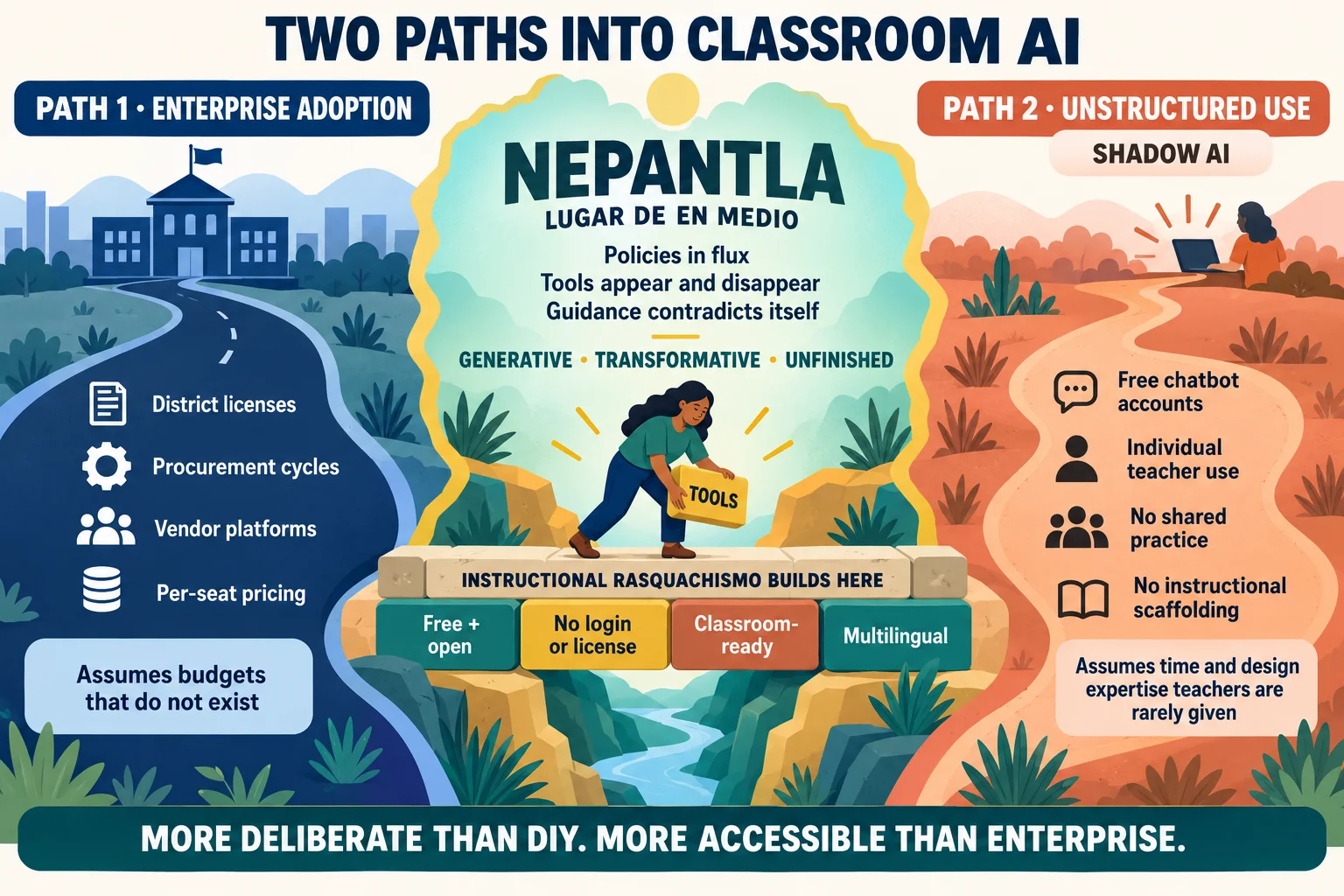
Generative AI reaches classrooms through two dominant paths. The first is enterprise adoption: district licenses, procurement cycles, vendor platforms, and per-seat pricing. This path is difficult for schools because there are no best practices. That is why these resources like SHINE can be helpful to school districts.
The second is unstructured individual use: a teacher with a free chatbot account, no shared practice, and no instructional scaffolding. Under-resourced schools are poorly served by both.
The enterprise path assumes budgets that do not exist. The unstructured path assumes time and design expertise that teachers are rarely given.
This gap is a borderland in Anzaldúa’s sense. It is a space where two systems meet and neither holds. Educators working in it experience the instability she described: policies in flux, tools appearing and disappearing, guidance contradicting itself.
The question the presentation asks is what it looks like to build deliberately for that space instead of waiting for one side or the other to close it.
The Tools as Nepantla Infrastructure
The tools described in the three examples shared, including AI Skills, DrawSplat.org, and Critical Thinking Online Breakouts occupy the in-between position on purpose. Each design decision maps to it.
These tools are not developed by an enterprise software company. They do not encode Gen AI tools on the backend to power them, and comply with FERPA, Texas Data Protection Agreements, GDPR, and other privacy protections. Students do not need logins to access these tools, and they are freely available to save to a device with a built-in browser (including mobile) and be usable at that point.
What’s more, a teacher does not need permission to use them. These tools seek to encode knowledge, produce structured and reusable outputs, and hold up across repeated professional use. They sit between the two dominant paths: more deliberate than DIY, more accessible than enterprise.
This is the lugar de en medio. That is by design, not accident.
Static deployment on GitHub Pages extends the point. The tools have no server, no database, and no dependency chain that a district must approve or a vendor can revoke. They persist in the cracks of institutional infrastructure the way Anzaldúa’s nepantla persists between fixed territories. The symposium’s call for papers names technology disobedience and sovereignty as a topic of interest; refusing the login and the license is a modest act of both.
Translanguaging is the third connection. Anzaldúa (1987) wrote in a deliberate weave of English, Spanish, and Nahuatl, and treated that mixture as the authentic language of the borderland rather than a deficiency. The tools serve educators for whom Spanish-English translanguaging is everyday classroom practice. Supporting that practice, rather than treating English as the default and Spanish as an accommodation, follows Anzaldúa’s insistence that the border tongue is a legitimate language of instruction and of thought.
DrawSplat.org and the Critical Thinking Online Breakouts (CTOBs) are available in seven languages. Those include English, Spanish, Vietnamese, Chinese, Arabic, Hindi, and Urdu. These reflect the top languages spoken in Texas classrooms.
The Educator as Nepantlera
Anzaldúa’s nepantleras give the project its human center. The under-resourced teacher who adopts these tools is doing bridge work: moving between the world of frontier AI models and the world of a classroom with aging devices and no software budget, translating between them, belonging fully to neither. The tools do not remove that labor. They are designed to respect it, by lowering the cost of crossing without pretending the border is gone.
The tool-builder occupies the same position. The suite was built from within border professional development contexts, not delivered to them from outside. This matters for theoretical honesty.
Anzaldúa (2002) warned that nepantla is uncomfortable. Transformation in that liminal space is never finished. The presentation makes the same claim about the tools: they are incomplete, evolving, and shaped by ongoing feedback from the educators who use them. The symposium’s call explicitly values slow and incomplete work. Nepantla explains why incompleteness here is not a flaw but a feature of the space.
Tools like DrawSplat.org, SplatWorks (the accompanying office suite), and other tools are always under development, ever incomplete. They are so intentionally since they are designed to be continually adapted for the situations they find themselves, by the people who use them.
Where Nepantla Meets Rasquachismo
The presentation’s two theoretical anchors reinforce each other. Rasquachismo, as Ybarra-Frausto (1989) defined it, is the sensibility of los de abajo: making the most from the least, with resourcefulness, irreverence, and dignity.
Rasquachismo describes how the tools were made: from available materials, without institutional blessing, with function prized over polish. Nepantla describes where they live and what they do: in the unstable space between systems, facilitating passage across it.
Both concepts come from the same borderland Anzaldúa wrote from and that this project serves. Both refuse the assumption that legitimacy requires wealth, and both treat the marginal position as a source of knowledge rather than a deficit. Together they frame instructional rasquachismo as a practice: building teaching infrastructure from an underdog position, for an in-between space, by and for the people who cross it daily.
Conclusion
Using nepantla precisely means resisting the temptation to treat it as a synonym for “middle ground.” Anzaldúa’s third space is unstable, demanding, and transformative. The tools offered do not resolve the tension between enterprise AI and the under-resourced classroom. Rather, they work from inside that tension. And, if educators know about them, they have the potential to change what educators can do there. It is an example of nepantla.
References
Anzaldúa, G. E. (1987). Borderlands/La Frontera: The new mestiza. Aunt Lute Books.
Anzaldúa, G. E. (2002). (Un)natural bridges, (un)safe spaces. In G. E. Anzaldúa & A. Keating (Eds.), This bridge we call home: Radical visions for transformation (pp. 1–5). Routledge.
Anzaldúa, G. E. (2009). The Gloria Anzaldúa reader (A. Keating, Ed.). Duke University Press.
Anzaldúa, G. E. (2015). Light in the dark/Luz en lo oscuro: Rewriting identity, spirituality, reality (A. Keating, Ed.). Duke University Press.
Keating, A. (2006). From borderlands and new mestizas to nepantlas and nepantleras: Anzaldúan theories for social change. Human Architecture: Journal of the Sociology of Self-Knowledge, 4(3), 5–16.
Ybarra-Frausto, T. (1989). Rasquachismo: A Chicano sensibility. In Chicano aesthetics: Rasquachismo (pp. 5–8). MARS, Movimiento Artístico del Rio Salado.