
Art history, or history in art, has never been my thing. That’s why I found visits to museums as a student, unless they focused on scientific accomplishments, bones and fossils, to be a waste of time. Michaelangelo’s sculptures awed me as a teenager, especially David. But show me a painting, and I would end up pulling out a book to read or walking around to find something more interesting. Of course, tapestries depicting battles weren’t easily available to me. Today, I am discovering a wealth of art that I missed. It’s art that tells a story, that shifts your perspective before you even know anything about it. This blog is my rediscovery of history as described in eleven pieces of art, American history paintings aligned to the Social Studies TEKS.
Eleven American history paintings, each with the era or issue it opens and the standards it touches. Every image links to the museum or collection that holds it — none are reproduced here. When you show the painting, don’t reveal the title until after the Articulate It observations.
Connecting the Dots
“In a visual age in which teenagers often have short attention spans, fine art can be a hook to help them build analytical skills for literature,” says Carol Jago as quoted by Ed Finkel, in Connecting the Dots Between Visual Art and Literacy Skills. Jago goes on to say in Finkel’s piece:
Instead, she suggests, educators can practice building students’ “reading muscles” by looking at a painting. “Two minutes is a long time for a teenager today,” she said.
But don’t just put up a painting and tell them to stare at it: Build a protocol, such as having them list eight things they notice about the painting, Jago said. Then, they can turn to a partner and share their thoughts before the class has a larger conversation.
Once students have become absorbed in such a scenario, educators should proactively make the connection to what students just accomplished, Jago said.
“Draw their attention to it, metacognitively,” she said. “‘Look at how much more you noticed. Let’s take this opening paragraph of a novel and give it that same kind of attention.’”
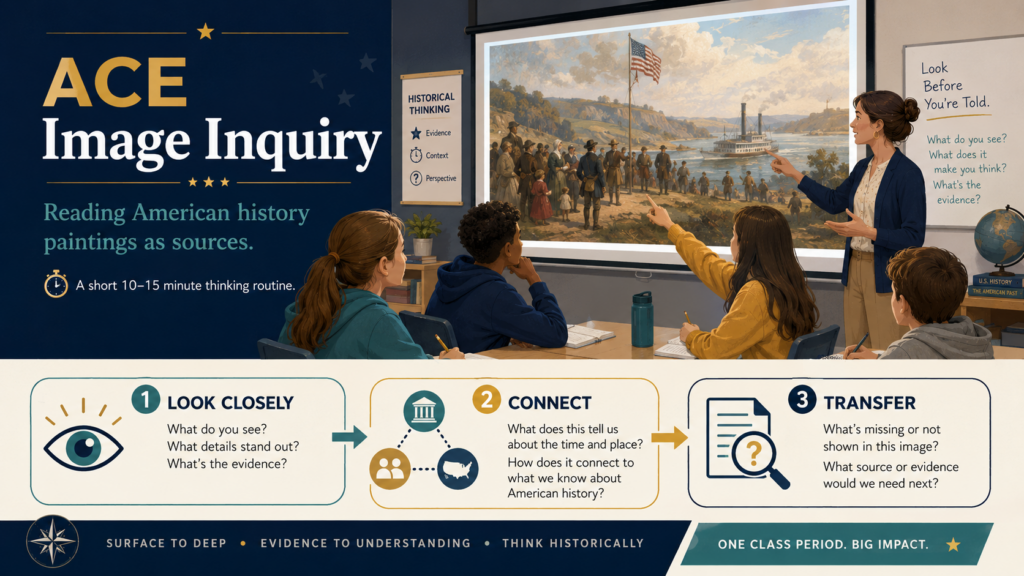
After I read that article, I read it again. Where was the “protocol” Jago was suggesting? Was it simply listing eight things they notice? That question about a missing protocol inspired me. Would it be possible to use the ACE framework as a way to conduct image inquiry, a short classroom routine that helps students read American history paintings as historical sources?
The Driving Question and the Protocol
“What can one painting tell us — and not tell us — about the past, and how would a historian find out more?” is the driving question. To answer that question, I considered applying ACE:
ACE = Articulate → Connect → Extend
ACE maps directly onto surface → deep → transfer. Students articulate what is visible before any lecture (surface), connect that visual evidence to historical context once the title and date are revealed (deep), then extend to a new source or question (transfer). Do the steps in order — naming the missing source only means something after students have looked closely and connected carefully.
Use the Gallery
The ACE Image Inquiry painting gallery gives you a starter set of American history paintings, each tied to an era or issue. The images link out to the museum or collection that hosts them. That is helpful because you are not downloading, reposting, or pretending a search result is a source.
Start with one painting. Do not turn it into a giant unit the first time. Pick the image closest to what you are already teaching and run the routine in 10–15 minutes.
A strong first choice is Norman Rockwell’s The Problem We All Live With. Show it without the title. Let students notice the child, the marshals, the wall, the clothing, the color choices, and the way the adult faces are cropped out. Then reveal the context: Ruby Bridges entering a newly desegregated New Orleans school in 1960.
Now the image is no longer just something to view. It is evidence to question.
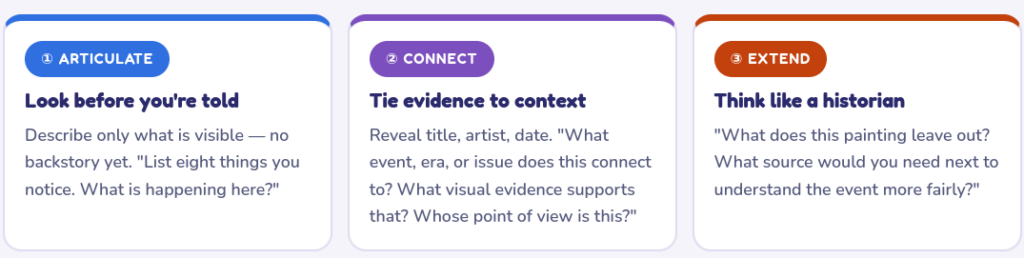
Articulate: Start with What Students Can See
The first move is Articulate. Students describe only what is visible. They list objects, people, colors, facial expressions, body positions, background details, and where their eye goes first. That last part is important because artists make choices. Students need to practice noticing those choices before they move to interpretation.
Try this prompt:
List eight things you notice. Do not explain them yet. Just name what you can see.
Slow students’ guesses and jumping to conclusions down by asking: “How do you know? Point to it.”
Accept only what is visible; push back gently on interpretation (“How do you know?”).
Facilitator questions:
- “List eight things you notice.”
- “What is happening here?”
- “Where does your eye go first — and what did the artist do to send it there?”
Student stems:
- “I notice…”
- “The first thing my eye goes to is…”
- “The artist makes ___ look important by…”
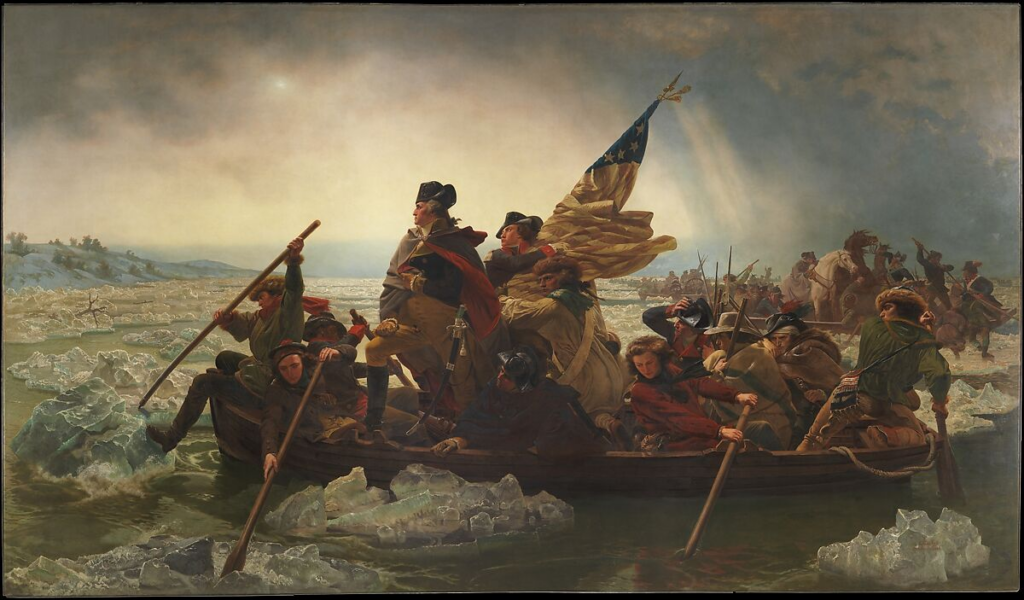
Washington Crossing the Delaware by Emanuel Leutze German American (1851)
Consider Emanuel Leutze’s Washington Crossing the Delaware. Students may recognize the image above, but recognition is not analysis. Did you know that the painting was created long after the event? That suggests a question, such as, “What does the image ask us to feel about Washington, leadership, and the Revolution?”
Connect: Add Context After the Looking
Once students have looked closely, reveal the title, artist, and date. Now they can Connect.
This is where the painting becomes more than a picture. Students link what they noticed to an event, era, issue, or point of view. They are no longer saying, “There is a child walking.” They are saying, “This connects to school desegregation because the child is surrounded by marshals, and the wall behind her shows hostility.”
That is a different level of thinking.
ACE step
Teacher move
Student thinking
Articulate
Show the image without title or background
What do I actually see?
Connect
Reveal title, artist, date, and context
What does this connect to, and what evidence supports that?
Extend
Ask what is missing
What source would I need next?
The sequence matters. If you reveal the backstory first, many students stop looking. They start remembering, guessing, or waiting for you to confirm the right answer.
Facilitator questions:
- “What event, era, or issue does this connect to?”
- “Point to the evidence.”
- “Who made this, when, and why might they have shown it this way?”
Use Paintings as Arguments
A painting is not a neutral window into the past. It is a made thing. Someone created it at a particular time, for a particular audience, with particular choices. That makes paintings useful. It also makes them tricky. Consider one of my favorites from history:
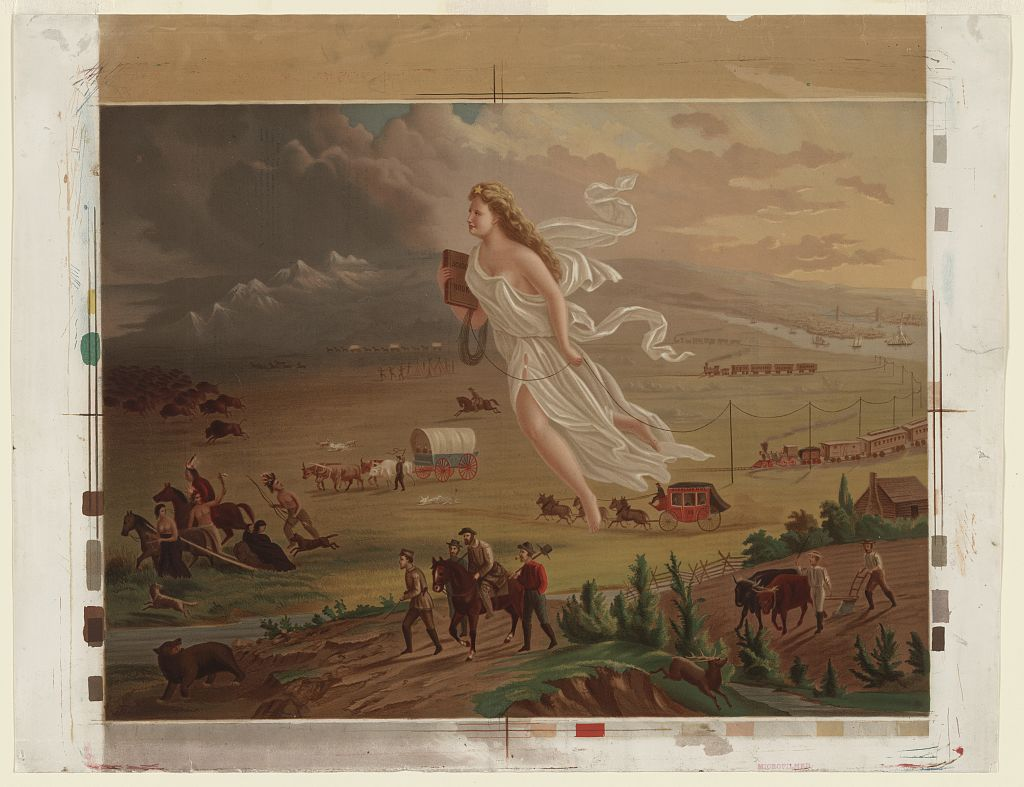
Crofutt, G. A. (ca. 1873) American Progress. , ca. 1873. [Photograph] Retrieved from the Library of Congress, https://www.loc.gov/item/97507547/.
Compare that image with Charles Hilliard’s Reversing Manifest Destiny (__read the story here*).* After analyzing the first image, a promotional image of Manifest Destiny that literally pushes Native peoples and animals into the dark margins, explore the second. You might ask, “Whose progress, and at whose cost?What does this leave out?” This is a powerful move in the ACE image inquiry process, that is, to Extend.
A Reminder: Make sure to double-check with your administration, curriculum director when dealing with paintings that may need to be handled with care. Paintings marked ⚠️ handle with care carry bias or difficult history. Teach the omission, not around it (TEC §28.0022: factual, respectful, non-inflammatory).
Paintings connected to Manifest Destiny, immigration, labor, civil rights, and war may carry bias. Some paintings leave people out. Some make violence look noble. Some turn a complex event into a clean story.
That is not a reason to avoid them, but rather, the reason to teach them carefully.
Extend: Teach the Omission
The Extend step is where the historian shows up.
Ask students:
What does this painting leave out?
Then ask:
What source would you need next to understand the event more fairly?
That second question changes the task. Students are no longer trying to “get” the painting. They are building an investigation.
A student might say they need a newspaper article from the time, a letter from someone who was there, a photograph, a law, a map, a census record, or an oral history. That is the move you want. They have gone from looking at one source to asking what evidence comes next.
For difficult history, this step is essential. You do not teach around bias. You teach through it, factually and respectfully. Whose story is centered? Whose story is missing? Who benefits from the image looking this way?
Those are fair questions. They are also the questions historians ask.
Facilitator Questions:
- “What does this painting leave out?”
- “What source would you need next to check it?”
- “Would a photograph, a letter, or a newspaper from that year agree?”
Quick rubric
Here’s a quick rubric you can use to gauge student’s understanding:
Level
What it looks like
Surface
Lists details from the image but does not say why they matter.
Developing
Connects details to a historical topic with some evidence.
Strong
Makes a claim, supports it with visual evidence, and names what the image leaves out or what source is needed next.
You can set this up pretty quickly:
- Project the painting with no title or backstory
- Ask students to list eight things they notice
- Reveal the title, artist, and date
- Ask students what the image connects to and what evidence supports that connection
- Ask what the painting leaves out and what source they would need next
- Collect a three-line exit ticket
The exit ticket is simple:
- Articulate: One thing I noticed
- Connect: What it connects to and my visual evidence
- Extend: One source I would need next or one thing the image leaves out
Read the Extend line first. That is where you can see whether students are moving past description into historical thinking.
Why It Works
ACE Image Inquiry works because students start with surface details, connect those details to context, and then transfer by asking what evidence comes next. That is the same pattern you want in strong reading, source analysis, problem-solving, and research.
Look closely. Support your claim. Ask what is missing.
If students can do that with one painting, they can begin doing it with photographs, maps, political cartoons, speeches, charts, and primary sources. One image becomes the front door into historical thinking. Jago points out (as cited in Ed Finkel’s article):
“Let’s be clear. They’re [students] locked into a bell jar of social media and phones. How can we help them see that there’s more out there, and that their attention could be well-spent slowing down and looking at a few things closely rather than the endless feed of Instagram?”
Try ACE Image Inquiry with one painting this week. Start with silence, protect the looking, and let students build the investigation from what they can actually see.