
When I first encountered advance organizers as a classroom teacher, I was skeptical. Another educational strategy to add to my already overflowing toolkit? But after implementing them consistently, I witnessed something remarkable: students who came to class better prepared to engage with new material, making connections faster and retaining information longer.
Advance organizers prepare the brain for new learning. They give students a structure before content appears. This simple shift can transform how learners encode and retrieve information. Instead of treating new material as isolated facts, students slot ideas into existing frameworks. The result is deeper learning with less cognitive strain.
More on Easing Cognitive Load
When students use tools that help them get ready to learn, their brains do not have to work as hard to make sense of new ideas. They already have a place to put the information. This means they can understand more, remember more, and stay focused because their minds are not getting overloaded.
An Advance Organizer for This Blog Entry
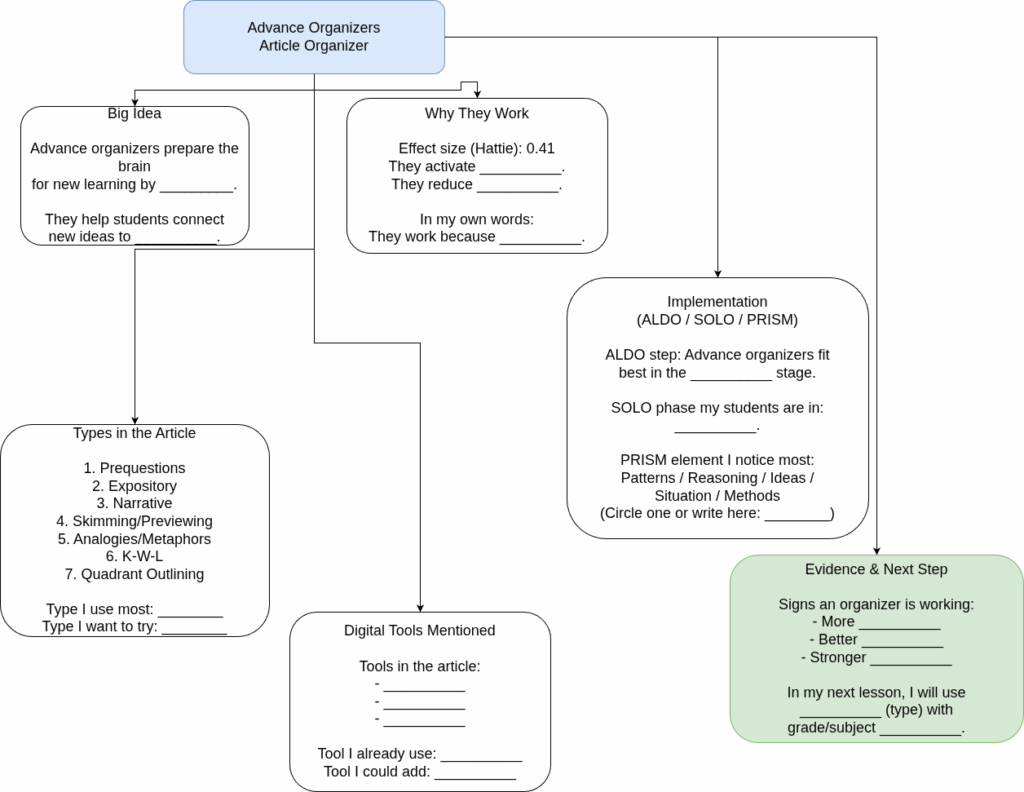
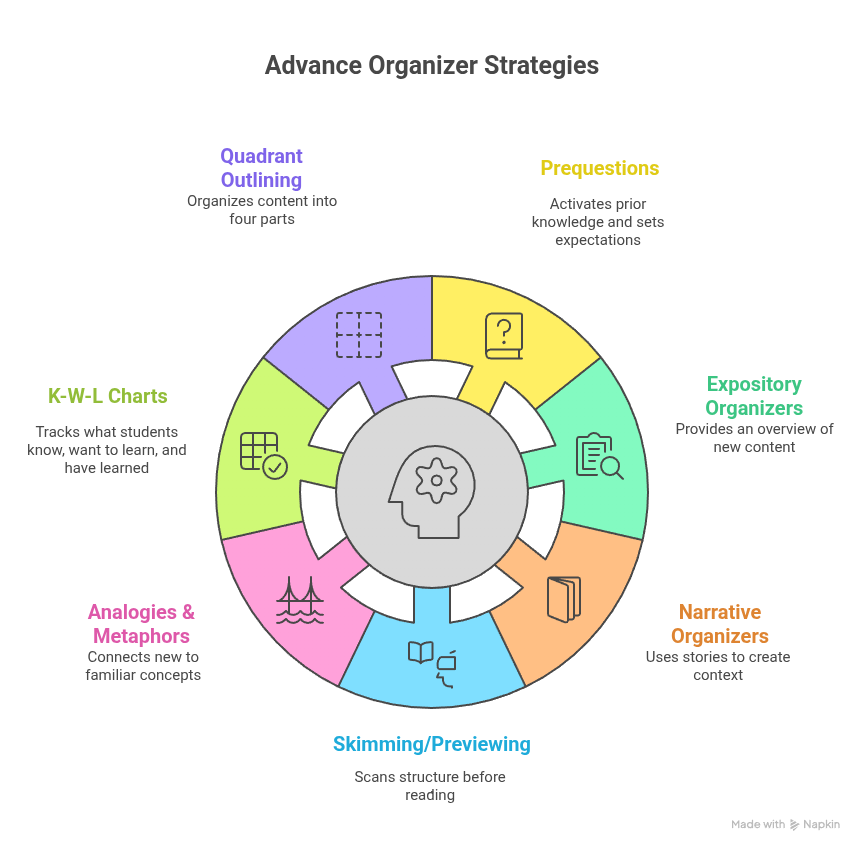
Before we go any further, allow me to share an advance organizer. It reflects the content of this article. Feel free to print it out (PDF) or draw your own on a piece of paper using the image below as a suggestion.
Why Advance Organizers Work
Research supports what teachers often notice first. John Hattie places advance organizers at an effect size of 0.41, above the point at which learning benefits become significant (d=0.40). That effect size speaks to what happens inside the brain. You understand new information by linking it to something you already know. When that connection is weak or missing, learners struggle. Advance organizers build those bridges before instruction begins.
A few other benefits to consider. Advance organizers:
- Activate prior knowledge
- Reduce cognitive load
- Give students a sense of purpose before content appears
- Provide a structure so learners enter a lesson ready to process, not just receive
Seven Advance Organizers You Can Use Tomorrow
The following organizers work across grade levels and content areas. Each one meets learners where they are and moves them toward deeper understanding. Which organizers are you NOT using and might consider in the future?
1. Prequestions: Priming Curiosity
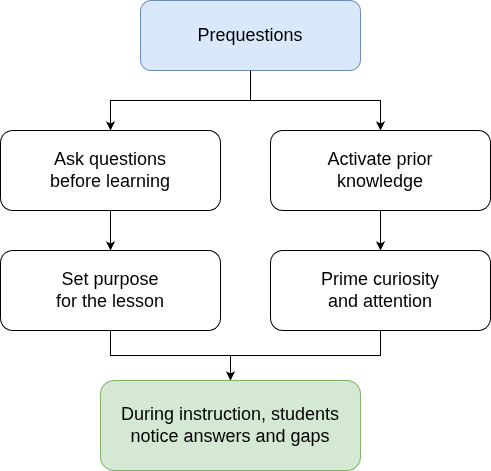
Prequestions invite students to think before learning begins. These questions do not require full answers. Their power lies in prompting learners to search their memories and anticipate what matters.
Example: Before a unit on ecosystems, ask: “What do living things need to survive in their environment?” Students begin making connections before the first slide appears.
2. Expository Organizers: The Overview
These offer a brief, structured summary of what students will learn. They provide the big picture, allowing learners to see how pieces fit together.
Example: Prior to teaching algebraic equations, outline how equations represent balanced quantities. This frames the details that follow.
3. Narrative Organizers: Story as Scaffold
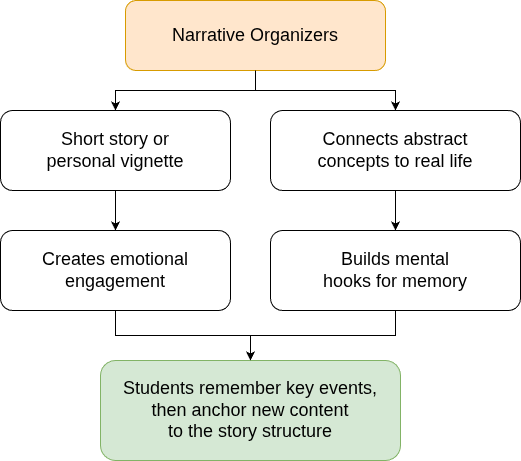
Stories give unfamiliar ideas familiar shape. They place abstract concepts within relatable experiences. The emotional connection strengthens recall.
Example: Start a Great Depression lesson with a short personal story from the era. Students step into the historical moment rather than study it from afar.
4. Skimming and Previewing: Strategic Scanning
Previewing teaches learners to recognize structure before diving into text. They examine headings, diagrams, graphs, and bolded terms. This primes them for comprehension and helps them anticipate key concepts.
Example: Ask students to skim a chapter for three minutes and note what they believe the central ideas will be. This simple act heightens attention during reading.
5. Analogies and Metaphors: Familiar Bridges to New Concepts
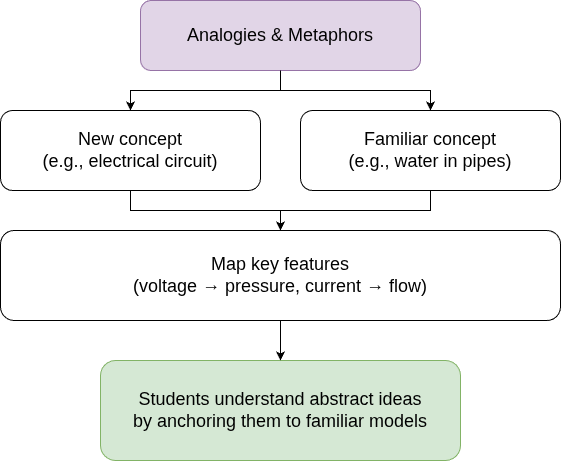
Comparing new concepts to familiar ones helps students grasp abstract ideas by connecting them to existing knowledge.
Example: When teaching about electrical circuits, compare them to water flowing through pipes, with voltage like water pressure and current like the flow rate. Students visualize something that was invisible moments earlier.
6. K-W-L Charts: Purposeful Knowledge Activation
K-W-L (also KWHL) charts remain one of the most effective ways to capture what students bring to a lesson. The K and W columns serve as the advance organizer. They reveal what learners already know and what they hope to uncover.
Example: Before studying ancient civilizations, have students complete the K and W sections. This directs attention and drives inquiry.
7. Quadrant Outlining: Structured Thinking
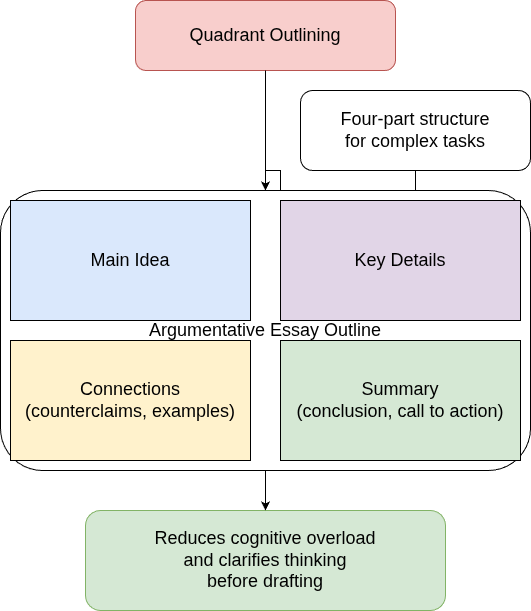
Quadrant outlining breaks information into four essential parts. This reduces overload and supports analysis. It works especially well before writing tasks or complex discussions.
Example: Have students outline an argumentative essay using four boxes: main idea, supporting details, connections, and summary statements. The structure clarifies their thinking before drafting.
Where Advance Organizers Fit in the ALDO Framework
In the Amazing Lesson Design Outline (ALDO), advance organizers align to pre-assessment. They help you identify where students sit on the SOLO Taxonomy continuum. Are they operating at a surface level? Are they ready for deeper reasoning? Your choice of organizer can nudge them forward.
When selecting the right organizer, consider:
- The phase of learning students are in (SOLO).
- The type of content (abstract content benefits from analogies).
- Your purpose (vocabulary, conceptual understanding, or reasoning).
- Your available time.
Technology Tools That Support Advance Organizers
Digital tools expand what is possible and increase student ownership.
- Collaborative word walls with Padlet
- Interactive prequestions using Kahoot, Quizizz, or Blooket
- Digital K-W-L charts in Google Docs, Google Forms with results embedded in a Google Sites page, or Microsoft Forms
- Visual organizers using AutoDraw, Canva for Educators (free), CMAP Tools, Draw.io/Diagrams.net (my recommendation for a free tool), or other drawing apps
The key is choosing tools that make thinking visible without slowing learning. You might even consider handwritten digital tools, like Rocketbook’s smart reusable notebook paper (if that’s an affordable option).
How to Know They Are Working
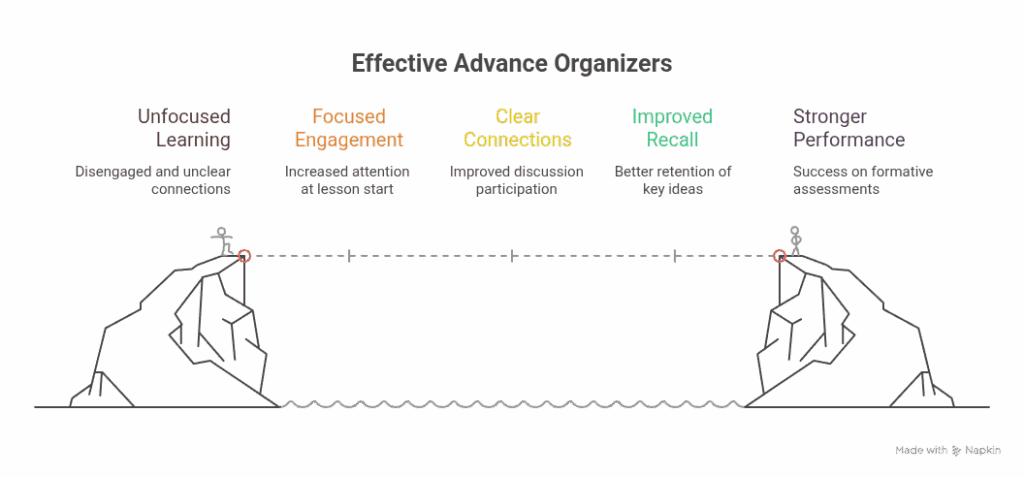
Look for these indicators during and after instruction:
- More focused engagement at the beginning of lessons
- Clearer connections during discussion
- Improved recall of major ideas
- More thoughtful questions from students
- Stronger performance on formative checks
If these signs appear, your advance organizers are doing their work.
Extending Advance Organizers with PRISM
For complex topics, the PRISM Framework (Patterns, Reasoning, Ideas, Situation, Methods) deepens the effect. You might design prequestions that target pattern recognition. Or use a narrative organizer that reveals a situation before students explore methods. PRISM encourages learners to ask stronger questions and move from surface recognition to deeper analysis when you transition into the main lesson.
Advance organizers mirror how the brain constructs meaning. They activate prior knowledge and lessen cognitive load. They create readiness. When used consistently, they transform how students connect, reason, and remember.
Which organizer will you try next?