
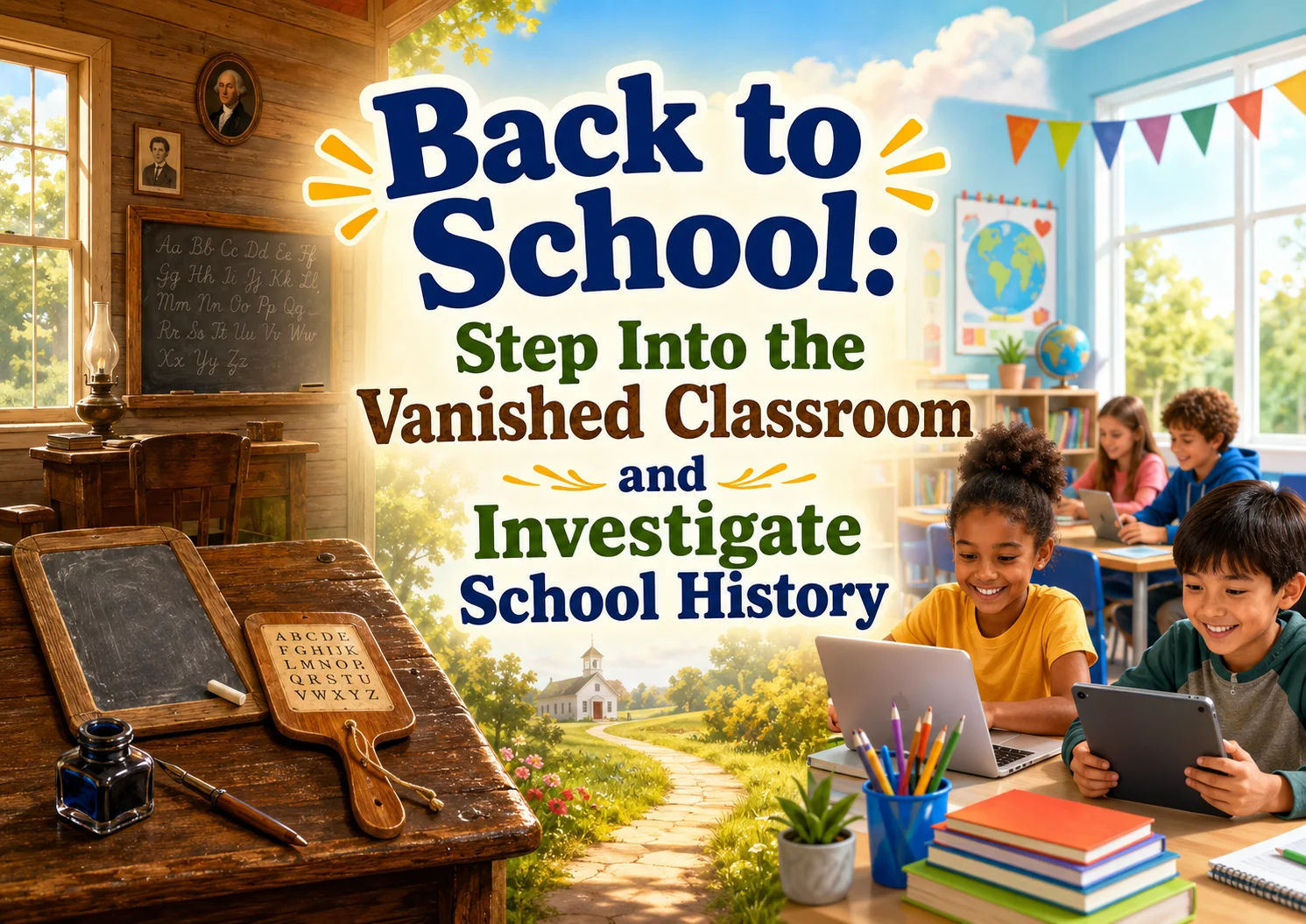
Anyone who has spent time in a museum exploring knows the wonder of picking through history, one artifact at a time. At one time, there were many classroom tools that were set aside in the face of technology’s progress. Some may look at the changes happening today with Generative AI as yet another pivot point when we set aside obsolete tools for current ones. I’m happy to announce a new series (aligned to the Texas Essential Knowledge and Skills (TEKS)) that offers fun activities for students to start the school year off.
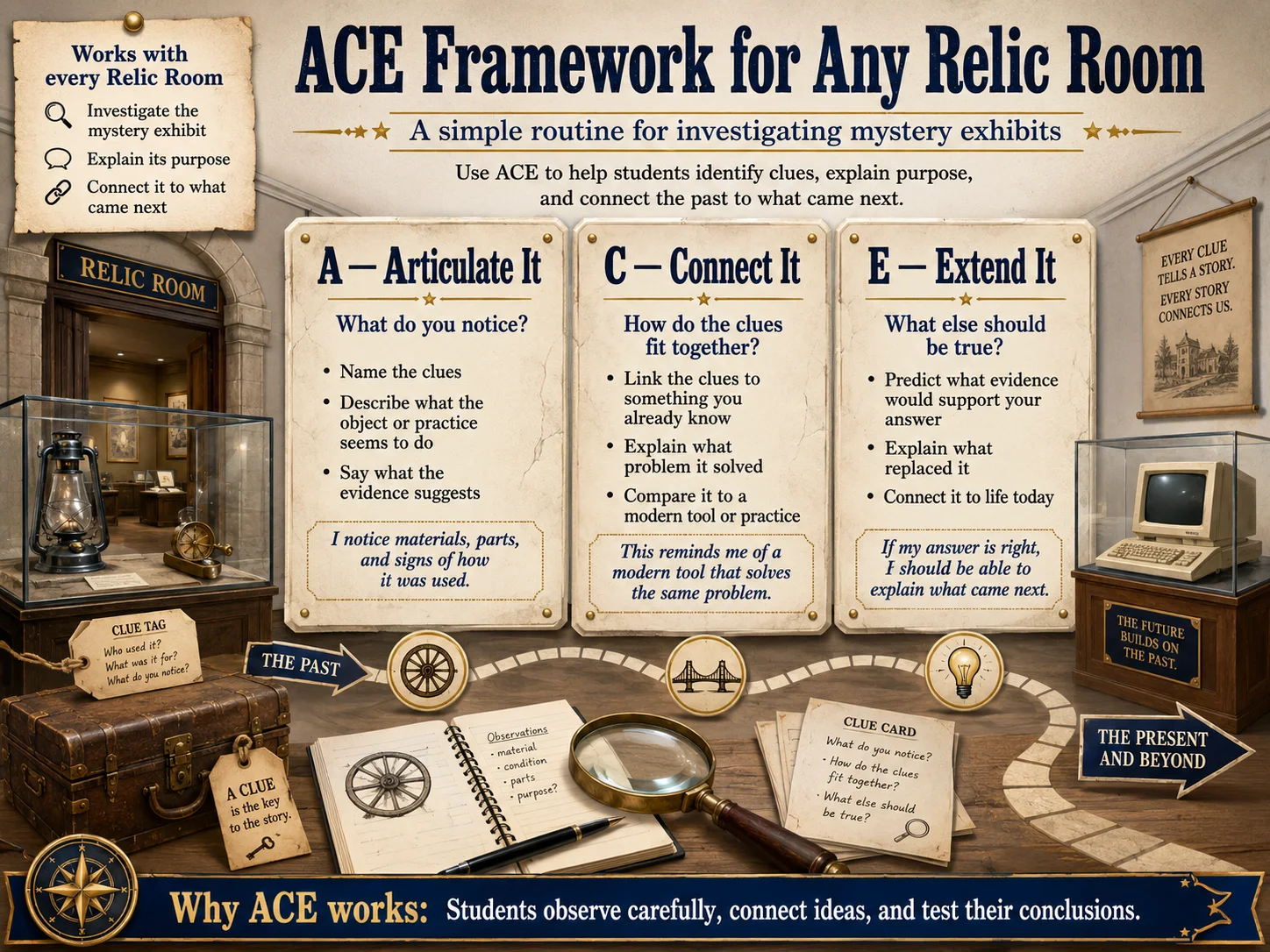
The series is the Relic Room series. You get access to NINE different, free (no account required) mystery exhibits. I make specific suggestions for applying the ACE Framework to critically analyzing the information in these exhibits.
One reason it’s important to help students make connections between past and present? It helps students see that technology does not appear from nowhere. By explaining how an older tool or practice evolved into a newer one, students recognize the problem each generation was trying to solve, understand why design choices changed. This assists them in becoming better able to evaluate or predict what may come next.
Here are some past challenges documented in the media:
| Age | Technology they struggled to use | Source |
|---|---|---|
| 5–13 | Rotary telephone: dialing, busy signals, and texting assumptions | TIME: Kids React to Rotary Phones (Time) |
| 6–13 | Manual typewriter: loading paper, returning the carriage, and correcting mistakes | TIME: Kids React to a Typewriter (Time) |
| 6–13 | Apple II computer: turning it on and operating it without a mouse | TIME: Kids React to an Old Computer (Time) |
| 6–13 | Sony Walkman and cassette tape: inserting the tape, playing it, and rewinding | YouTube: Kids React to Walkmans (YouTube) |
| 15 | Rotary phone, wind-up alarm clock, cassette player, film camera, and paper map | The Guardian: Today’s Teens Tackle Old Technology (theguardian.com) |
Relic Rooms like the ones below focus on bridging the gap between yesterday and today, and better able to navigate future change.
The Relic Rooms
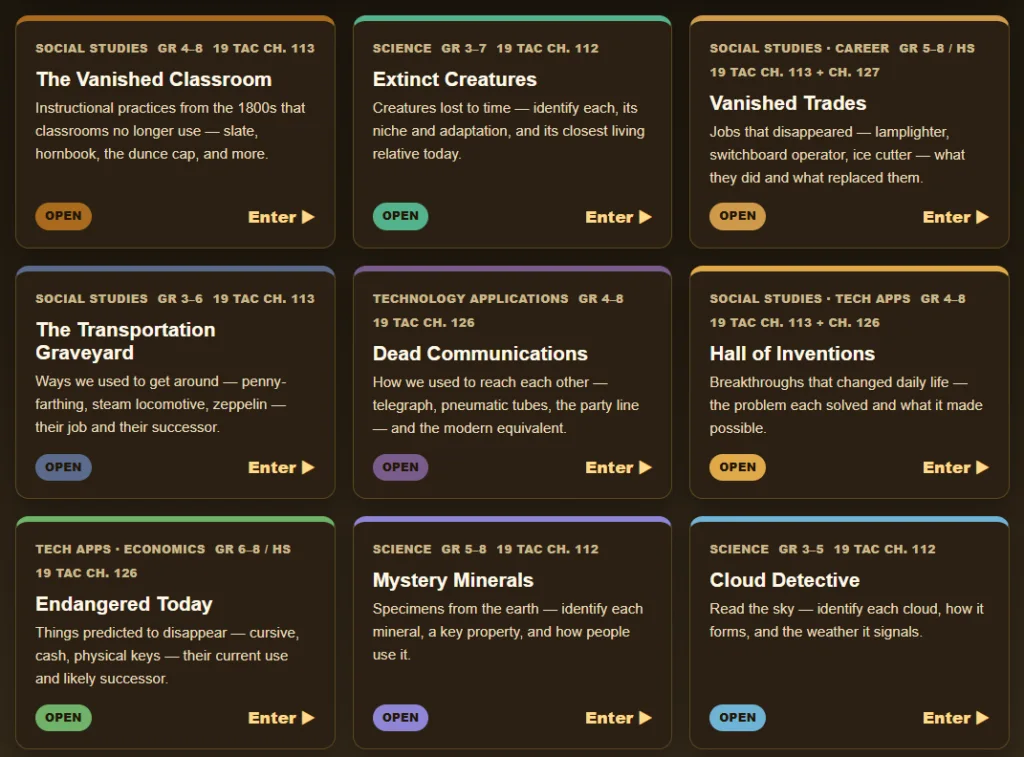
These nine mystery exhibits come in seven different languages and offer students the opportunity to explore critical thinking. Before I go in-depth using one of them as an example, The Vanished Classroom, allow me to share a little about each in the image below. You will see activities covering subjects like Social Studies, Science, Technology Applications, and Economics in grades 3-8 mostly, with a few activities for high school.
These are several practices waiting inside The Vanished Classroom, an interactive investigation for upper elementary and middle school students. This interactive activity, inspired by my colleague Peggy Reimers, offers an opportunity to see the past with fresh eyes.
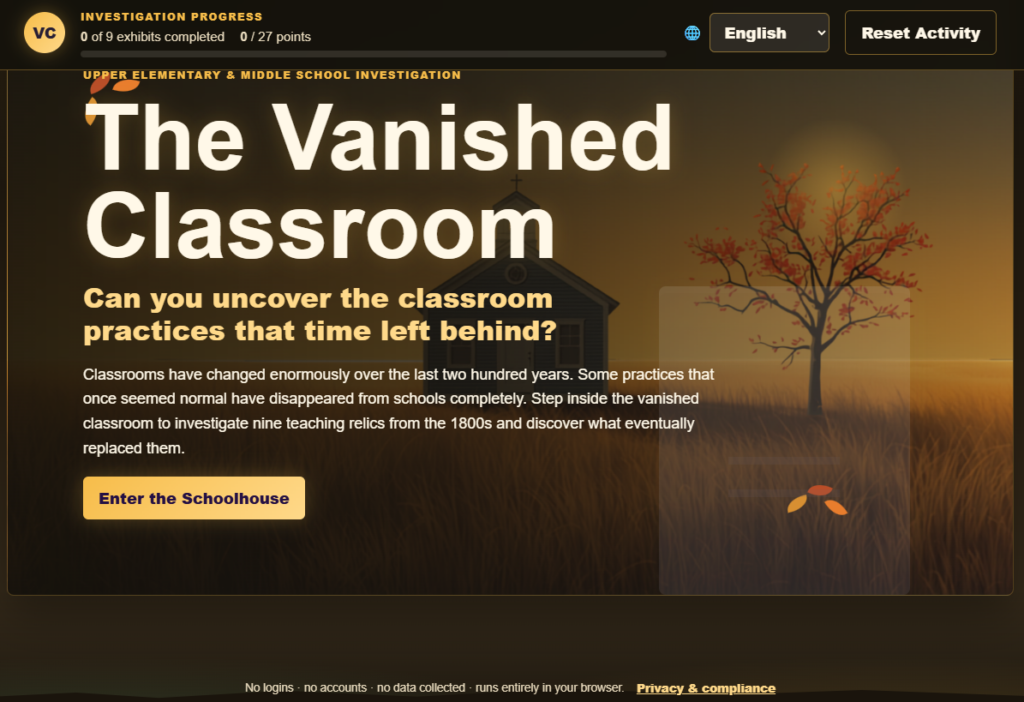
Let’s explore what Relic Rooms look like through the lens of one, The Vanished Classroom.
Introducing Relic Rooms with The Vanished Classroom
These are several practices waiting inside The Vanished Classroom, an interactive investigation for upper elementary and middle school students. This interactive activity, inspired by my colleague Peggy Reimers, offers an opportunity to see the past with fresh eyes.
Classrooms have changed quite a bit over the last two hundred years. Students once copied lessons onto stone slates, memorized passages word for word, practiced identical lines of penmanship, and learned in rooms where one teacher might be responsible for children ranging from age six to the teenage years.
Some of those practices solved real problems. Paper was expensive. Trained teachers were scarce. Rural communities could not build separate schools for every grade. That does not mean the solutions worked well.
The Vanished Classroom asks students to investigate old classroom practices as historical evidence. They do more than identify an object. They examine why people used it, what its limitations were, and what eventually took its place.
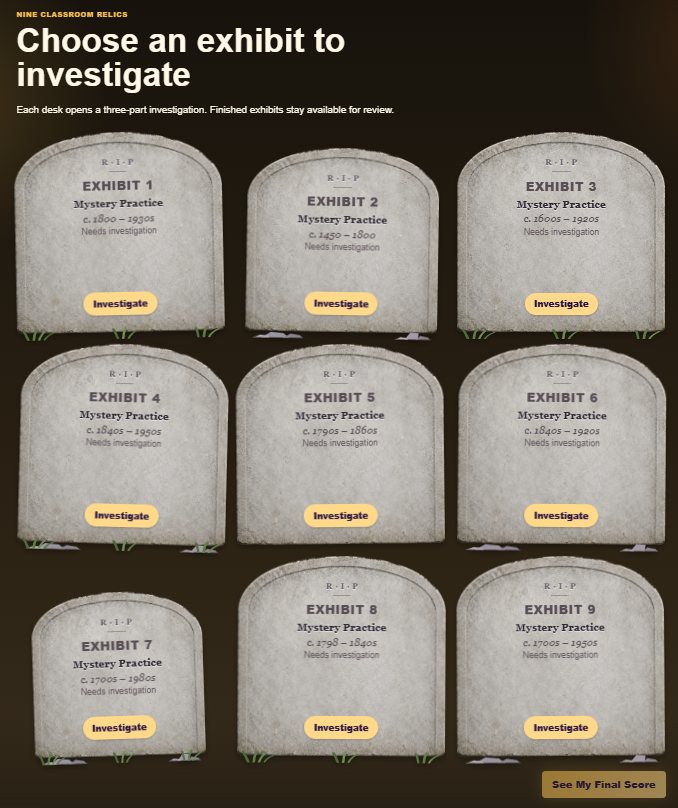
Investigate Nine Classroom Relics
Students explore nine exhibits, such as slate and slate pencil, etc.
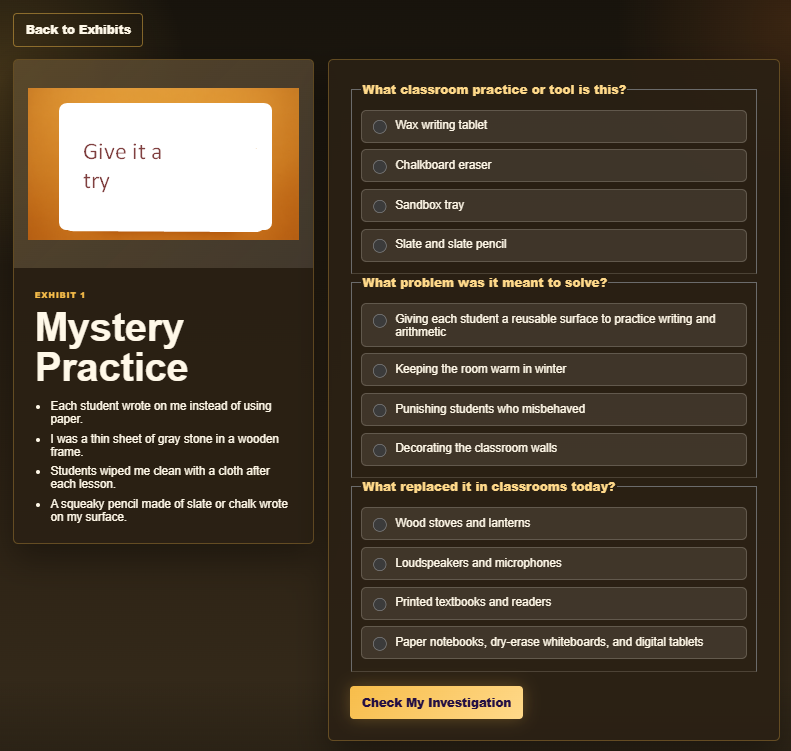
Some will be familiar. Most students have probably seen a one-room schoolhouse in a book or movie. They may recognize the dunce cap, although hopefully not from recent classroom experience. Others require more investigation.
Follow Three Clues Through Time
Each exhibit follows the same three-part process.
| Investigation step | What students determine |
|---|---|
| Identify it | The name of the classroom practice or tool |
| Find its purpose | The problem people hoped it would solve |
| Track its replacement | The practice or technology used in classrooms today |
Students study four clues, answer three multiple-choice questions, and check their investigation. When an answer needs another look, the activity identifies which part should be reconsidered without immediately giving everything away.
After the exhibit is complete, students see the practice’s original purpose, its major limitation, and its modern replacement.
That last piece matters. Students begin to see that classroom change is rarely random. New practices appear because older ones have limits.
Look Beyond “Old and Strange”
It is easy to laugh at outdated classroom practices. The more useful question is why those practices existed. Students do not have to approve of a practice to understand the problem it attempted to solve. Consider using the ACE Framework with students:
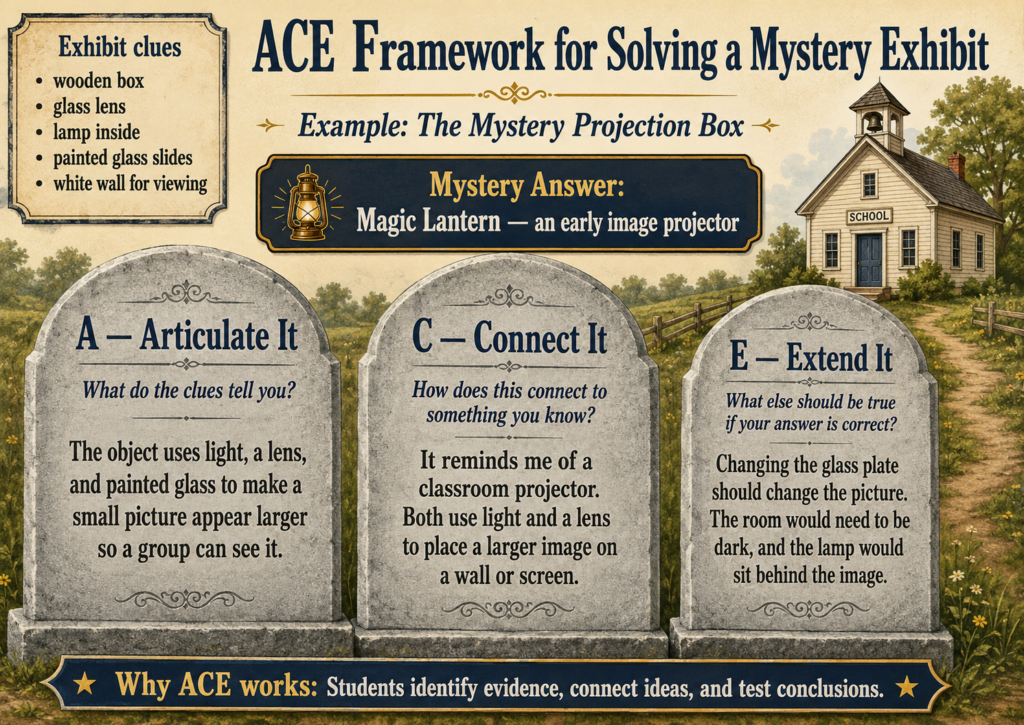
That distinction can lead to a stronger classroom conversation. A failed solution may still tell us something important about the people, resources, and expectations of its time.
Connect Past Classrooms to Today
After students finish the investigation, ask them to compare vanished practices with current ones.
Discussion questions might include:
- Which old practice solved its original problem most effectively?
- Which practice caused the most harm?
- Which modern replacement represents the greatest improvement?
- Do any vanished practices still appear in classrooms in a different form?
- What current classroom practice may disappear during the next fifty years?
That fourth question may produce some uncomfortable answers.
Rote recitation vanished as a dominant teaching model, but memorization has not disappeared. The monitorial system is gone, yet peer tutoring remains common. Copybook drills faded, but students still practice keyboarding and formatting until those skills become automatic. Classroom practices do not always vanish completely. Sometimes they change names, lose their rougher edges, and return in a new form.
Complete the History Detective Reflection
Students earn up to 27 points and receive a result level such as History Time Traveler, Classroom Historian, or Schoolhouse Detective.
They can then complete a printable History Detective Reflection. The report asks them to explain:
- The classroom practice they selected
- The problem it was meant to solve
- One limitation it had
- The practice or tool that replaced it
- One classroom practice used today that may disappear someday
That final prompt moves the activity beyond recalling historical facts. Students must examine their own classroom as something temporary.
Desks arranged in rows, printed textbooks, homework packets, letter grades, bells, hall passes, computer labs, and even one-device-per-student programs may eventually become historical exhibits.
Every normal classroom practice is normal only for a while.
Use It Without Creating Accounts
The activity runs entirely in the browser. Students do not need to create accounts or provide personal information. Their progress remains on the device they are using.
The activity is also available in English, Spanish, Vietnamese, Arabic, Hindi, Urdu, and Chinese. Students can switch languages without losing their completed exhibits or score. That makes it easier to use the investigation with multilingual learners, families, or groups who benefit from reviewing the same ideas in more than one language.
What Will Vanish Next?
The Vanished Classroom works as a school-history activity, a back-to-school discussion, or a companion to lessons on technological and social change. More importantly, it asks students to see education as something people continually redesign. Some changes improve access. Some improve learning. Some remove practices that should never have existed in the first place.
After students finish, ask them one final question:
Which classroom practice used today is most likely to vanish next, and what will replace it?
Their answer may be sitting in your classroom right now.
Enter The Vanished Classroom and begin investigating the school practices that time left behind.