
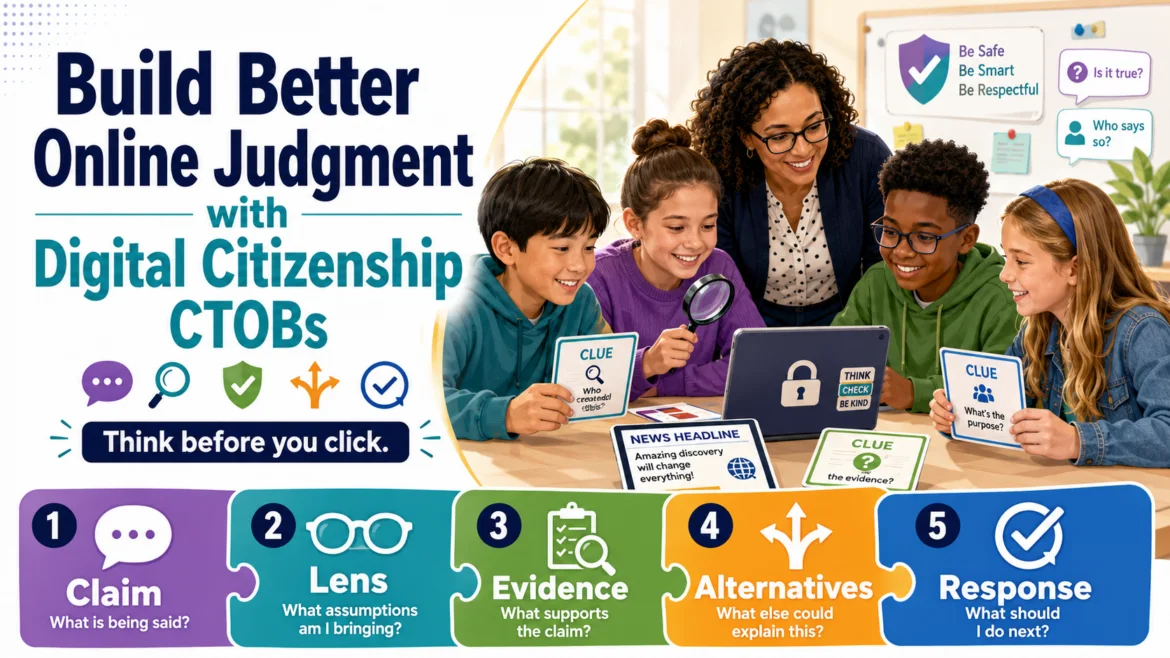
Every day, anyone with an account (e.g. email, game console account, whatever) gets bombarded with information and free deals. Each takes a little bit of will power and wisdom to work through. Some days, a student gets a message promising free game coins. Another is about to post a photo (you’ve seen the Think Before You Post series, right?) that reveals more than intended. Somewhere nearby, a seventh grader is sharing a headline after reading exactly six words of it. You know, that may also cover adults on Facebook, too.
Did You Know?
Digital Citizenship Day is October 28, 2026? This year, it is organized by MediaSmarts during Media Literacy Week. It focuses on responsible, respectful, and safe participation online. This blog entry is one of three focused on digital citizenship.
While you could respond with another slideshow about online safety, why not take a different approach with a mystery that prompts students to ask, “What went wrong?”
Introducing the CTOBs for Digital Citizenship, Grades K-8
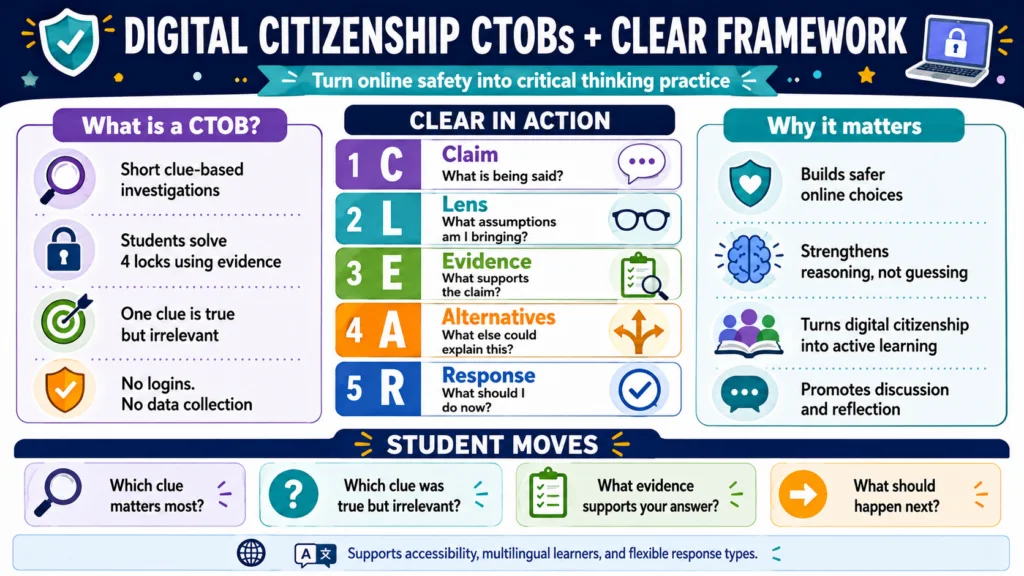
The new Digital Citizenship Critical Thinking Online Breakouts collection gives students in kindergarten through grade eight a chance to practice safer, kinder, and more thoughtful online behavior. These Critical Thinking Online Breakouts, or CTOBs, turn digital citizenship lessons into short investigations built around clues, evidence, and locked answers.
What a Digital Citizenship CTOB Does
Each CTOB gives students six short clues and four locks. One clue is true but irrelevant, so students cannot solve the activity by grabbing every fact they see. They have to decide which evidence matters and explain why.
That’s crucial because the internet contains plenty of accurate information that has nothing to do with the question in front of you. Sorting out the irrelevant stuff, especially stuff that wants to do you harm in some way, is a life skill.
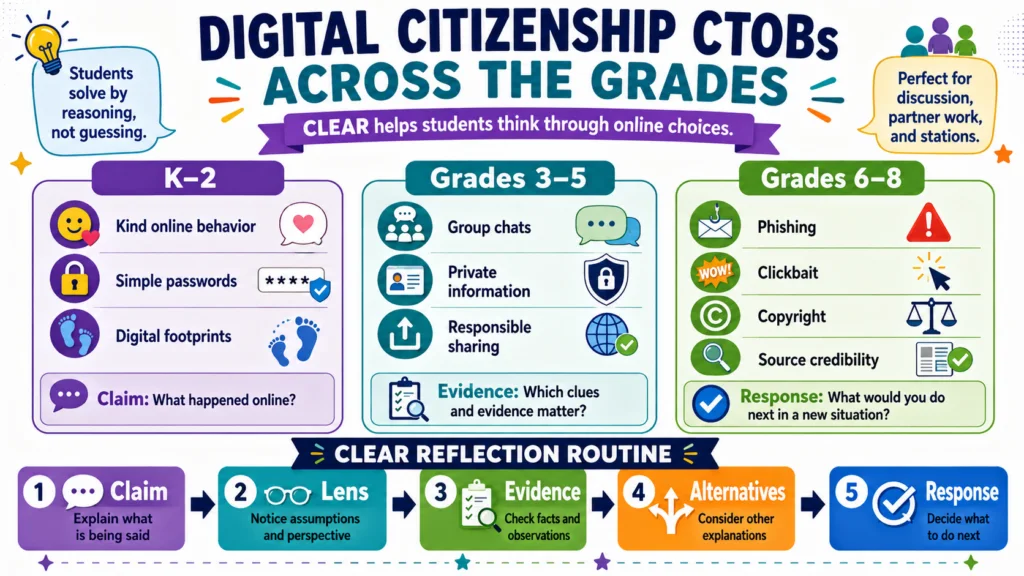
The topics grow with students. Younger learners explore kindness, passwords, and digital footprints. Grades three through five tackle group chats, private information, and responsible sharing. Middle school students investigate phishing, clickbait, strong passphrases, copyright, bias, and source credibility.
Build the Conversation Around the Locks
These CTOBs work best when students explain their choices before entering an answer. Try questions such as:
- Which clue gave you the strongest evidence?
- Which clue was true but did not help?
- What assumption almost fooled you?
- What should the student do next?
That discussion connects the activities to the CLEAR thinking process: Claim, Lens, Evidence, Alternatives, and Response. Students practice slowing down, examining what they believe, weighing evidence, considering another explanation, and choosing a reasonable action.
What Teachers Get
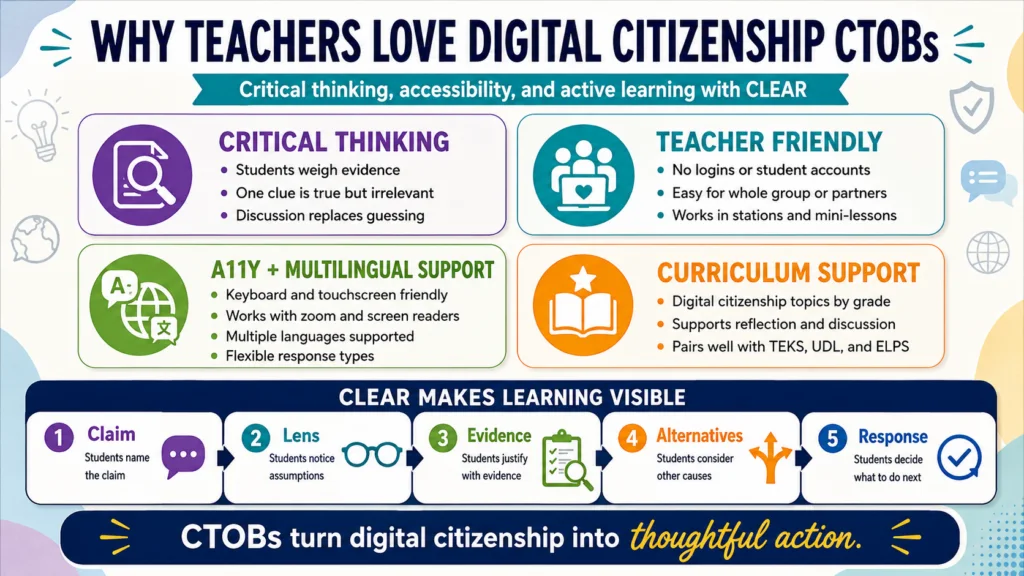
The collection includes a searchable activity library, curriculum guide, scope and sequence, lesson-plan guidance, TEKS correlations, UDL supports, ELPS supports, and separate answer-key access. The language picker supports English, Spanish, Vietnamese, Arabic, Hindi, Urdu, and Chinese.
The CTOBs also address A11Y, shorthand for accessibility. Students can navigate using a mouse, touchscreen, or keyboard. The activities work with browser zoom, screen readers, and district assistive technology. Short clue cards break information into smaller pieces, while varied lock types let students respond by selecting, sorting, sequencing, or typing.
The CTOBs run in the browser without student accounts or data collection. You can project one for a whole-class discussion, assign it to pairs, or place it in a station.
Start Here
Choose the free CTOB for your grade level and ask students to defend each answer before they open the lock. When they begin saying, “That clue is true, but it does not prove the claim,” the activity has done more than review digital citizenship.
Students are learning to pause, examine the evidence, and think before they click.