
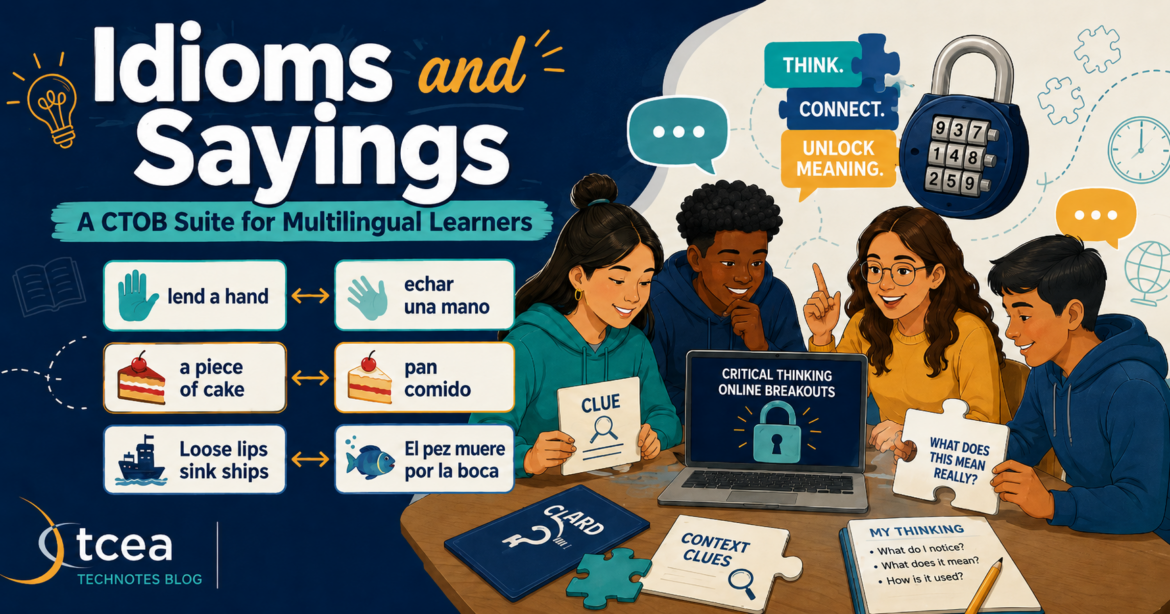
“El pez muere por la boca,” my mother liked to tell me. In English, the literal meaning “The fish dies by its mouth.” But what does that mean? It’s the equivalent of “Loose lips sink ships.” As an avid fishing enthusiast on the Gamboa River (Republic of Panama) in my childhood, I got the message. When you pull a hook out of a huge bass fish you caught off a river pier, it’s easy to get. But idioms built on such experiences may be strange to those learners who never stood on a metal pier and watched five bass surround a luckless minnow on a hook, eyeing their dinner and becoming mine. Learning idioms in English, or any other language, is both fun and frustrating.
English has an **estimated 25,000 idiomati**c expressions. Those idioms are especially difficult for non-native speakers. That’s because their meanings are usually metaphorical, not literal. The same study found that younger second-language learners often interpreted idioms literally, with non-literal understanding developing more gradually through adolescence.
What’s more, nonnative English speakers answered 200 out of 360 common idiom items correctly, about 56 percent. (JSTOR). There’s a clear need for resources on how to learn idioms and sayings because, as of Fall 2021, English learners made up 10.6 percent of U.S. public school enrollment. That’s about 5.3 million students. In Texas, that number was 20.2 percent. That is one out of every five students. (National Center for Education Statistics).
Small Phrases with Big Comprehension Costs

While students may know every word in “the ball is in your court,” they will still miss the meaning. That meaning is simply that someone expects them to make a decision. Idioms are small phrases but can be difficult to grasp. The reason why is that idioms break the usual rules students depend on. In most reading tasks, students can use word meaning, sentence structure, and context to make a solid guess. With idioms, that does not always work.
“Cost an arm and a leg” does not mean anything helpful if you translate it word by word. “Spill the beans” may involve no beans at all. “Hold your horses” has very little to do with horses in most classrooms, unless you teach agriculture, in which case your examples are better than mine.
When an idiom has a close match in a student’s home language, it is easier to understand. When the image changes, or no close match exists, students need more support. (Academy Publication)
Use the Home Language
That is where the Idioms and Sayings CTOB suite takes a better approach. It treats the home language as a problem as a resource to work with.
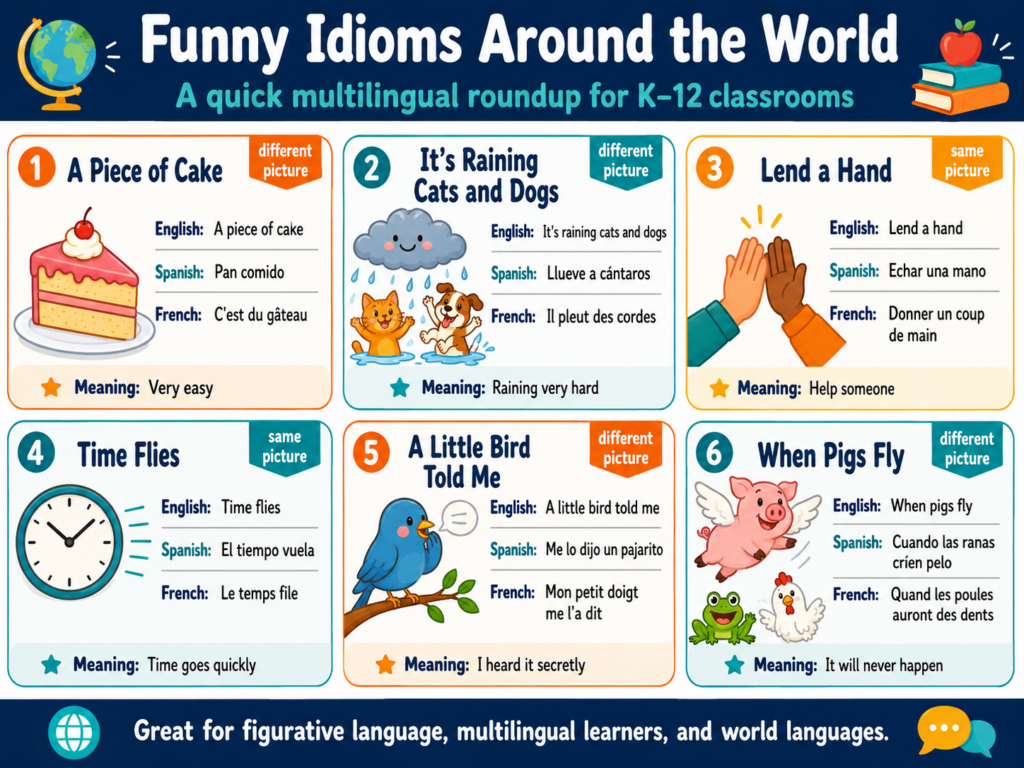
Students compare English idioms with Spanish equivalents. Sometimes the image is close: “lend a hand” and “echar una mano.” Sometimes it changes: “cost an arm and a leg” and “costar un ojo de la cara.” That contrast can make all the difference.
| Student Question | What It Builds |
|---|---|
| Do both languages use the same picture? | Transfer from home language |
| Does the picture change? | Flexible figurative thinking |
| Is there no close match? | Paraphrasing and context use |
As a result, that contrast can be more useful than memorizing a list and hoping it sticks.
What Students Work With
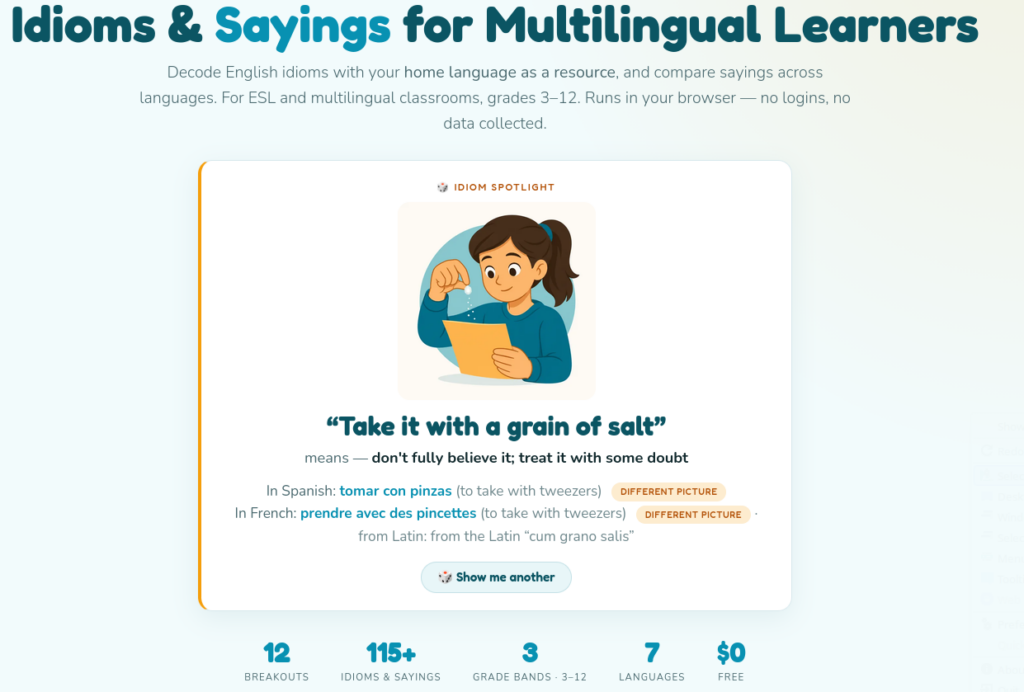
The suite is built for grades three through twelve and includes a variety of English and Spanish breakouts across three grade bands. It also includes a search-first landing page, a trilingual English, Spanish, and French idiom spotlight, and an ELPS and TEKS alignment page. By the time this blog publishes, it may have even more activities of varying difficulty.
| Grade Band | Breakout Focus | Sample Idioms |
|---|---|---|
| Grades three through five | Body, animal, and food idioms | “lend a hand,” “hold your horses,” “a piece of cake” |
| Grades six through eight | Sports, school, time, and money | “hit the books,” “drop the ball,” “time flies” |
| Grades nine through twelve | Proverbs, sayings, and Latin roots | “better late than never,” “carpe diem,” “the apple doesn’t fall far from the tree” |
Students can see how English, Spanish, and French express the same idea. Sometimes the languages share an image. Sometimes they do not. That is a quick opening for discussion in ESL, ELAR, and world language classrooms.
Built Like a Breakout
Each CTOB uses clues and locks instead of a worksheet. Students read, compare, eliminate weak answers, and solve. They are not just matching idioms to definitions. They are thinking through meaning.
That matters because idiom learning is not only vocabulary learning. It is context, culture, metaphor, and pattern recognition.
The student task stays simple:
- Read the clues
- Compare the English idiom with the home-language equivalent
- Notice whether the image is the same or different
- Solve the locks
- Explain the meaning in plain language
If students can explain the idiom without repeating the exact definition, you have better evidence of understanding.
Let the Games Begin!
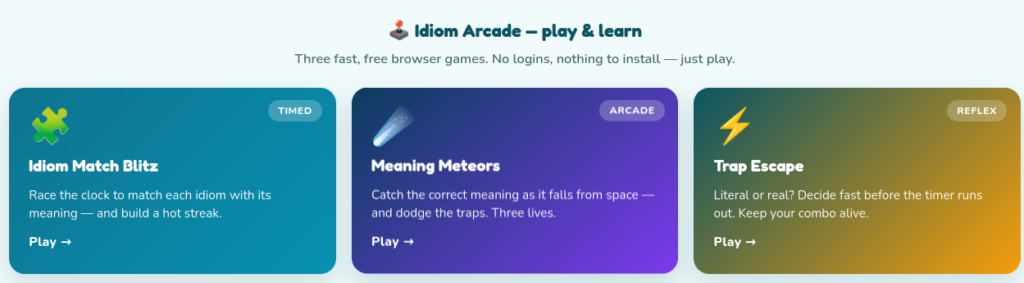
You will also find three games, including:
- Idiom Match Blitz – Race the clock to match each idiom with its meaning
- Meaning Meteors – Catch the correct meaning as it falls from space while dodging traps
- Trap Escape – Decide which is “literal” or real idiom interpretation
These are fun games to get students thinking about idioms and their meanings.
Where It Fits
Use the suite in English/Language Arts/Reading (ELAR) when teaching figurative language, context clues, and author’s craft. Use it with multilingual learners when working on academic language and everyday English. Use it in world language classes when comparing how languages express meaning.
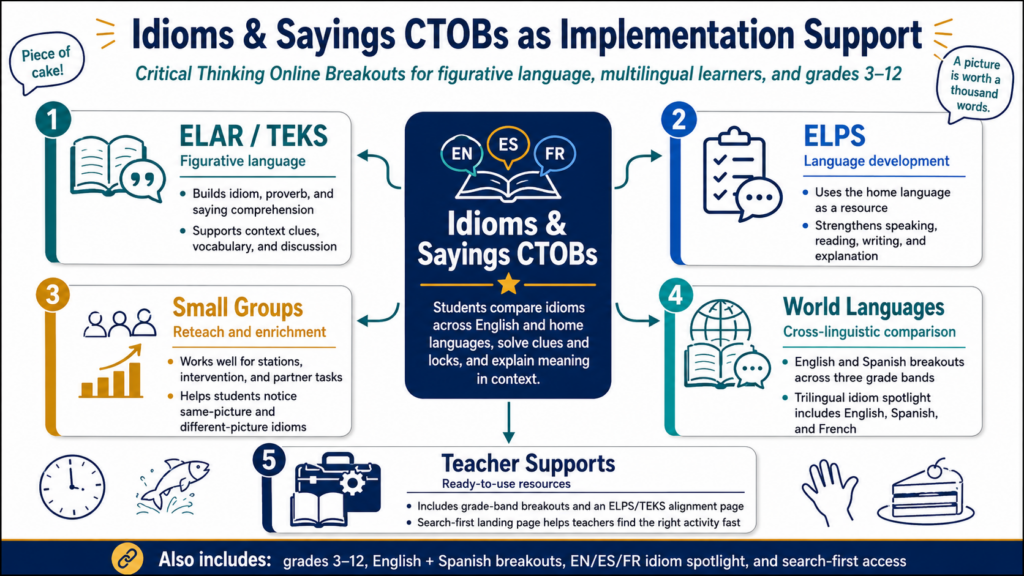
It also works well as a station activity. Put students in pairs, give them one breakout, and ask them to keep a two-column note catcher…then ask, “Which idiom makes more sense in your home language, and why?”
| Same Picture | Different Picture |
|---|---|
| “lend a hand” and “echar una mano” | “cost an arm and a leg” and “costar un ojo de la cara” |
In a Nutshell
Idioms are not just odd phrases to memorize. They are small puzzles. This CTOB suite gives students a way to solve them.
Try the Idioms and Sayings CTOB suite with your multilingual learners or world language students, then ask which idiom caused the best discussion.