
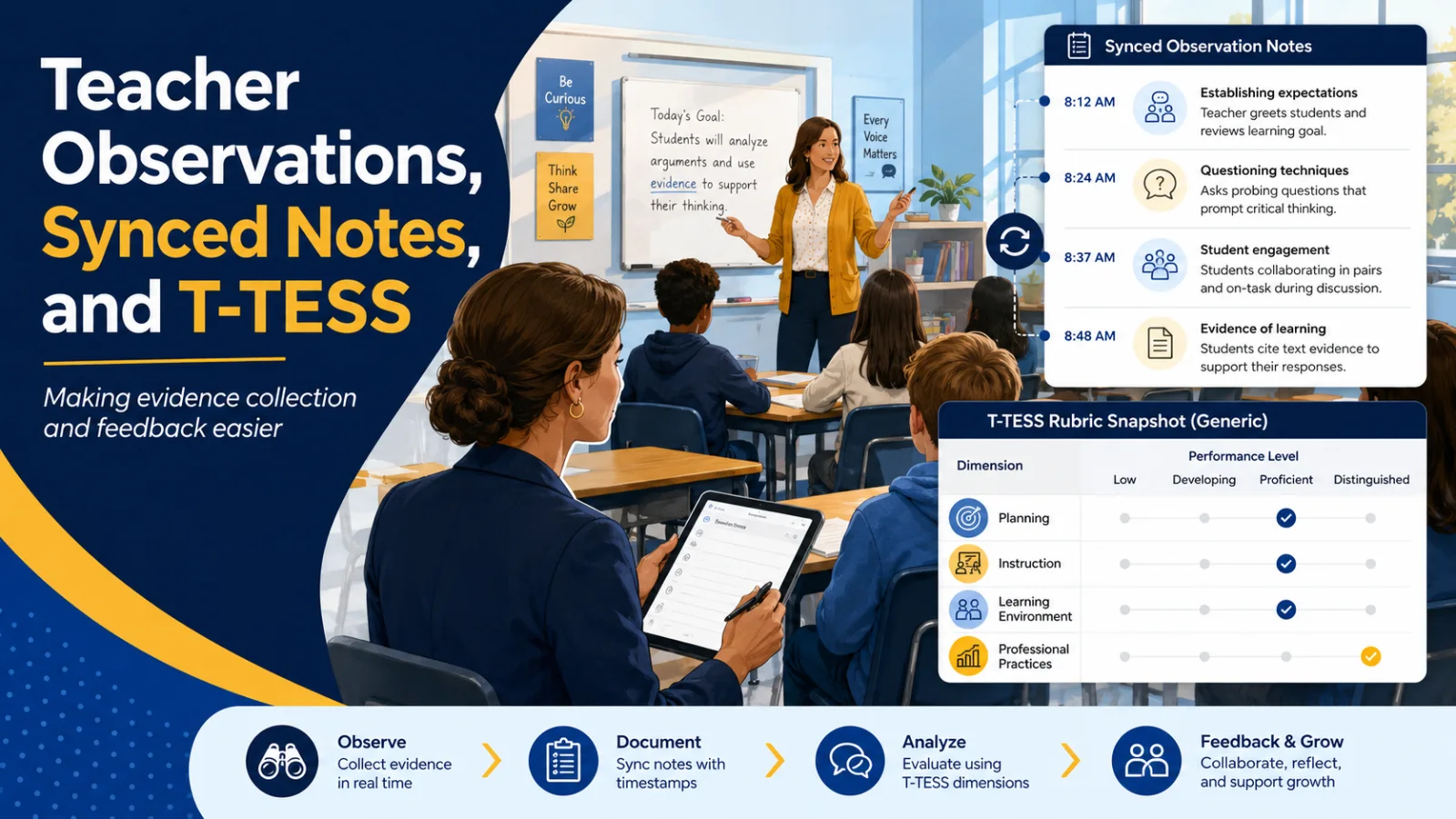
Like other teachers, I have experienced numerous classroom observations. And, for a short time, I had the opportunity to observe and assess using T-TESS instrument. Each time, I felt like a bit of an impostor given my memories of my first year observations administrators made of my classroom. One of the things I struggled with, and worked with administrators on managing, is how to manage all the components of an observation. Often, a principal finishes a formal observation, closes the classroom door, and returns to an office full of unfinished work. The lesson lasted 45 minutes. Turning the notes into evidence, ratings, feedback, and a conference document may take several more hours.
That is the problem tools such as Sibme, Edthena, Vosaic, Frontline, among others, are trying to solve.
Start with Sibme as an Example
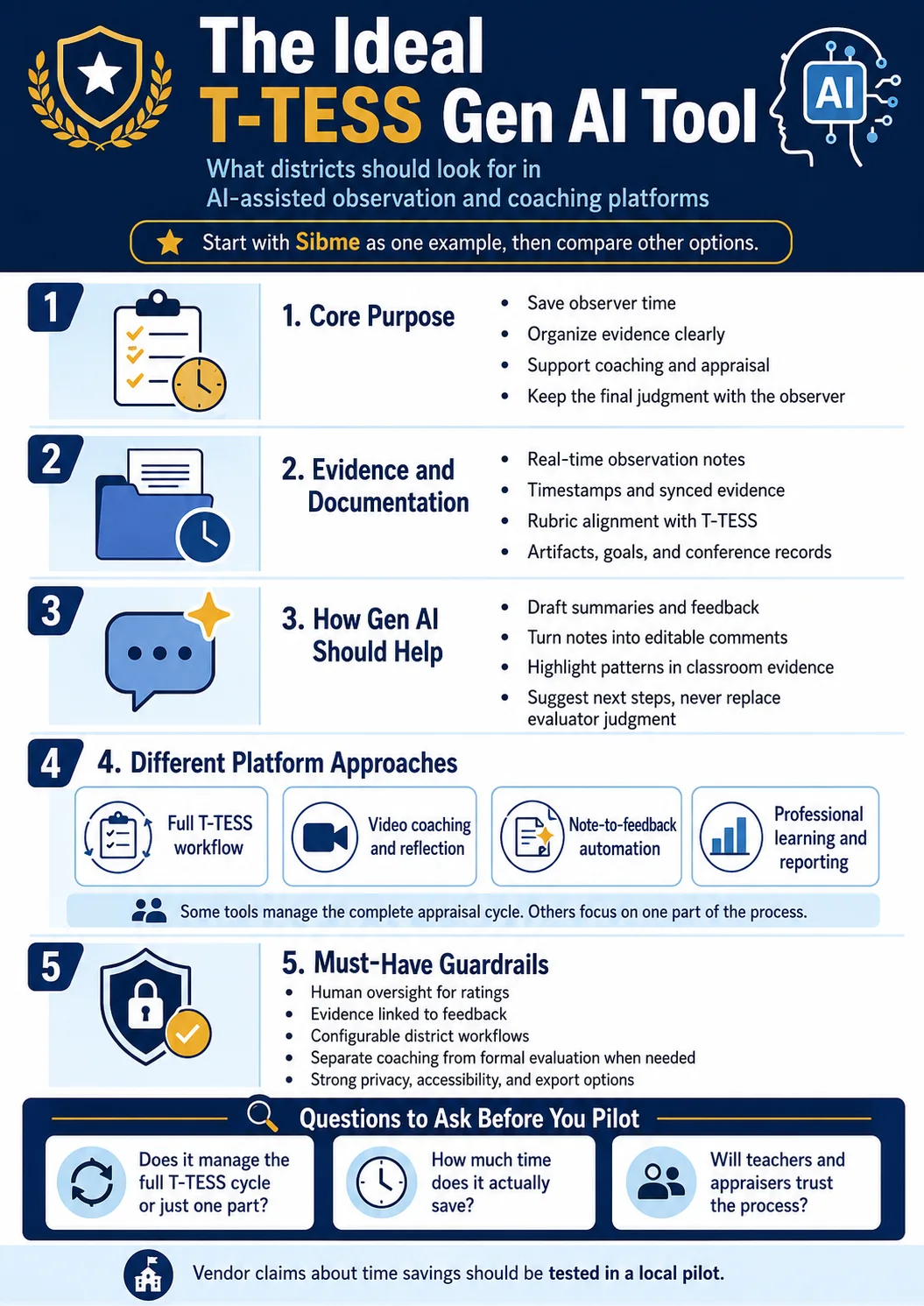
Sibme combines classroom observations, video coaching, artifacts, goals, and AI-assisted documentation. Its observation tools can organize timestamped evidence, connect it to a district rubric, and help draft feedback. Sibme specifically promotes built-in support for T-TESS and customizable district processes. The company says the final judgment remains with the observer, not the AI.
The time-saving claims caught my attention. One Texas principal reported cutting a six-to-seven-hour observation process in half. Another district reported doubling walkthroughs with the same staff. Those examples come from Sibme, so treat them as vendor evidence rather than independent research. Still, they make a pilot worth considering.
Compare the Alternatives
As you might have guessed, Sibme is not the only option. Other solutions take an observer’s notes and create editable, framework-aligned feedback. Other report that one principal reduced post-observation work from three hours to about 20 to 30 minutes.Other tools bring in video coaching (including secure video recordings with timestamped comments, transcription, AI-assisted video review), teacher reflection, and professional learning.
Others manage configurable rubrics, evaluation forms, goals, reports, professional learning, and records for different employee groups. Some may focus on workflow management or AI analysis of classroom evidence. You will want to consider whether you are trying to manage the complete T-TESS appraisal cycle or simply focus on one aspect, such as coaching and reflection.
Here’s a short list of the vendors, followed-by a solution provider (in alpha order):
Your text starts here. It will wrap on the left side of the image on wider screens.
- Edthena: Observation Copilot, VC3, and AI Coach
- Frontline Professional Growth
- GoReact
- SchoolMint Grow
- Sibme Observations
- TeachFX
- TORSH Talent
- Vosaic
Vendor Comparison
View vendor comparison via full-screen in a new tab or scroll down below:
Pilot Before You Purchase
To assist you in selecting a solution partner, consider asking each vendor to process the same sample lesson and observer notes.
- Separates classroom evidence from AI interpretation
- Shows exactly which evidence supports each rating
- Lets the appraiser edit every score and comment
- Keeps coaching records separate from formal evaluation
- Explains video, transcript, and AI-output retention
- Prohibits district data from training outside models
The real test is not how quickly the tool writes. It is whether the observer spends less time fixing its work afterward. You can also find a sample RFP Vendor Selection Rubric below.
Have you used Sibme or another platform with T-TESS? Share the time saved, the problems encountered, and whether teachers trusted the process.
Sample RFP Vendor Selection Rubric
AI-Assisted Teacher Observation, Coaching, and T-TESS Platform
District: __________________________________________
RFP number: ________________________________________
Vendor: ____________________________________________
Evaluator: _________________________________________
Evaluation date: ___________________________________
1. Purpose
This rubric evaluates platforms that support one or more of the following:
- Formal teacher appraisal
- T-TESS observations and documentation
- Classroom walkthroughs
- Synchronized observation notes
- Video or audio evidence
- Instructional coaching
- Teacher reflection
- Goal setting and professional development
- Gen AI-assisted summaries, feedback, or evidence analysis
The district seeks a platform that saves staff time while preserving human judgment, evidence quality, teacher trust, privacy, security, accessibility, and compliance.
Stage One: Mandatory Requirements
Mark each requirement Pass, Fail, or Needs Clarification.
A vendor that fails a mandatory requirement may be disqualified unless the district approves a written exception.
| # | Mandatory requirement | Vendor evidence required | Result |
|---|---|---|---|
| 1 | Supports the district’s current T-TESS rubric and appraisal process | Live demonstration using district-provided forms and rubric | |
| 2 | Can be reconfigured for future T-TESS revisions without replacing the platform | Written configuration process, timeline, and cost | |
| 3 | Keeps the certified appraiser responsible for every final rating and summative decision | Workflow demonstration and contract language | |
| 4 | Does not submit, finalize, or change appraisal ratings without human approval | Product demonstration | |
| 5 | Clearly separates collected evidence, AI-generated interpretation, and appraiser conclusions | Sample observation record | |
| 6 | Connects feedback or suggested ratings to specific evidence, timestamps, notes, or artifacts | Live demonstration | |
| 7 | Permits the district to disable individual Gen AI features | Administrative settings demonstration | |
| 8 | Provides role-based access for teachers, appraisers, coaches, administrators, and auditors | Permissions matrix | |
| 9 | Allows coaching records to remain separate from formal evaluation records | Workflow and permissions demonstration | |
| 10 | Provides district ownership of observations, videos, transcripts, notes, ratings, and exports | Contract language | |
| 11 | Prohibits selling district data or using it for advertising | Contract and privacy policy | |
| 12 | Does not use district content to train shared or public AI models without explicit written authorization | Contract and AI data-use statement | |
| 13 | Provides documented retention, deletion, legal-hold, and account-closure procedures | Data retention schedule | |
| 14 | Provides secure export of all district records in usable formats | Sample export files | |
| 15 | Encrypts protected data in transit and at rest | Security documentation | |
| 16 | Provides documented breach-notification and incident-response procedures | Contract and incident-response plan | |
| 17 | Identifies all subprocessors and hosting locations | Current subprocessor list | |
| 18 | Supports district authentication requirements, such as SSO and multifactor authentication | Technical documentation | |
| 19 | Provides a current Accessibility Conformance Report or VPAT | Current accessibility documentation | |
| 20 | Supports keyboard access, screen readers, captions, transcripts, and text alternatives | Accessibility demonstration | |
| 21 | Provides a sandbox or pilot environment using district-defined scenarios | Pilot agreement | |
| 22 | Agrees to service-level, support, data-protection, and exit provisions in the RFP | Written acceptance or exceptions list |
Stage One determination
- Vendor advances to scored evaluation
- Vendor requires clarification
- Vendor is disqualified
Mandatory requirement notes:
Stage Two: Weighted Evaluation
Scoring scale
| Score | Performance description |
|---|---|
| 5 | Exceeds requirements. Fully demonstrated, documented, configurable, and included in the proposed price |
| 4 | Meets requirements. Minor limitations do not affect the intended district workflow |
| 3 | Partially meets requirements. Additional configuration, process changes, or costs may be required |
| 2 | Limited capability. Significant gaps, manual workarounds, or unverified claims remain |
| 1 | Planned, under development, available only through a partner, or dependent on a future roadmap |
| 0 | Does not meet the requirement or vendor did not provide sufficient evidence |
Weighted-score formula
Weighted points = (Raw score ÷ 5) × Criterion weight
Do not award more than one point for a feature described only as planned or on the vendor’s roadmap.
A. T-TESS and Appraisal Alignment: 20 Points
| Criterion | Weight | Raw score 0–5 | Weighted points | Evidence and evaluator notes |
|---|---|---|---|---|
| Supports all district-required T-TESS domains, dimensions, performance levels, forms, and evidence fields | 4 | |||
| Supports pre-conferences, observations, post-conferences, goal setting, professional development plans, student-growth evidence, and summative conferences | 3 | |||
| Can support both the current T-TESS structure and future T-TESS revisions | 3 | |||
| Allows district administrators to configure rubrics, forms, workflows, required fields, calendars, and approval steps | 3 | |||
| Supports appraiser calibration and comparison of evidence without improperly averaging ratings | 2 | |||
| Maintains a complete audit trail of ratings, revisions, signatures, comments, and conference records | 2 | |||
| Produces teacher, campus, district, and compliance reports without exposing unnecessary individual data | 2 | |||
| Separates developmental coaching from formal appraisal | 1 |
Category A subtotal: ______ / 20
B. Observation Evidence and Synchronized Notes: 14 Points
| Criterion | Weight | Raw score 0–5 | Weighted points | Evidence and evaluator notes |
|---|---|---|---|---|
| Supports real-time scripting and synchronized notes with timestamps | 3 | |||
| Connects notes to video, audio, transcript sections, rubric dimensions, or uploaded artifacts | 3 | |||
| Allows appraisers to tag, search, sort, revise, and organize evidence efficiently | 2 | |||
| Supports classroom walkthroughs, formal observations, remote observations, and uploaded recordings | 2 | |||
| Allows teachers to review evidence, respond, acknowledge receipt, and prepare for conferences | 2 | |||
| Works effectively on district-supported laptops, tablets, and mobile devices | 1 | |||
| Provides usable workflows during weak or interrupted connectivity | 1 |
Category B subtotal: ______ / 14
C. Gen AI Functions and Safeguards: 15 Points
| Criterion | Weight | Raw score 0–5 | Weighted points | Evidence and evaluator notes |
|---|---|---|---|---|
| Produces useful drafts of summaries, feedback, questions, or next steps without replacing appraiser judgment | 3 | |||
| Links every AI-supported conclusion to observable evidence, timestamps, notes, or artifacts | 3 | |||
| Clearly labels AI-generated text and preserves the original evidence | 2 | |||
| Allows appraisers to accept, edit, reject, or regenerate each AI suggestion | 2 | |||
| Documents the AI models, hosting arrangements, subprocessors, data flows, and model-change process | 1 | |||
| Tests and monitors accuracy, reliability, harmful bias, security, and inappropriate outputs | 1 | |||
| Provides incident reporting when an AI feature produces unsafe, misleading, or materially inaccurate results | 1 | |||
| Allows the district to disable AI scoring while retaining observation and coaching functions | 1 | |||
| Maintains records showing which AI outputs were used, changed, or rejected | 1 |
Category C subtotal: ______ / 15
D. Coaching and Professional Growth: 9 Points
| Criterion | Weight | Raw score 0–5 | Weighted points | Evidence and evaluator notes |
|---|---|---|---|---|
| Supports coaching cycles, goals, action steps, follow-up dates, and progress monitoring | 2 | |||
| Provides timestamped feedback, comments, clips, questions, and teacher reflection tools | 2 | |||
| Connects observation evidence to professional learning resources or district programs | 1 | |||
| Supports peer coaching, mentoring, induction, and instructional-coach workflows | 1 | |||
| Allows teachers to control or understand who can view coaching videos and reflections | 1 | |||
| Provides reports showing coaching activity and progress without turning coaching into surveillance | 1 | |||
| Supports teacher self-reflection independent of formal appraisal | 1 |
Category D subtotal: ______ / 9
E. Privacy, Security, and Data Governance: 15 Points
| Criterion | Weight | Raw score 0–5 | Weighted points | Evidence and evaluator notes |
|---|---|---|---|---|
| Collects only the data required for the contracted purpose | 2 | |||
| Provides clear ownership, access, correction, export, retention, deletion, and legal-hold terms | 2 | |||
| Prohibits unauthorized model training, advertising, sale, profiling, or unrelated secondary use | 2 | |||
| Uses encryption, secure authentication, role-based access, and administrative controls | 2 | |||
| Provides audit logs for viewing, downloading, sharing, editing, exporting, and deleting records | 2 | |||
| Protects student faces, voices, names, classroom work, accommodations, and other sensitive information | 2 | |||
| Documents security testing, vulnerability management, backups, disaster recovery, and business continuity | 1 | |||
| Provides acceptable breach-notification timelines and district cooperation requirements | 1 | |||
| Identifies subprocessors and provides notice before material changes | 1 |
Category E subtotal: ______ / 15
F. Accessibility and Usability: 8 Points
| Criterion | Weight | Raw score 0–5 | Weighted points | Evidence and evaluator notes |
|---|---|---|---|---|
| Provides a current ACR or VPAT with documented testing results | 2 | |||
| Demonstrates keyboard navigation, screen-reader support, focus visibility, zoom, and reflow | 2 | |||
| Provides accurate captions, transcripts, labels, instructions, and alternatives for audio or video content | 1 | |||
| Gives the district a documented accessibility-remediation process and response timeline | 1 | |||
| Is understandable and efficient for teachers, appraisers, coaches, and district administrators | 1 | |||
| Supports district-required languages and accessible communication formats | 1 |
Category F subtotal: ______ / 8
G. Integration, Data Portability, and Technical Fit: 7 Points
| Criterion | Weight | Raw score 0–5 | Weighted points | Evidence and evaluator notes |
|---|---|---|---|---|
| Integrates with district identity, HR, SIS, LMS, calendar, and professional-learning systems as required | 2 | |||
| Supports SSO, automated rostering, role changes, and account deactivation | 1 | |||
| Provides documented APIs, secure file transfers, or standard integration methods | 1 | |||
| Exports observations, forms, evidence, ratings, videos, transcripts, and audit records in usable formats | 1 | |||
| Provides a practical migration plan for existing records | 1 | |||
| Provides a contract-end transition plan without excessive extraction fees or proprietary lock-in | 1 |
Category G subtotal: ______ / 7
H. Implementation, Training, and Support: 7 Points
| Criterion | Weight | Raw score 0–5 | Weighted points | Evidence and evaluator notes |
|---|---|---|---|---|
| Provides a clear implementation plan with responsibilities, milestones, dependencies, and risk controls | 2 | |||
| Provides role-specific training for appraisers, teachers, coaches, system administrators, and support staff | 1 | |||
| Demonstrates knowledge of Texas appraisal practices and T-TESS implementation | 1 | |||
| Provides a sandbox, pilot, test data, and configuration support before launch | 1 | |||
| Provides acceptable help-desk hours, response times, escalation procedures, and named support contacts | 1 | |||
| Provides release notes, administrator notices, and training when major features or AI models change | 1 |
Category H subtotal: ______ / 7
I. Cost and Overall Value: 5 Points
Evaluate cost only after technical, instructional, privacy, and accessibility reviews are complete.
| Criterion | Weight | Raw score 0–5 | Weighted points | Evidence and evaluator notes |
|---|---|---|---|---|
| Five-year total cost of ownership is clear and competitive | 2 | |||
| Pricing includes implementation, configuration, training, support, storage, AI usage, integrations, and exports | 1 | |||
| Pricing remains predictable as observation volume, video storage, or AI use increases | 1 | |||
| Expected time savings and operational benefits are supported by pilot evidence or comparable district references | 1 |
Category I subtotal: ______ / 5
Weighted Score Summary
| Category | Maximum points | Vendor points |
|---|---|---|
| A. T-TESS and appraisal alignment | 20 | |
| B. Observation evidence and synchronized notes | 14 | |
| C. Gen AI functions and safeguards | 15 | |
| D. Coaching and professional growth | 9 | |
| E. Privacy, security, and data governance | 15 | |
| F. Accessibility and usability | 8 | |
| G. Integration, portability, and technical fit | 7 | |
| H. Implementation, training, and support | 7 | |
| I. Cost and overall value | 5 | |
| Total | 100 | ______ |
Recommended Decision Bands
| Total score | Recommendation |
|---|---|
| 90–100 | Excellent fit; advance to contract negotiation and final reference checks |
| 80–89 | Strong fit; advance with documented conditions or clarifications |
| 70–79 | Possible fit; significant gaps, risks, or costs require resolution |
| Below 70 | Does not meet the district’s preferred threshold |
| Any failed mandatory gate | Disqualify or require a formally approved exception |
A high numerical score does not override a failed privacy, security, accessibility, legal, or human-oversight requirement.
Required Vendor Demonstration Scenarios
Vendors should demonstrate the platform using district-provided sample data rather than a prepared sales demonstration.
Scenario One: Formal T-TESS Observation
The vendor must demonstrate how an appraiser:
- Schedules a pre-conference
- Reviews a lesson plan or uploaded artifact
- Records synchronized observation notes
- Connects notes to T-TESS dimensions
- Distinguishes evidence from interpretation
- Uses or disables Gen AI assistance
- Revises suggested feedback
- Conducts and documents a post-conference
- Completes required ratings and signatures
- Exports the complete appraisal record
Scenario Two: Video-Supported Coaching
The vendor must demonstrate how a teacher and coach:
- Record or upload a lesson
- Add timestamped comments and clips
- Review a transcript
- Identify a coaching goal
- Add action steps and follow-up dates
- Restrict the recording to the coaching relationship
- Keep the coaching record outside the formal appraisal file
- Delete or export the recording according to district policy
Scenario Three: AI Accuracy and Traceability
The vendor must:
- Analyze a district-provided observation
- Generate a draft summary
- Show the evidence supporting each statement
- Identify uncertainty or insufficient evidence
- Allow the evaluator to reject a suggestion
- Show whether the rejected output is retained
- Explain whether district data enters model training
- Demonstrate how administrators disable the AI feature
Scenario Four: Accessibility
The vendor must demonstrate:
- Keyboard-only completion of a common workflow
- Screen-reader navigation
- Browser zoom and responsive reflow
- Caption and transcript controls
- Accessible form errors and instructions
- The process for reporting and correcting an accessibility barrier
Scenario Five: Contract Exit
The vendor must demonstrate:
- Full district data export
- Export formats
- Video and transcript retrieval
- Audit-log export
- Account closure
- Certified deletion
- Transition assistance and associated costs
Required Reference Checks
Obtain at least three references from comparable school systems.
Ask each reference:
- How much observation or documentation time did the platform save?
- What work did the platform add?
- How accurate and useful were its AI-generated summaries?
- Did appraisers frequently need to correct the output?
- Did teachers trust the observation and coaching process?
- Were coaching records kept separate from formal evaluation?
- Were there video-upload, transcription, integration, or reliability problems?
- How responsive was vendor support?
- Did costs increase because of storage, AI use, integrations, or training?
- Would the district purchase the platform again?
Risk and Exception Log
| Risk or exception | Severity | Vendor response | District mitigation | Responsible owner |
|---|---|---|---|---|
| Low / Medium / High | ||||
| Low / Medium / High | ||||
| Low / Medium / High |
Final Evaluation
Strengths:
Limitations:
Unresolved risks:
Required contract conditions:
Final recommendation
- Recommend award
- Recommend award with conditions
- Advance to pilot
- Request clarification or revised proposal
- Do not recommend
Evaluator signature: _______________________________________________
Date: ____________________________________________________________