
In our Remote Learning Strategies series so far, we’ve explored two powerful strategies. Those strategies included classroom discussion and summarization. In this blog entry, we’ll review three more strategies that teachers should use. Ready for a whirlwind review of evidence-based strategies?
Strategy #3: Teacher Credibility
"One high-effect size instructional strategy would be teacher credibility," says a teacher. She points out that understanding what she is teaching garners trust. Students respect her more when they understand what she is teaching and why. Of course, knowing the research about how to teach is important. To convey her confidence, she relies on screencasting (e.g. Screencastify).Did You Know?When you think of teacher credibility, know that it is about perception. Teachers convey competence, trustworthiness, and caring. Students have to be answer affirmatively when they ask themselves, “Is this someone I can turn to?” (Source: Visible Learning Meta X database).You can explore teacher credibility, along with other core strategies, via the TCEA self-paced, online course. The course Strategies That Work: Core Components explores evidence-based strategies and how to use them in the classroom and is now available.
How do you influence student perception? One way might be to meet these three criteria:
- Show up on time
- Be prepared to teach
- Have a thorough understanding of the content and be able to explain why learning it is important
As a third grade student, I had learned phonics growing up as a second language learner. As a teacher in training, my professors denied the efficacy of phonics. Yet, it turns out they were wrong.
Reading comprehension is the product of two things. First, a child needs to be able to sound out a word. Second, the child needs to know the meaning of the word she sounded out.Can a credible teacher admit they are wrong? I’d like to think so. This next strategy taps into several other evidence-based strategies. Lori Oczkus (@LoriOczkus) terms these strategies as the “Fab Four” in her book Reciprocal Teaching At Work. John Hattie writes the foreword.Many educators don’t know this.
That’s because the cognitive science research has not made its way into many schools. Nor has it made it into many schools of education (Source: At A Loss for Words). More reading on vocabulary.
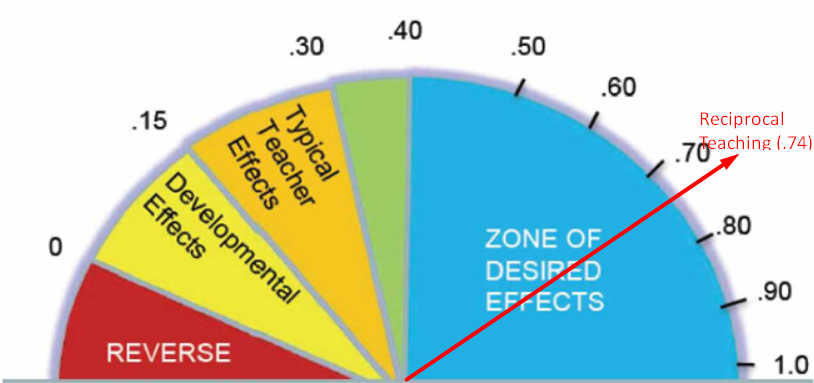
Strategy #4: Reciprocal Teaching
"One high-effect size instructional strategy is reciprocal teaching," says one educator. She goes on to say:I love this one and I am learning more about this. The tool to help with it is Seesaw as you can see how they are processing and understanding of your teaching.Reciprocal teaching aims at improving reading comprehension across all subject areas. It does this through the use of four strategies, including:
- Summarizing
- Questioning
- Clarifying
- Predicting
Consider how this teacher uses Zoom:
Incorporating active monitoring by having students show me their work during ZOOM! I also love using the chat as a way for students to answer intro questions!Other teachers rely on NearPod. They share informational text so that students have summaries and questions. Then, students make their own clarification statements and predict how something will work. "NearPod allows me to see all students working. I can provide instantaneous feedback as necessary."
A final approach involves students using reciprocal teaching via Google Slides. “Do this when you use an organizer via a Google Slide.” She goes on to explain the directions in this way:
- First, divide students into break out rooms.
- Second, allow students to discuss and complete their respective roles in the team.
Strategy #5: The Jigsaw Method
Explored in detail in other blog entries, this surface learning strategy is great at introducing new information. The Visible Learning Meta X database describes it in this way:The Jigsaw instructional method is a cooperative approach to learning originally developed by Elliot Aronson. Following this method, a teacher introduces a main topic and several subtopics.One way that teachers are using jigsaw in remote learning involves Google Slides. This approach lends itself for use in the regular or hybrid classroom as well.Jigsaw students are broken into “home groups”, and each member of the home group is assigned a subtopic. Then, students form expert groups to study their assigned subtopic through research and discussion.
After the students have mastered the subtopic in question, they return to their home group to report on their findings. At the conclusion of the exercise, each home group member has learned about each subtopic from a member of the relevant expert group or through their own investigation with an expert group.
To use the jigsaw method with Google Slides, assign expert groups a collaborative slide deck. Each student adds their info to the expert group slide. Comments within the slide deck make up the final presentation slide(s). At the end, each expert group member copies the slide/s to the “table group” slide deck. They include any explanation in the slide comments or as an embedded video.
Aside from Google Slides, Google Classroom was also mentioned. “I love the idea of using Jigsaw in the classroom.” That teacher describes it in this way:
Teachers can divide roles and create prompts in Google Docs. Then they can be assigned in Google Classroom. Teachers can later have students work as a whole by having them collaborate on a final group Doc.In the next installment of this series, we'll explore more ways that teachers are matching up digital tools with high-effect size strategies. Stay tuned!