
While attending a start-of-the-year school district event, it became apparent to me that many districts are at different places in a journey towards adopting AI in schools. The fundamental question for them is, “How can we as educators responsibly harness the power of AI while safeguarding student interests?” As artificial intelligence (AI) reshapes how schools work — and leaders lead — schools face the challenge of effective, ethical integration of AI in academic settings.
That’s why we’re providing two powerful documents that you can use to integrate AI responsibly into your district.
The first document gives you a roadmap towards full AI adoption in your school organization. The second provides you with TCEA’s Essential Learning Expectations for AI. Together, these documents provide a framework for AI adoption in your teaching, learning, and leading spaces. They seek to provide practical guidance for educators trying to make sense of it all.
Key Points
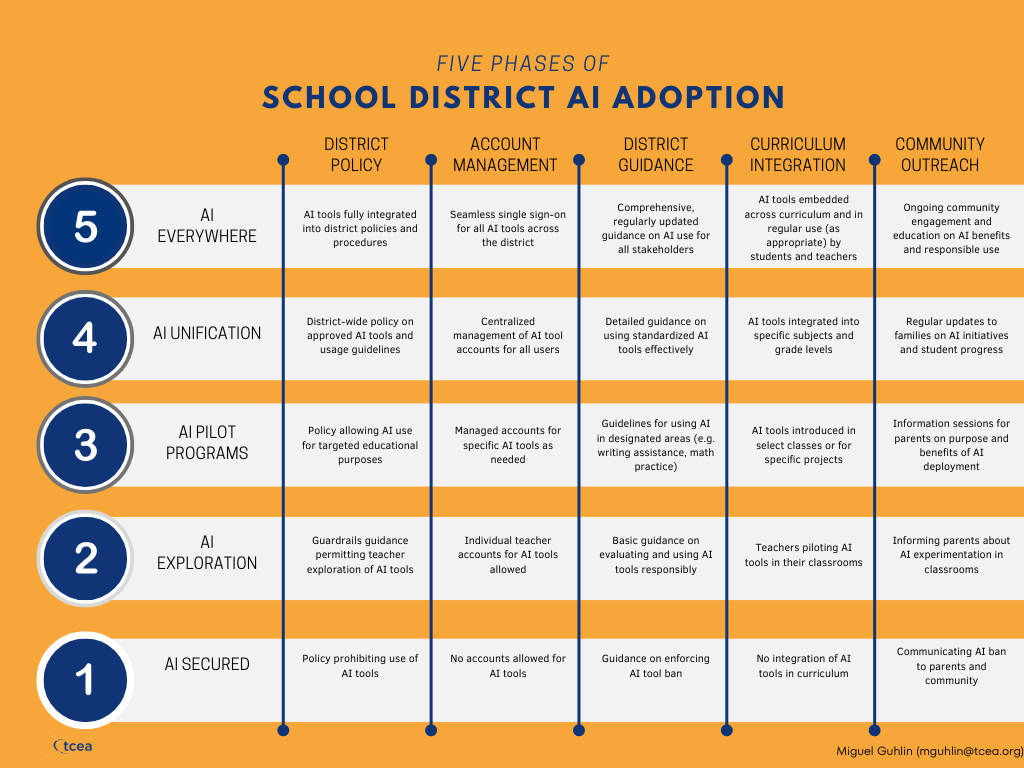
It’s important to keep several key points in mind, especially since AI adoption in schools will take time. There are no shortcuts, but you can track your school or District’s progress using the Five Phases of District AI Adoption. Those phases include:
- AI Secured. At this phase, AI usage is prohibited or discouraged.
- AI Exploration. In this phase, guardrails are available that allow exploration of free versions of digital tools.
- AI Pilot Programs. Managed AI tools are introduced for specific purposes.
- AI Unification. A clear district-wide approach to centralized AI use is in place and it is integrated into key areas.
- AI Everywhere. AI is fully integrated into school district policies, procedures, curriculum, and guidance is available to all.
These descriptions briefly touch on the points raises in the infographic above. Let’s take a closer look at each of the categories that define each phase.
Categories
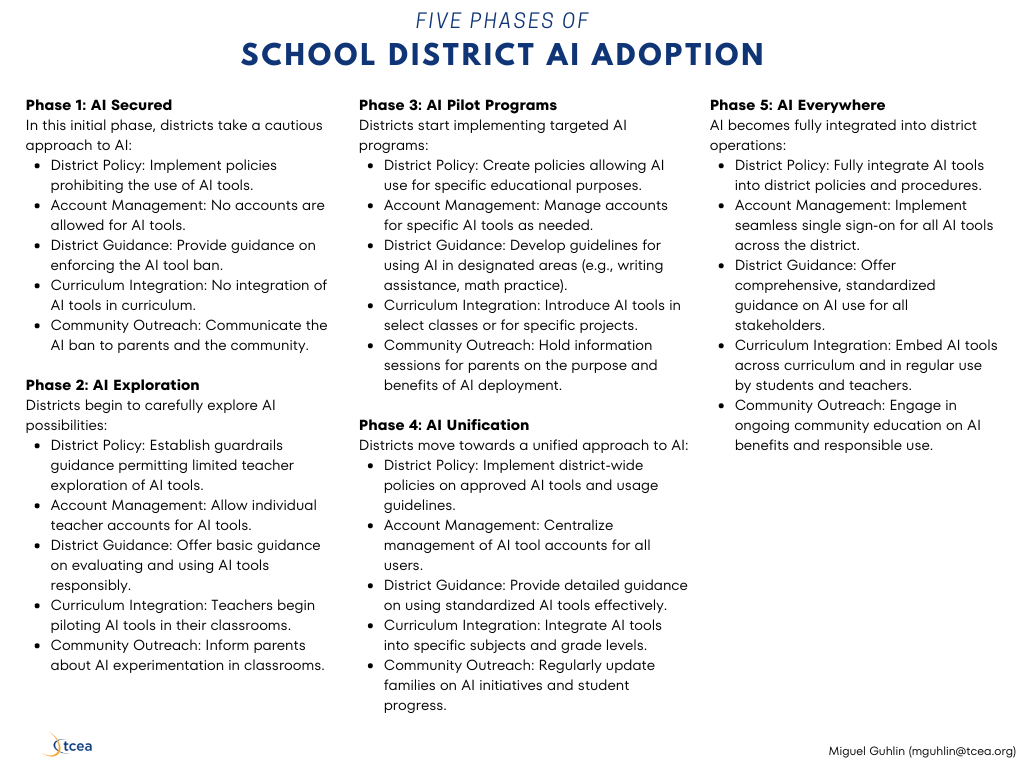
There are also categories that define each phase, including:
- District Policy. Policy moves from outright securing of AI tools to full integration and acceptance.
- Account Management. This area determines central account management, moving from no accounts allowed to integration into single-sign-on (SSO).
- District Guidance. The District has put together documents providing specific guidance on the use and evaluation of AI tools for a variety of purposes.
- Curriculum Integration. AI usage in the classroom ranges from non-usage to teacher and student use.
- Community Outreach. Shifts from focusing on fear to inviting the community to better understand what part AI plays in K-12 education.
What other areas are key to responsible AI adoption? Let’s take a look.
Data Privacy and Security
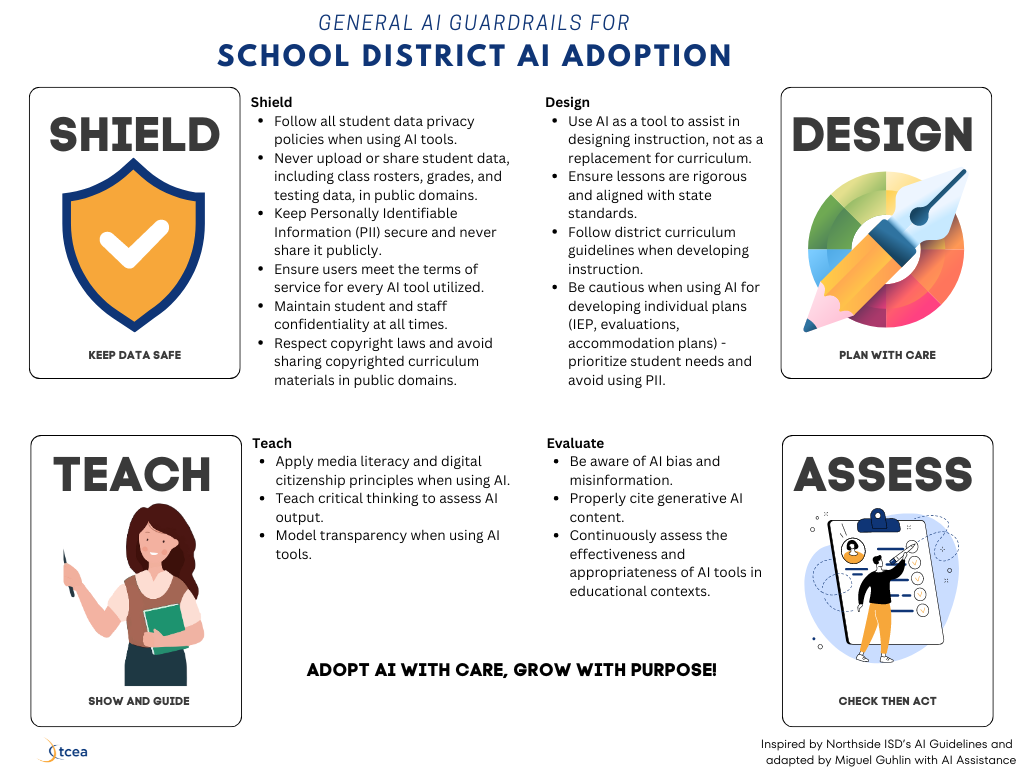
Protecting student information is paramount when using AI tools in education. Account management for students and staff, data is critical. Districts must ensure AI solutions are part of SSO. This makes it easier for staff and students to access it in approved ways. Do this to safeguard sensitive information. Another point to remember? Communicate clear suggestion on how to protect data.
Here’s a sample classroom scenario to illustrate this:
Mr. Rodriguez, a middle school math teacher, uses an AI-powered math practice app. Before implementation, he ensures all student data is anonymized and securely stored, explaining to parents how the tool enhances learning without compromising privacy.
AI as a Supplemental Tool
Responsible AI adoption seeks to enhance, not replace, curriculum and instruction. When exploring how to use AI in the classroom, knowing what guidance to give teachers and staff is critical. AI should be approached as a tool that complements our efforts at teaching and learning, not supplants it.
What this might look like in the classroom:
Dr. Lee, a biology professor, incorporates an AI-driven virtual lab simulation into her course. She emphasizes to students that this tool complements hands-on lab work, providing additional practice opportunities rather than substituting real experiments.
Critical Thinking and Media Literacy
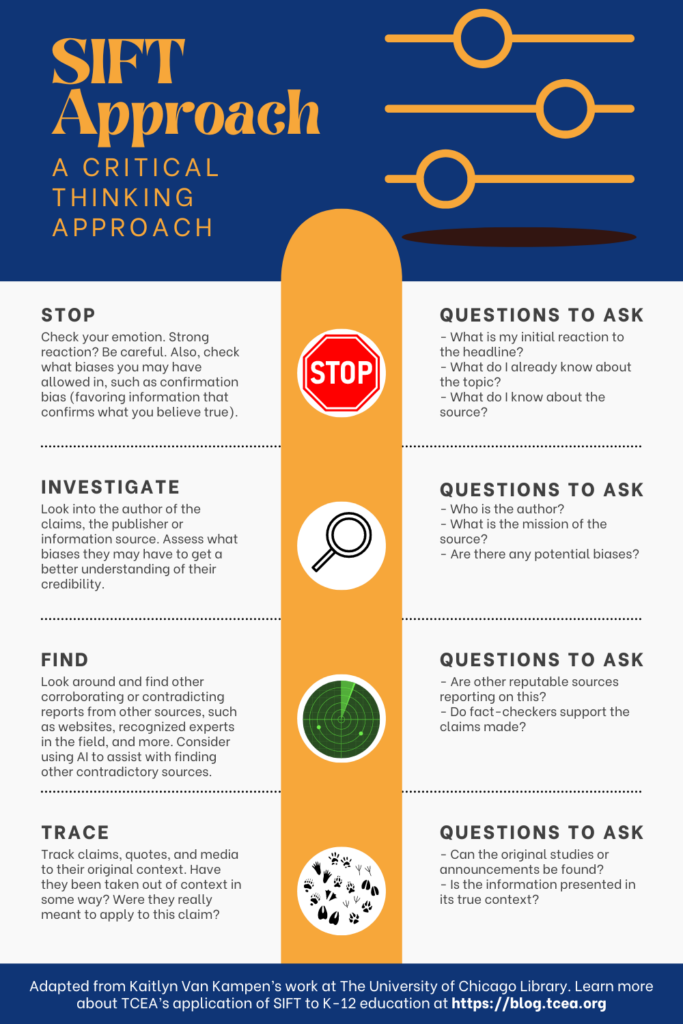
AI isn’t a panacea or perfect tool. While many know that they need to be critical, they may be unsure of how to best critique and assess AI generated content. To ensure staff and students don’t simply use and consume AI content uncritcally, all must learn to critically evaluate AI-generated content.
You can find several critical thinking approaches in the TCEA blog, as well as direct mention of The SIFT Approach.
View | Get a Copy in Canva | Get PPTx or PDF
Consider this scenario with an elementary school librarian**:**
Ms. Patel, an elementary school librarian, designs a lesson on distinguishing between human-written and AI-generated stories. She guides students through analyzing text characteristics and discussing the importance of human creativity.
TCEA Essential Learning Expectations
TCEA offers Essential Learning Expectations for students, teachers, school leaders, and instructional coaches.
The Essential Learning Expectations for AI in Education are designed to guide all stakeholders in the educational system – teachers, students, instructional coaches, and administrators – in the ethical and effective use of AI technologies. These expectations build upon existing educational research and best practices, while addressing the unique challenges and opportunities presented by AI in learning environments.
The TCEA Essential Learning Expectations (ELEs) for Artificial Intelligence (AI) in Education (View | Get a copy)
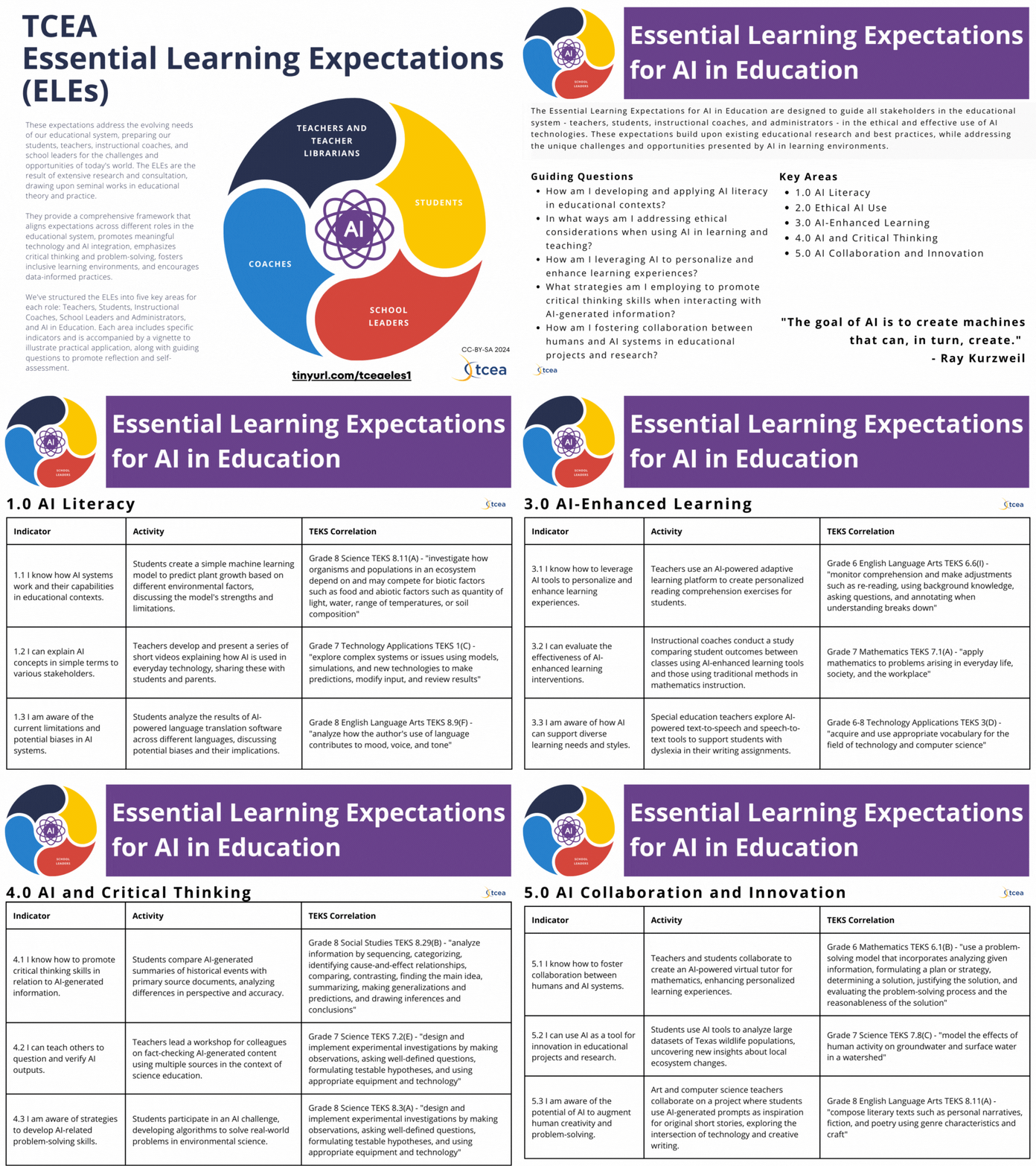
TCEA Essential Learning Expectations (ELEs) for AI in Education – Generated by Author
The TCEA ELEs for AI in Education include:
- AI Literacy
- Ethical AI Use
- AI-Enhanced Learning
- AI and Critical Thinking
- AI Collaboration and Innovation
You can explore these expectations in more details with examples in this document.
Responsible AI Adoption
By adopting a phased approach and sticking to essential guardrails, you can begin the work of using AI in teaching, learning, and leading situations. You will be able to seize the benefits of AI, while protecting students and staff. What’s more, you can use AI to have a positive impact on the work you are about in K-12 education.