
One of the things I’ve come to appreciate in my work at TCEA? Working side by side with Peggy Reimers, who loves these kinds of activities and introduced me to a few. That’s why, when I saw a Facebook post from a science teacher asking about hidden cups challenge, I found myself wondering, “Why can’t we have a website that aggregates all these great ways to engage students into one online space?” That’s how the Say It, Make It STEAM educator resource came to be.
A Quick Reminder: Allow me to point out that these STEAM challenges are available in SEVEN different languages, including English, Spanish, Vietnamese, Chinese, Arabic, Hindi, and Urdu. This is incredible. They are also aligned to the Texas Essential Knowledge and Skills (TEKS) and the Next Generation Science Standards (NGSS). Finally, efforts have been made to make it A11Y friendly.
Introducing Barrier Type Activities
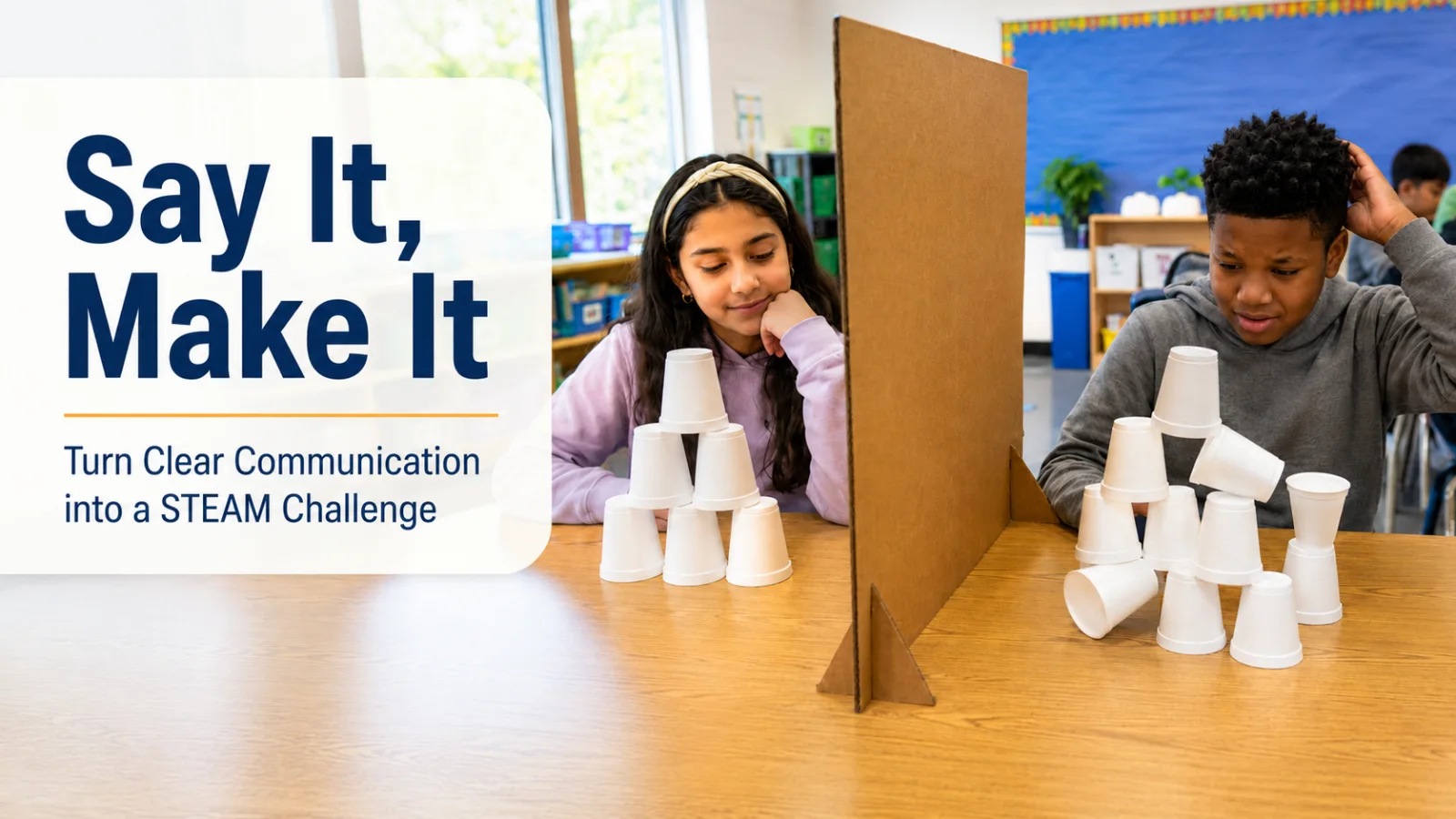
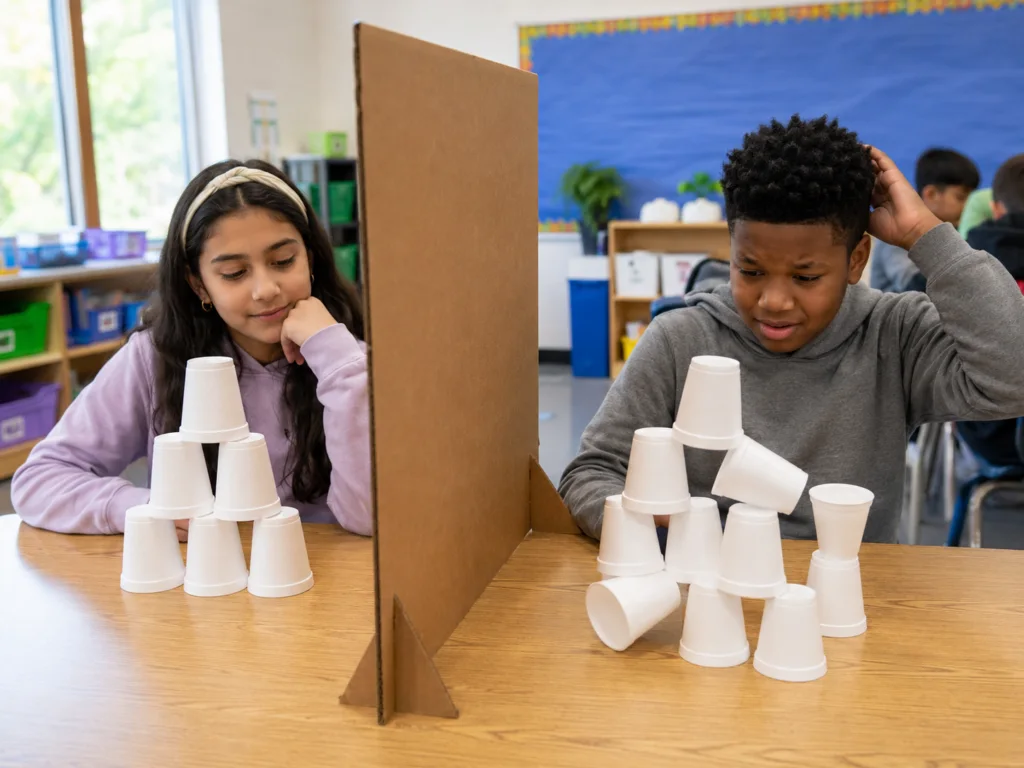
A cardboard screen divides two students. On one side, a student studies a small tower built from plastic cups. On the other, a partner waits with an identical pile of cups and no idea what the finished structure should look like.
“Put one cup above the other one” sounds perfectly clear until the cups end up sideways, three inches apart, and balanced in a way that concerns everyone nearby. I always have the most trouble with these kinds of activities. What someone else says, I find it hard to make. It’s a fun way to learn about following directions.
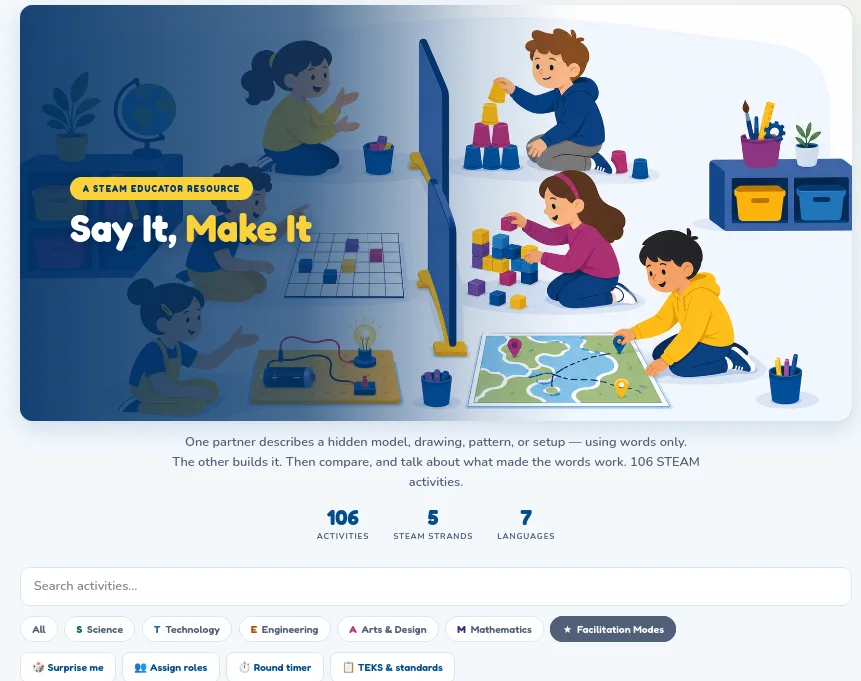
The small communication breakdown is the heart of Say It, Make It, a collection of hands-on STEAM barrier activities. One student describes a hidden model, drawing, pattern, map, or setup. A partner attempts to recreate it using only those directions. Then they compare the results and discuss which words helped, which caused confusion, and what they would change next time.

Choose from 106 Challenges
The collection includes 106 activities and facilitation options across science, technology, engineering, arts and design, and mathematics. You can filter the collection by strand or search for a topic that fits your lesson. The site is also available in seven languages.
The activities range from familiar barrier games to content-specific challenges:
- Build a hidden cup structure
- Recreate a molecule model
- Program a robot through a grid
- Copy a weather map
- Reconstruct a bar graph
- Describe a polygon or fraction model
- Draw a picture while sitting back-to-back
Each activity page lists the materials, suggested grade range, student roles, skills, reflection questions, and ways to adjust the difficulty. For example, the Hidden Cup Structure activity uses two matching cup sets and a cardboard screen. Teachers can make it harder by banning questions or adding a thirty-word limit.
Change the Communication Rules
The facilitation modes may be the most useful part of the collection. Run one round without questions, then allow questions during the second. Limit students to yes-or-no questions. Require the Builder to repeat each direction before acting. Add a Messenger who must carry instructions across the room from an Architect to a Builder.
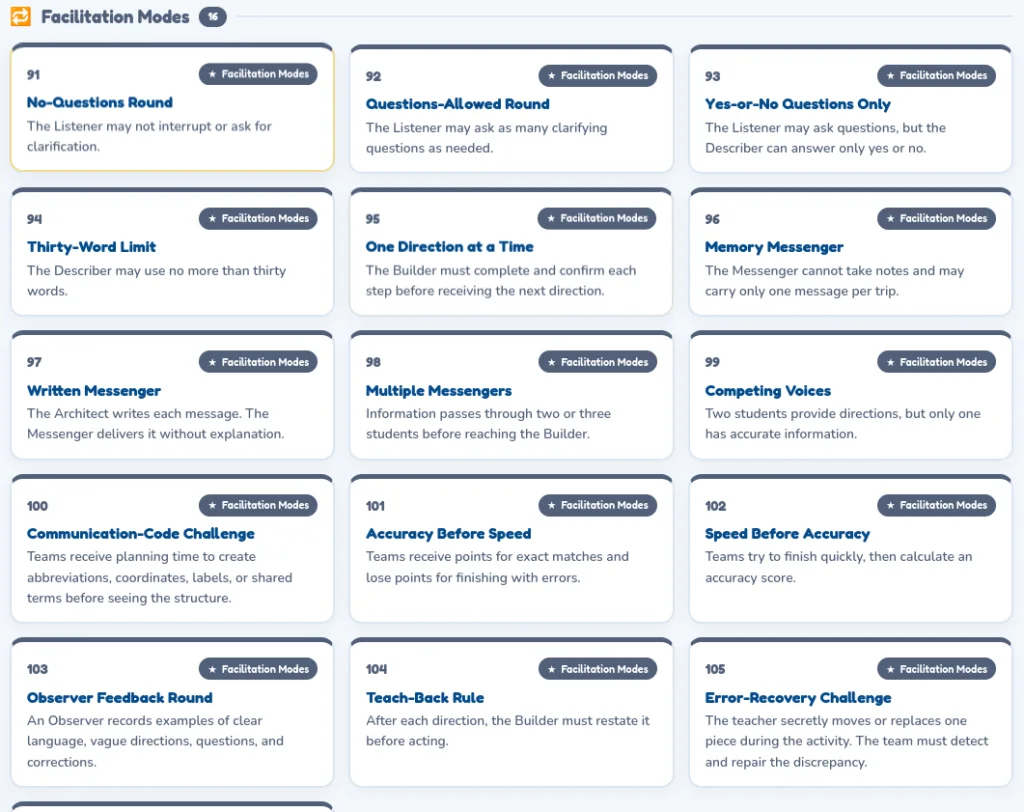
I like these variations because you can reuse one simple activity several times without repeating the same learning experience. Students begin noticing that accurate communication depends on sequence, shared vocabulary, reference points, and useful feedback.
Start with Materials You Already Have
You do not need robotics kits or specialized equipment. Cups, blocks, grid paper, pencils, index cards, classroom objects, and printed picture pieces are enough for many of the challenges.
Choose one activity, place a barrier between two partners, and let the first attempt get a little messy. The comparison and conversation afterward are where students begin turning vague directions into precise communication.
Explore the complete Say It, Make It activity collection and select a challenge for your next STEAM lesson.