

Ever wonder if your students got that lesson or not? Someone said recently, “Some new teachers entering schools today don’t know what entry or exit tickets are.” I was shocked to hear that. While it’s possible, it’s unlikely. What’s more likely is that they may not be aware of the power of the high-effect size strategy, Retrieval Practice. In this blog entry, I’ll share over 130+ entry and exit tickets aligned to the Social Studies TEKS for grades 3-11. You will have to decide if they are useful or not.
Introducing the Problem-Solving Teaching (PST) Arcade
The arcade started out as a fun activity. I had already generated a few arcade games for use as part of teaching Critical Thinking Online Breakouts (CTOBs). I wondered, “What might arcade games aligned to Social Studies TEKS look like?” These multi-lingual entry/exit tickets are a by-product of building the Problem-Based Learning and Problem-Solving Teaching (PST) units for Social Studies.
They are intended to serve as quick activities you can use with students. And, that’s the whole reason the new PST Arcade exists.
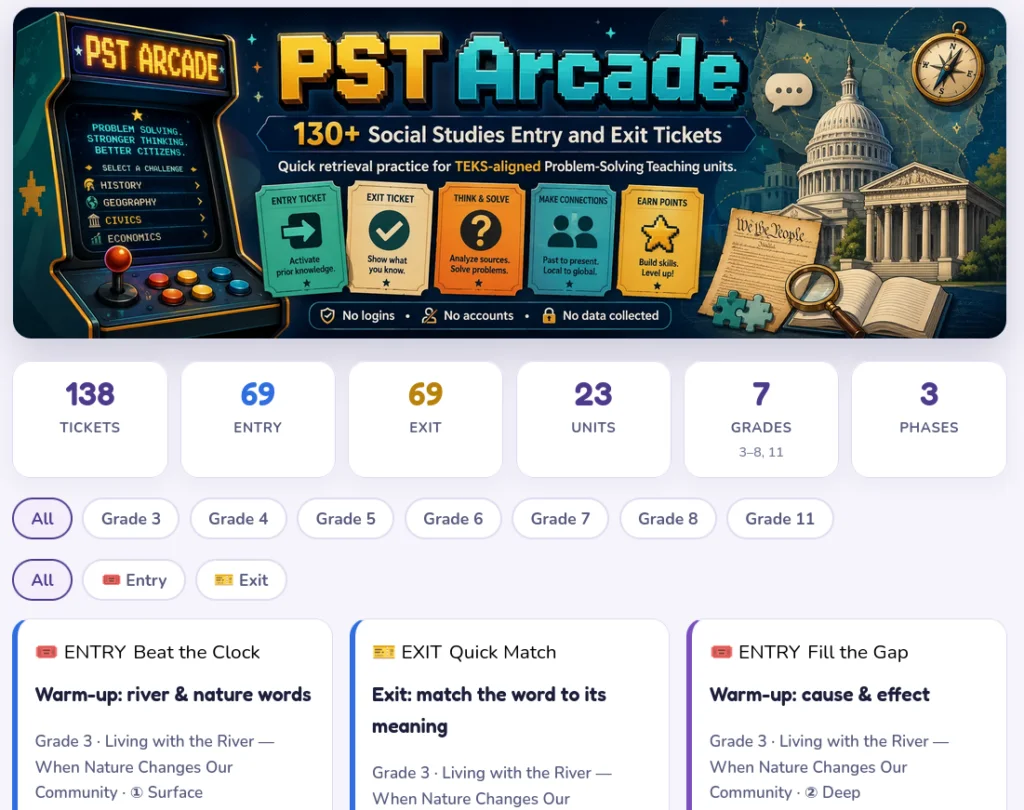
What Is PST Arcade?
PST Arcade is a collection of more than 130 quick, game-style entry and exit tickets for social studies classrooms. Each one is designed to take about one to two minutes. Students get a fast retrieval-practice check before or after a learning phase, and teachers get a simple read on what is sticking.
The tickets are tied to the larger Problem-Solving Teaching suite, which includes TEKS-aligned social studies PBL units for grades three through eight. These units ask students to work through real, messy problems as stakeholders. They do not just read about a historical moment. They step into it.
Why Entry and Exit Tickets Matter
Entry tickets help students pull prior knowledge back into working memory. That matters before students tackle a new source, question, or problem.
Exit tickets help teachers see what students understood before the next lesson begins. That matters because Problem-Solving Teaching moves in a deliberate sequence: surface, deep, and transfer. If students are still shaky at the surface level, asking them to transfer too soon can turn inquiry into guessing. I have learned to respect that sequence the hard way.
| Ticket Type | Teacher Use | Student Benefit |
|---|---|---|
| Entry ticket | Activate prior knowledge | Start with what they already know |
| Exit ticket | Check understanding | Practice retrieval before moving on |
| Phase-based ticket | Match the unit sequence | Build from surface to deep to transfer |
Built for TEKS-Aligned Social Studies Units
The TEKS-aligned Social Studies Problem-Solving Teaching units give students a problem worth thinking through: a town square decision, a Texas Revolution family dilemma, an immigration question, a shared river dispute, an oil boom challenge, or a Constitutional Convention compromise.
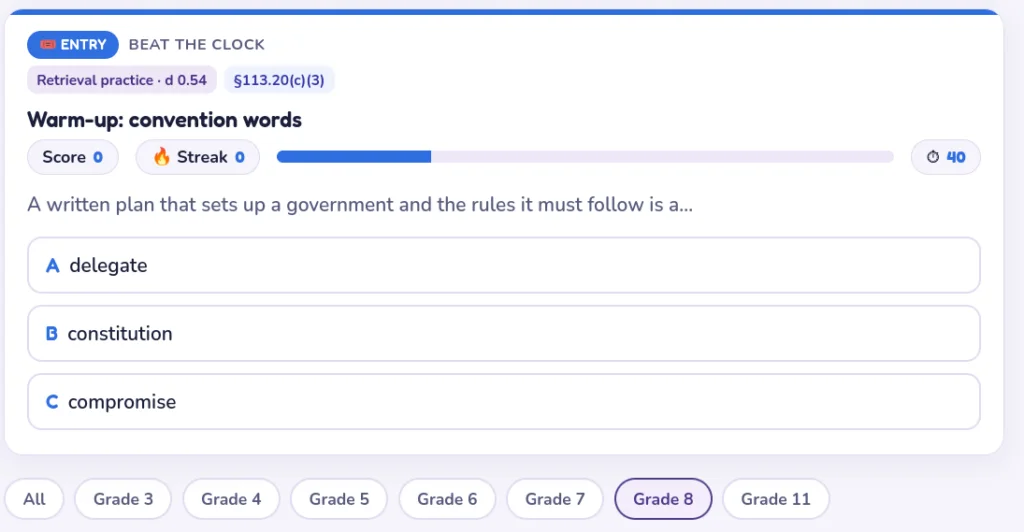
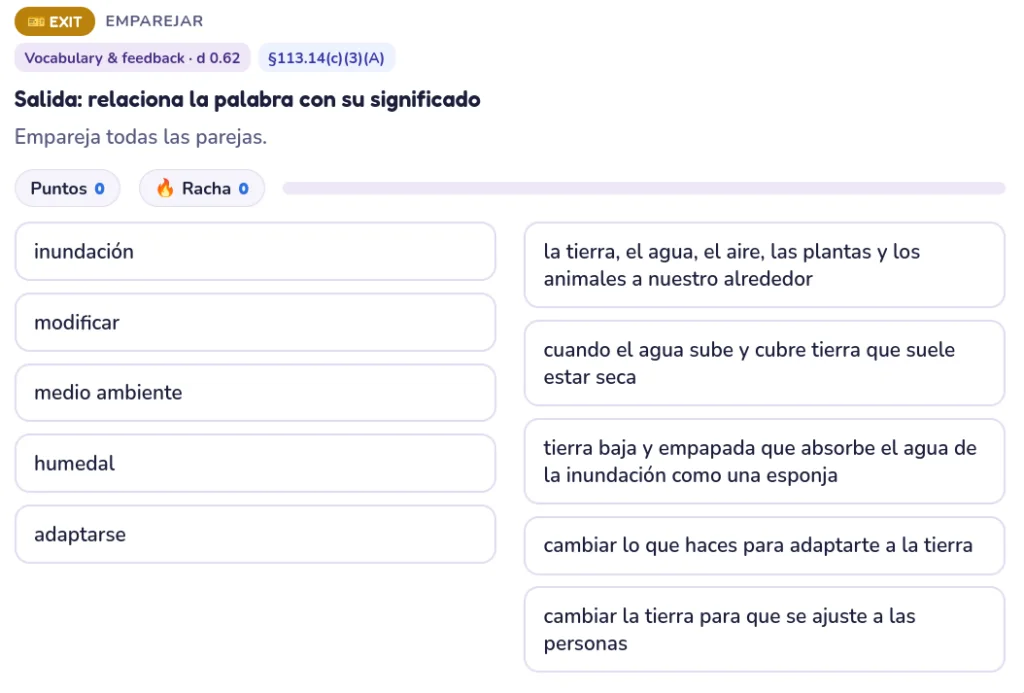
The tickets support that work by keeping the learning visible along the way. Each one connects to a unit, learning phase, TEKS alignment, and instructional strategy. That makes the arcade useful as more than a warm-up bank. It becomes a lightweight formative assessment layer for the full PST experience.
A Simple Way to Start
Start small. Pick one PST unit. Use an entry ticket before the first activity and an exit ticket after the learning phase. Watch what students miss. Then adjust.
These tickets are not meant to replace discussion, writing, source analysis, or teacher judgment. They are meant to give you a quick signal before students move deeper into the problem.
Try the PST Arcade, then connect it to a TEKS-aligned Problem-Solving Teaching unit already in the suite.