
Coaching for every learner requires moving from reactive differentiation to proactive Universal Design for Learning (UDL). By focusing on high-effect strategies like Jigsaw (0.92 effect size), you help teachers anticipate variability and remove learning barriers before instruction begins. See actual coaching scenarios are handled with one of three protocols. You also get access to a free tool I designed for your use, the Coaching UDL (CUDL) tool.
Note: This blog entry is based on my TCEA 2026 Convention and Exposition presentation, Coaching for Every Learner*.*
The Gap Between Belief and Reality
You’ve been there. You stand in a professional development session and nod your head because you believe, deep down, that every student deserves access to rigorous learning. Then you walk into a classroom and see a different reality. You see teachers struggling to keep up with 30 students who don’t fit the mythical “average.” That average is what many plan for, but that can be problematic.
In fact, Zaretta Hammond warns about the trap of magical thinking. This is the dangerous belief that if a teacher simply follows the steps of a strategy with fidelity, learning automatically happens. All have to remember that compliance is not engagement. Your job as an instructional coach is to assist teachers in looking past the quiet, orderly room and see the actual cognitive processing taking place (or not taking place). That’s why tools like the SOLO Taxonomy are so helpful, as opposed to tools like Bloom’s Taxonomy.
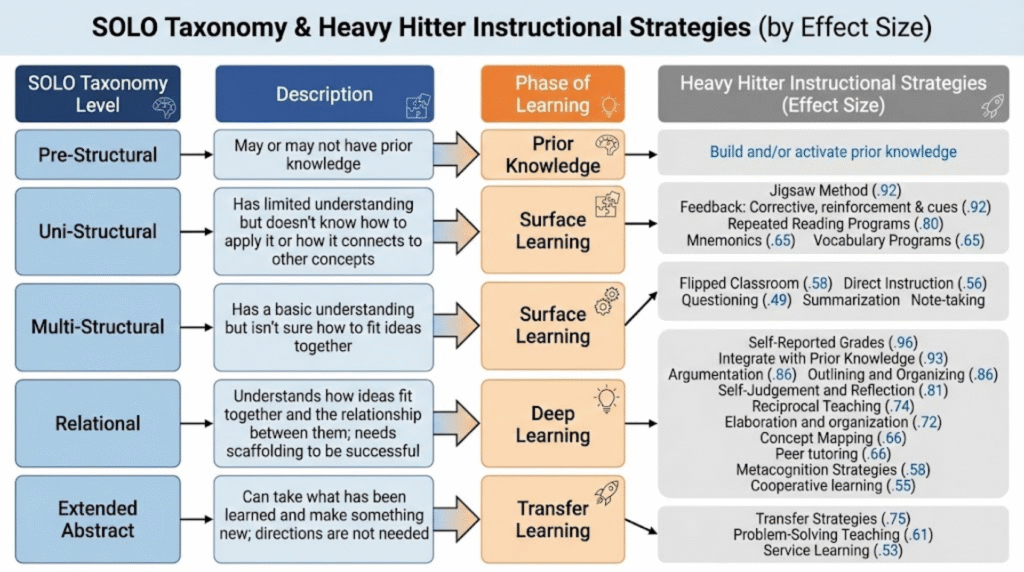
How the SOLO Taxonomy levels correspond to phases of learning, and heavy hitter instructional strategies.
As Hammond puts it: “Only the learner learns.” You can’t do the learning for them. But you can design an environment where learning becomes possible for everyone.
Reframe the Problem: UDL is Architecture
Work in a classroom where class size limits have been waived, and you are aware of the uncomfortable reality. It is impossible to differentiate for 30 unique humans if you’re designing for the “average.” The average student is a statistical myth, a point on a bell curve that represents no one in your actual classroom.
When you coach, you must first validate the stress teachers feel. Then pivot the conversation from coaching to fix the child to coaching to fix the barrier.
Consider the difference:
- Reactive approach: Building a ramp after the building is finished because someone in a wheelchair showed up.
- Proactive approach: Designing a building with an accessible entrance from day one.
UDL is the architecture of the lesson. It means anticipating that some students will need audio, some will need visuals, and some will need movement. This is true, even before you even start teaching. Keep this in mind:
Firm goals, flexible means.
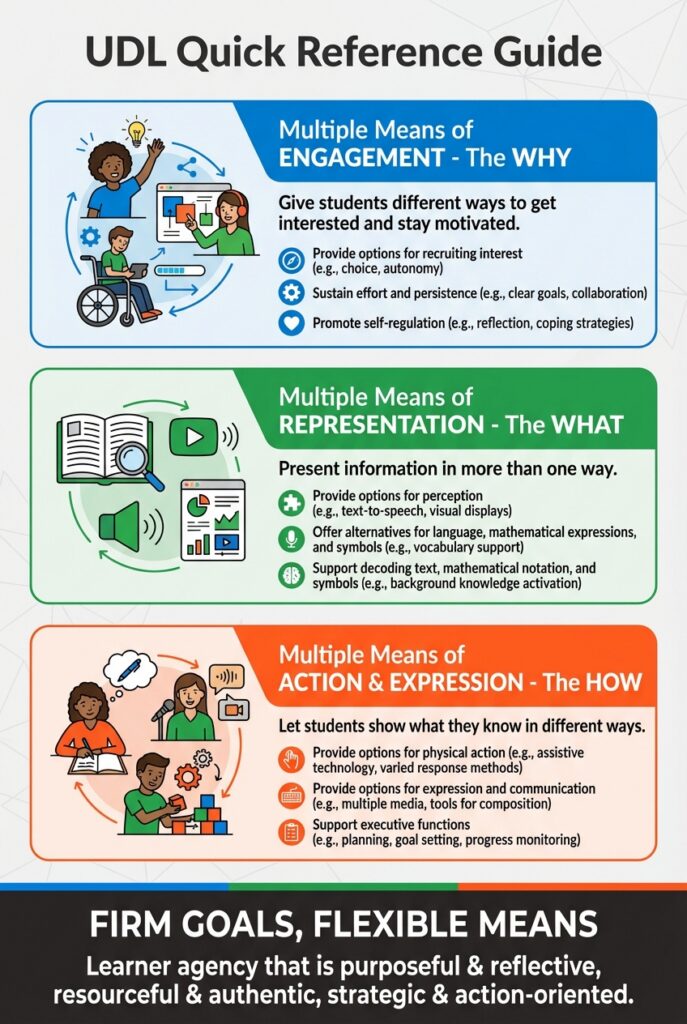
The standard stays the same (everyone analyzes the theme of betrayal). The method is flexible (essay, podcast, debate, or graphic novel).
The Research: High-Effect Equity Strategies
Not all strategies are created equal. Here’s what the Visible Learning research tells you about impact:
| Strategy | Effect Size | Learning Impact |
|---|---|---|
| Jigsaw Method | 0.92 | Considerably accelerates learning |
| Reciprocal Teaching | 0.74 | Students own the learning process |
| Transfer Strategies | 0.75 | Applying learning to novel situations |
| Differentiation | 0.58 | Effective, but often reactive |
The threshold for “accelerating” learning is 0.40. Notice that Jigsaw doubles that. Compare it to differentiation:
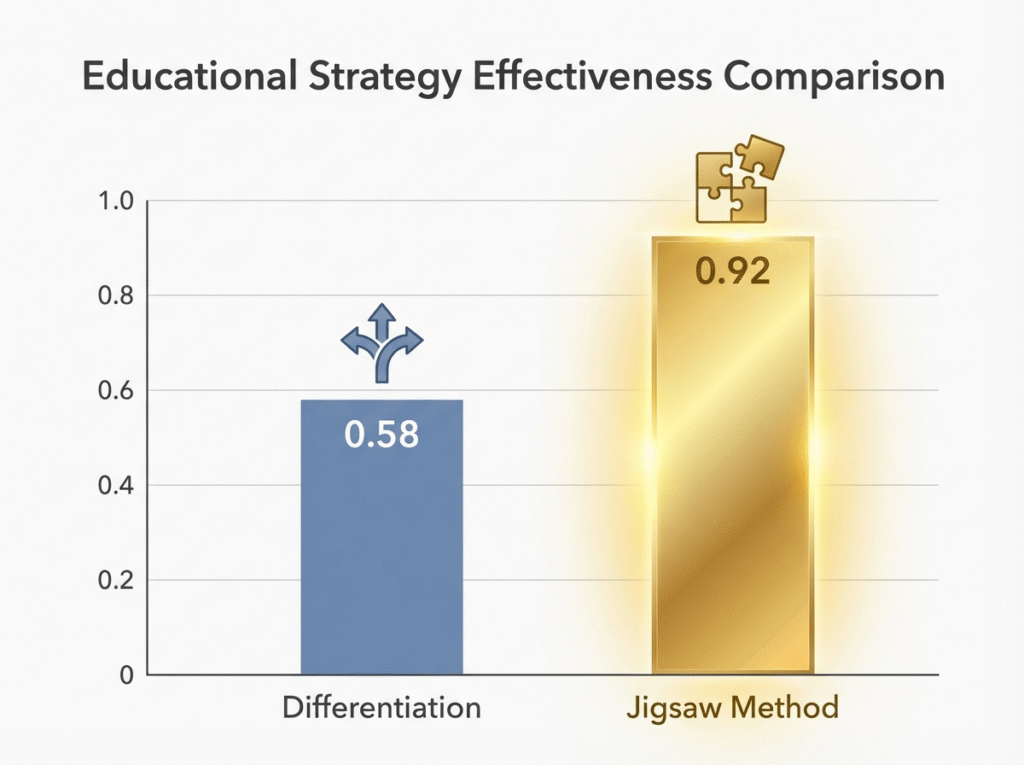
Strategy Spotlight: The Power of Jigsaw (0.92)
The Jigsaw Method outperform teacher-led differentiation because it creates interdependence. In a lecture, a student can hide. In a Jigsaw, every student holds a piece of the puzzle. If one student doesn’t teach their piece, the group fails. This makes every student valuable, not only those who are the high achieving students.
The Jigsaw also naturally embeds UDL principles:
- Engagement: Students have a clear role and purpose.
- Representation: Content is chunked and distributed.
- Action & Expression: Students must teach, not just receive.
When you coach teachers toward Jigsaw, you’re not adding to their workload, you’re actually reducing the amount of teacher talk time while increasing student cognitive engagement.
Upgrade “Turn and Talk” to Cognitive Apprenticeship
“Unstructured ‘Turn and Talk,’ says Zaretta Hammond, “is often the weakest instructional move.” Without protocols, it can actually reinforce gaps if students lack background knowledge or feel unsafe speaking up.
Your coaching move is to help teachers upgrade unstructured talk into structured protocols, or discourse. Hammond refers to this as “Cognitive Apprenticeship.”
By Grade Band:
- Elementary (VOICE): Use sentence stems like “I think… because…” to provide training wheels for thought.
- Middle School (ARGUE): Channel natural adolescent energy into analyzing, researching, and evaluating evidence. Give them something to push against.
- High School (RHETORIC): Move students into “Transfer” learning where they synthesize multiple viewpoints to create new knowledge.
![Poster and key for the "VOICE Framework for Structured Discourse (Grades 3-5): Making Our Conversations Stronger and Meaningful". V Verify: confirm understanding or check the facts — "I heard you say…" or "Where is the evidence for that?" O Offer: clearly state your own new idea — "My idea is…" or "I propose that…" I Invite: bring others into the conversation to ensure equity — "What do you think, [Name]?" or "Can you tell me more about that?" C Challenge or Connect: link to the text or respectfully question an idea — "I see it differently because…" or "The text supports this by…" E Extend: build upon what someone else said rather than repeating it — "Adding on to your point…" or "That connects to…"](/portfolio/assets/images/8e3f083311f34ca2861569e6a27d7d77-4bfc1631d82466eb.png)
An example of structured protocol. See more examples.
Getting to Know the Protocols – ARC, N-W-N, VIVA
One of the challenges is coaching others in how to embrace UDL in a fifteen minute meeting. To assist you with that, I share the following protocols along with a variety of scenarios:
One approach is use the ARC Protocol. That involves:
- Acknowledge the teacher’s reality.
- Reframe the problem from student-deficit to design-deficit.
- Commit to one small, high-leverage shift.
The ARC Protocol is intended to keep the conversation moving forward without dismissing the teacher’s feelings. Other protocols include Notice-Wonder-Next and VIVA. To assist you, give this a spin:
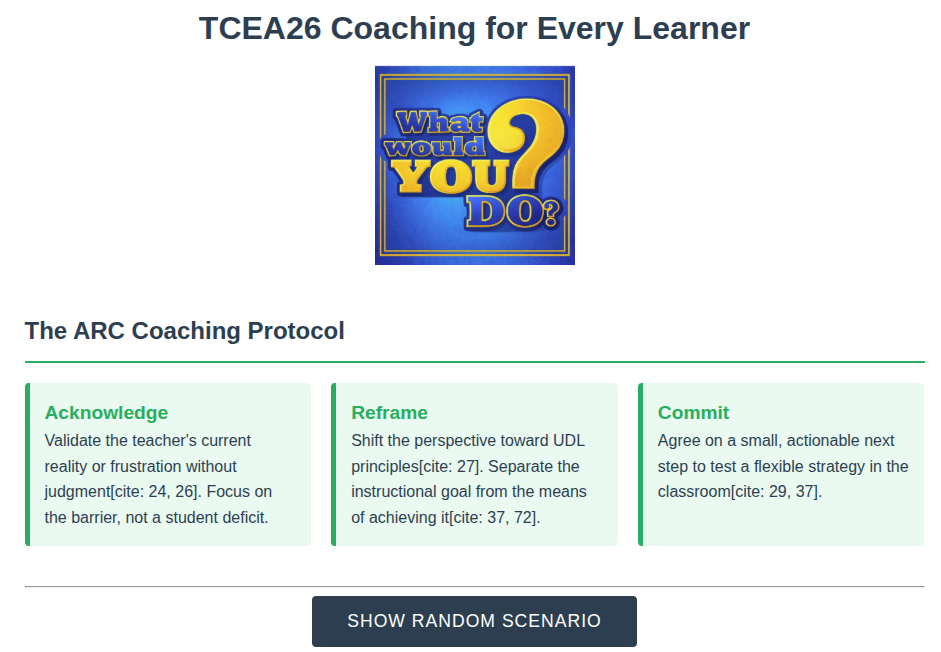
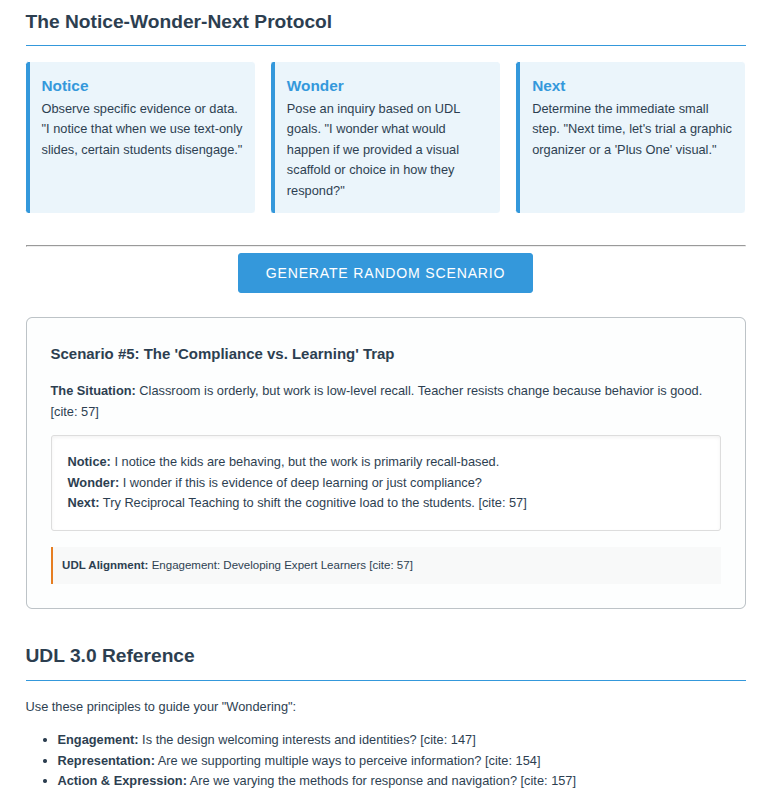
You will see a “SHOW RANDOM SCENARIO” button. Press the button to get a coaching scenario with guide for each protocol you have chosen. You can see the Notice-Wonder-Next protocol with a scenario below:
Your Next Step
Identify one design barrier in your building this week. Look for a lesson where every student must demonstrate understanding in exactly the same way. Then use one of the protocols, perhaps the Notice-Wonder-Next protocol, to discuss it with a colleague:
- Notice: “I noticed every student had to write a 5-paragraph essay.”
- Wonder: “I wonder if some students know the content but struggle with written expression.”
- Next: “What if we offered a podcast or debate option for the next unit?”
Change one thing, then watch what happens when you remove the barrier instead of trying to fix the student.