
“Math is my worst subject,” I often thought growing up. Never was this fact more evident than when my teacher presented me with a word problem. My mother, a veteran middle school math teacher, worked math problems and read Algebra textbooks the way I do books on writing. But the calculus of word problems continued to escape me even into college.
It’s no surprise that word problems intimidate. Having a framework to build problem-solving mastery may make the difference for students like me. I often wished for a simple approach to solving math problems, but my mother, who taught math for many years successfully, never gave me one approach or model. I always wonder, if we offered students one model or approach to use consistently, would that would work? Perhaps like George Polya’s approach or the STRIDE Model, which I will focus on in this blog.
The STRIDE Model
The STRIDE Model (Scan, Think, Reflect, Identify, Do, Evaluate) equips learners with systematic steps. It facilitates breaking down problems into steps. The Model aligns itself to schema-based instruction, and critical thinking. Let’s explore how to integrate STRIDE into classrooms with grade-specific activities, templates, and actionable infographics.
Let me know what you think, non-math experts and fellow bewildered word problem-solvers. Does STRIDE work for you?
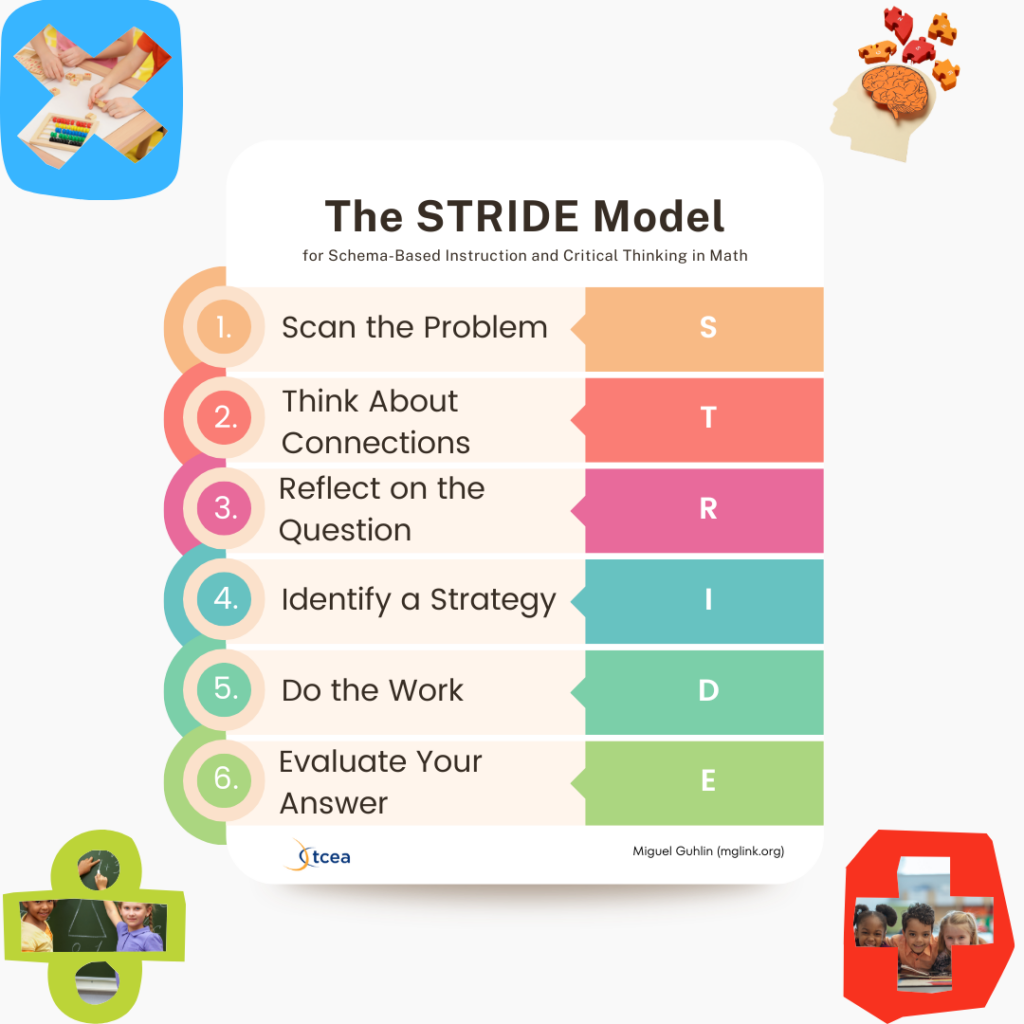
Image created by author
An Example Solution: The STRIDE Framework
Let’s explore what this might look like below. If you’re a math teacher, I hope you’ll double-check the math and share your thoughts in the comments. Be kind, I’m not a math person and I totally relied on AI for support.
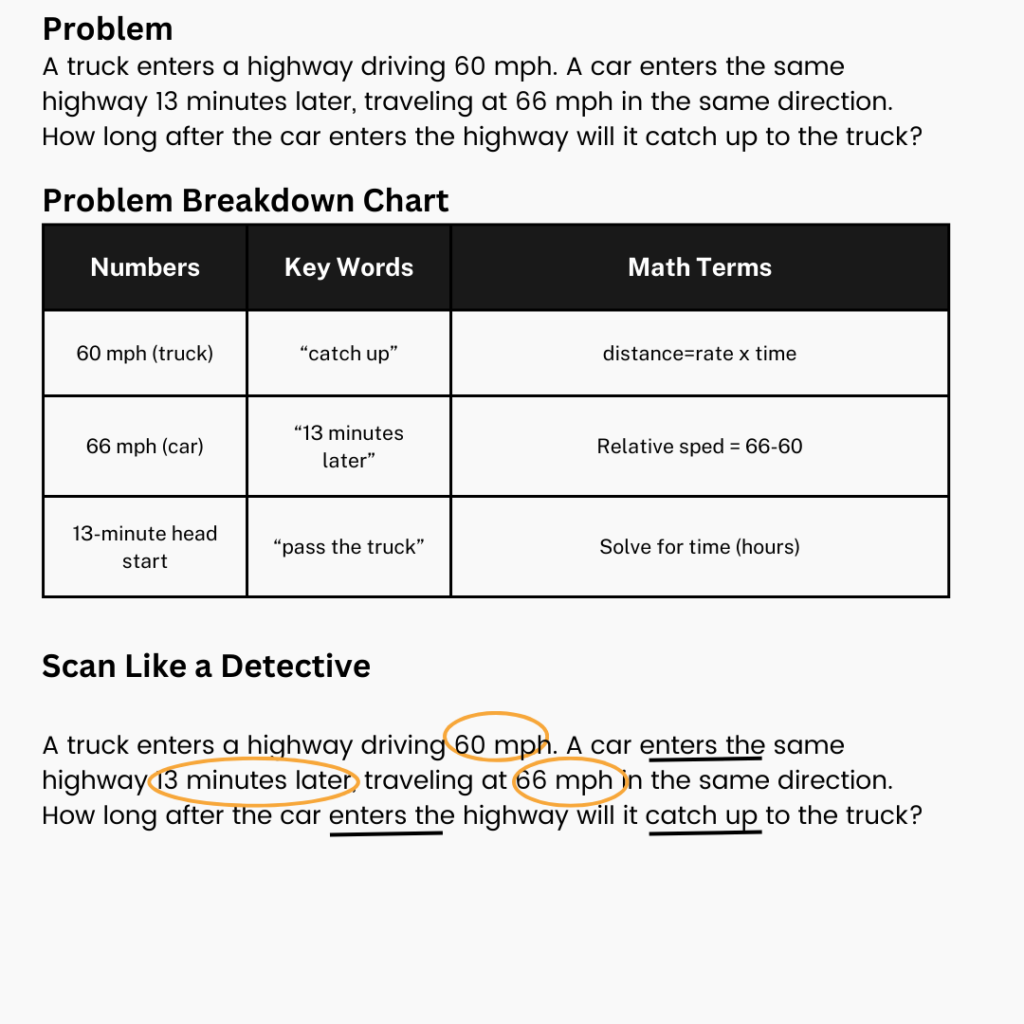
Image created by author
1. Scan the Problem
- Numbers:
- Truck speed = 60 mph,
- Car speed = 66 mph,
- Head start = 13 minutes.
- Key Words: “13 minutes later,” “pass the truck.”
2. Think About Connections
- Relate to real-life highway overtaking.
- Visualize the truck’s head start as a distance gap.
3. Reflect on the Question
- Rephrase: “How long will the car take to close the 13-minute distance gap created by the truck?”
4. Identify a Strategy
Calculate the truck’s head start distance:
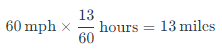
Determine the car’s relative speed:
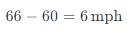
5. Do the Work
Time to catch up:

6. Evaluate Your Answer
Verify both of these items:
a) Truck’s distance after 2.17 hours:

b) Car’s distance:

Digital Templates
Below, you will find a chart that clarifies each stage of the STRIDE strategy, along with some sample ideas for activities. You can find a Canva template link to the STRIDE Model here.
| Strategy | Activities | Focus |
|---|---|---|
| Scan the Problem | Problem dissection worksheets; keyword highlighting in multi-step problems | Circle numbers, underline keywords |
| Think About Connections | Drawing diagrams; writing real-life scenarios to contextualize problems | Real-life connections, diagrams |
| Reflect on the Question | Rephrasing exercises (individual worksheets and group comparisons) | Goal identification, self-check prompts |
| Identify a Strategy | Strategy justification; challenge prediction during planning | Brainstorming, step-by-step planning |
| Do the Work | Step-by-step demonstrations (interactive whiteboards); collaborative solving | Showing work, explaining logic |
Give it a go! Try students out on the STRIDE Model, a schema-based framework for solving word problems. You never know, it may assist them as they work to solve problems.