
Dear TCEA Responds:
Does anyone have a binder check rubric they would be willing to share? I’m looking to implement weekly binder checks this year. For reference, we use OpenSciEd curriculum.
Thank you,
-Binder-Bound in Boerne
Dear Binder-Bound:
Seeing my daughter come with a huge binder from time to time, all her science classwork in the binder, I was always impressed with the amount of work generated. As a writing teacher, I also depended on folders and binders to track student work. Some teachers use all sorts of approaches for the best ways to do check those binders. Those ways can include:
- scavenger-hunt quizzes where students check their own notebooks,
- per-page checklists graded during test time,
- quarterly binder tests tied to bonus points.
And, all of those work for someone. What some of them may lack is a shared rubric that makes expectations visible to students before the check, not just a grade handed back after. To fill the gap, in case you do not already have a rubric, please find five rubrics below.
The first three are tuned to OpenSciEd. The last two aren’t tied to any curriculum. The last two should work whether your students carry a three-ring binder, a composition notebook, or a folder system. Each rubric below also carries a Texas science TEKS alignment note, since a binder check is a defensible place to document process standards you rarely get to grade directly.
First, a Word About OpenSciEd
OpenSciEd isn’t a worksheet-packet curriculum. This means a generic “did they do the homework” check may miss what matters. The signature artifact is the Progress Tracker, a recurring chart where students log the driving question, cite evidence from investigations, and describe what they figured out after each lesson. Units are built on phenomena and follow storyline routines, so the notebook shows thinking over time, not just completed tasks.
One important caution from OpenSciEd’s own guidance:
The Progress Tracker is meant as a thinking and self-assessment tool. Avoid using it for a summative grade beyond completion. The point is to keep students free to record half-formed ideas without worrying about being marked wrong. Rubrics below are intended to grade tracker completion, not tracker correctness. Reserve the real scoring of understanding for the initial models, revised models, and investigation entries.
Weekly checks are a lot of grading if you collect notebooks. Most of the rubrics below are built so you never carry a stack home. Nobody wants to spend a Friday hauling thirty comp books to the car, then hauling the same thirty back Monday still ungraded.
Rubric 1: The 60-Second Weekly Check (Self-Verified)
Consider this rubric when you don’t want to collect notebooks. Students keep their own notebooks open while you circulate.
Total: ten points.
| Criterion | 4 — Consistent | 2 — Developing | 0 — Not Yet |
|---|---|---|---|
| Completeness (this week’s lessons present) | Every lesson entry and handout for the week is in place | One or two entries missing or partial | Multiple entries missing |
| Progress Tracker updated (completion only) | Driving questions and figured-out statements filled in for the week | Started but incomplete | Blank or absent |
| Findability (student locates a page on request) | Locates any page in under ten seconds; dated and titled | Slow; some pages undated | Cannot locate; no organization |
Scoring shortcut: ask two or three scavenger-hunt questions (“Turn to the sound-demo lesson. What was your prediction?”). If they find it and it’s filled in, they’ve shown all three criteria at once.
You may also want to rotate a single focus criterion each week, making it worth double, and announce it ahead of time. This may help identify students who try to cram weeks of organization into a short time period. Instead, they build a habit of maintaining their notebook over time.
TEKS alignment: This rubric documents the scientific and engineering practices process standards (the recurring “A” strand, for example 6.1(A)–8.1(A) on planning and recording), since findability and complete records are what those standards ask students to sustain.
Rubric 2: The Unit Notebook Rubric (Analytic, Thinking-Focused)
This rubric may be best relied on for a deeper grade check. Use it once per unit, focusing on reasoning over neatness. If that feels like too much, use it weekly.
Total: twenty points. Organization is capped low on purpose.
| Criterion | 4 — Proficient | 3 — Developing | 2 — Beginning | 0-1 — Insufficient |
|---|---|---|---|---|
| Progress Tracker (completion) | Present and filled in for every lesson, in student’s own words | Most entries present, some thin | Partial | Missing or blank |
| Initial and revised models | Initial model present and revised as ideas changed, changes visible | Both present, little revision | Only initial model | No models |
| Investigation and lab entries | Data, observations, and reasoning recorded for each investigation | Most present | Sparse | Missing |
| Sensemaking in own words | Explanations show personal understanding, not transcription | Mixed | Mostly copied | Absent |
| Organization and completeness | Dated, titled, sequential, all handouts present | Minor gaps | Disorganized | Chaotic |
The reason this may work well is that even if a notebook is color-coded and beautiful, but shows no revised thinking, misses the point of a storyline curriculum. This rubric rewards students whose model is crossed out and redrawn twice.
Yo might want to give full credit on the models line only when the initial model was actually changed as the unit progressed. A first draft never revisited signals a student who stopped thinking or didn’t find a better way to represent ideas.
TEKS alignment: The models and investigation lines map to the recurring scientific-investigation and data-analysis strands (the “B” and “C” process standards), where students analyze data and construct explanations. This is the rubric to cite when an evaluator asks where students construct and revise explanations from evidence.
Rubric 3: The Student Self-Assessment (Metacognitive, Half-Sheet)
This metacognitive, self-assessment rubric works best for building student ownership. This one fits OpenSciEd, since the Progress Tracker is designed as a self-assessment tool. You might reach for it when a class is big enough that grading everything yourself is unrealistic. If possible, students score themselves, then you spot-check and co-sign.
Total: ten points, two columns.
| Criterion | Yes (2) | Partly (1) | Not Yet (0) |
|---|---|---|---|
| I have every lesson entry for this unit | |||
| My Progress Tracker is complete and in my own words | |||
| My models show how my thinking changed | |||
| I can explain any page to my teacher right now | |||
| One thing I still have a question about is: ___ | written = 2 |
The last line isn’t scored for correctness. Rather, the focus is on whether they wrote a real question. The value in that is that it allows you to see misconceptions you can use as a warm-up prompt later.
When your score and the student’s differ by more than two points, you get an insight into who to talk to. It can help you identify who to spend time on, and how, rather than trying to grade all in the same way.
TEKS alignment: Self-assessment against a clear standard supports the metacognitive habits embedded in the process strands, and the written question line gives you evidence of students asking testable questions (the “A” strand’s questioning element).
Rubric 4: The Table-of-Contents Binder Rubric (Any Curriculum)
This rubric works best when you are trying to focus on organization. It should work with any science course. The idea is that students maintain a running table of contents and organize by category.
Total: fifteen points.
| Criterion | 3 — Strong | 2 — Adequate | 1 — Weak | 0 — Absent |
|---|---|---|---|---|
| Table of contents | Current, numbered, matches the binder | Mostly current, minor mismatches | Started but abandoned | None |
| Sections and dividers | All categories separated and labeled | Most sections present | One catch-all pile | No divisions |
| Completeness | Every assigned item filed | One or two items missing | Several missing | Mostly empty |
| Order and dating | Chronological within sections, dated | Mostly ordered | Random order | No dates |
| Condition | Pages secured, nothing loose or torn | A few loose pages | Many loose pages | Falling apart |
The table of contents approach does most of the work. If it’s accurate, spot-check three listed items. Make sure to check for blank items. You might want to grade the table of contents as its own weighted line. A student who keeps an accurate index has the organizational skill you care about, and the filing follows from it.
TEKS alignment: Recordkeeping and organization support the process-standard expectation that students maintain and organize their work across a unit. This one is curriculum-neutral, so cite it against whatever grade-level “A” strand your course sits in.
Rubric 5: The Quick-Points Roster Check (Fastest Possible)
This last rubric is intended to be simple, and easy to grade at a glance. It also may be usable as a completion grade. There are five items on a class roster and each is worth two points.
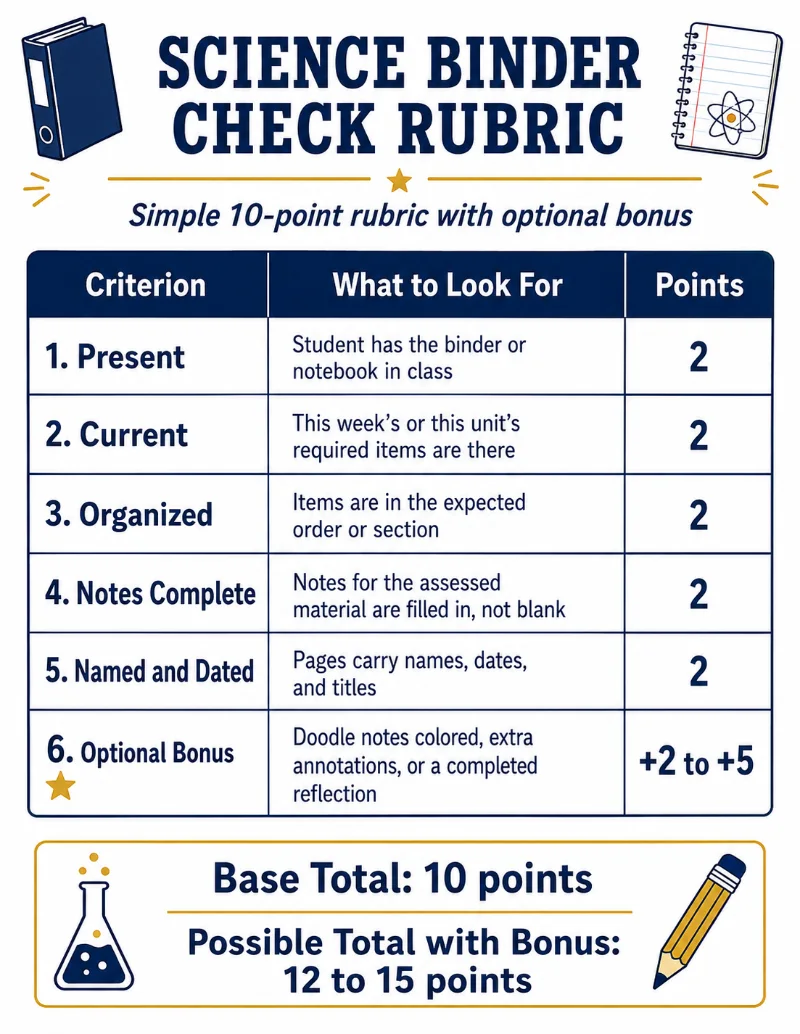
Total: ten points, optional bonus.
- Present: student has the binder or notebook in class (2)
- Current: this week’s or this unit’s required items are there (2)
- Organized: items are in the expected order or section (2)
- Notes complete: notes for the assessed material are filled in, not blank (2)
- Named and dated: pages carry names, dates, and titles (2)
- Optional bonus (+2 to +5): doodle notes colored, extra annotations, or a completed reflection
When you score using this rubric, walk the room with a roster during a quiz or bell-ringer. Glance, mark, move. You may also want to make one bonus point contingent on fixing a prior gap rather than on decoration.
TEKS alignment: As a completion-focused check, this documents the safety, materials, and recordkeeping elements of the process standards rather than content mastery. Pair it with Rubric 2 when you need evidence of actual science understanding.
Picking One
If you genuinely want weekly, use Rubric 1 or Rubric 5 and don’t collect notebooks, then supplement with Rubric 2 once per unit for a real grade. If weekly is aspirational, run Rubric 3 weekly, since students self-assess in two minutes, and save Rubric 2 for the end of the unit. If your students carry three-ring binders and organization is the habit you’re building, Rubric 4 is your anchor.
Whatever you choose, hand students the rubric on day one. The single biggest predictor of a usable binder isn’t the check. It’s whether students knew the standard before the check arrived.
By Tuesday, you could print Rubric 1 or Rubric 5, project three scavenger-hunt questions from your current unit, and score a full class period without carrying anything home. Which rubric fits your grading reality this year?