
Dear TCEA Responds:
I’m an instructional coach, and lately, I feel like I’m hitting a brick wall. Every time I suggest a high-effect size strategy or mention video coaching, I get “the look.” You know the one: the crossed arms and the “I don’t have time for this” sigh. How can I have these tough conversations without ruining my relationship with my teachers?
Thank you!
-Frustrated in Frisco
Dear Frustrated:
Thanks so much for reaching out. First, take a deep breath. Resistance isn’t a sign that you’re a bad coach. It’s a sign that your teachers are human.
In my blog entry on Coaching for Results, you learn about the “vulnerability gap.” When you ask teachers to change, you are asking them to step out of their comfort zone and into a space where they might fail. That’s terrifying, especially when their professional identity is on the line.
Did You Know?
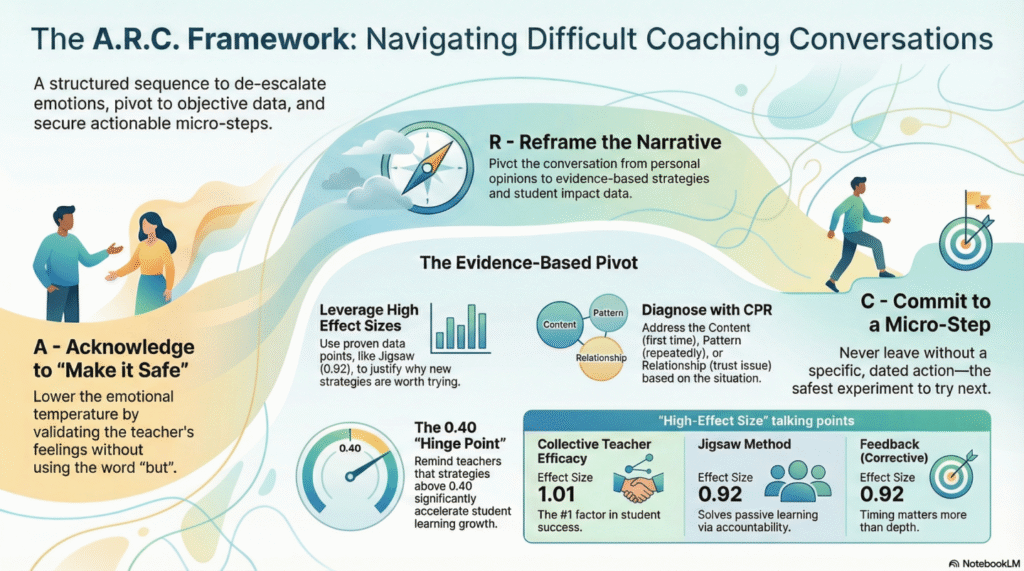
According to John Hattie’s research, the “hinge point” for instructional strategies is an effect size of 0.40. Anything above that is considered significantly impactful. But here is the catch: no strategy works if the teacher is too defensive to implement it.
The real question isn’t “What strategy should I recommend?” It’s “How do I create the psychological safety needed for that strategy to even have a chance?”
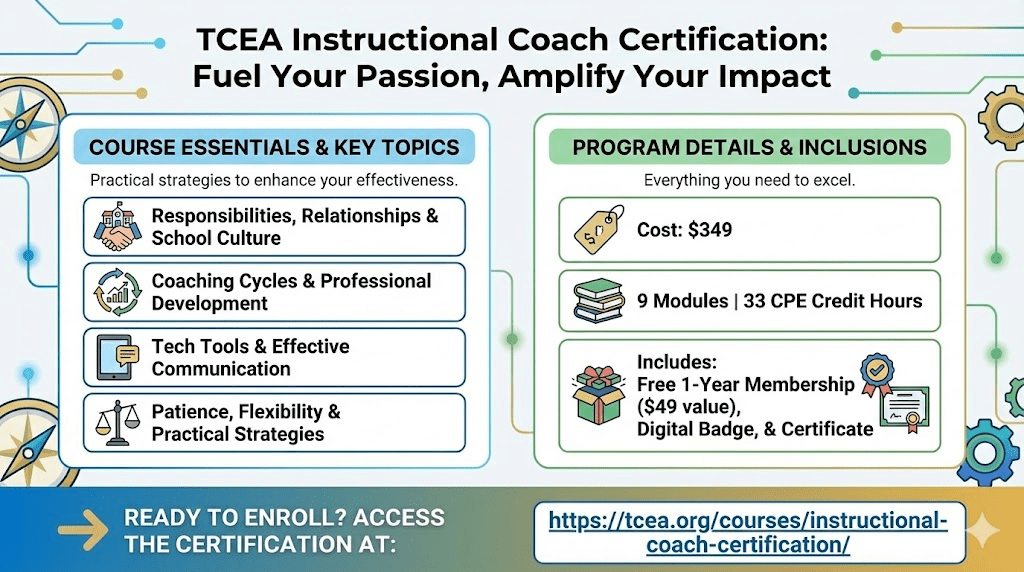
Learn more about TCEA’s Instructional Coaching Certification
The Secret Sauce: The ARC Protocol
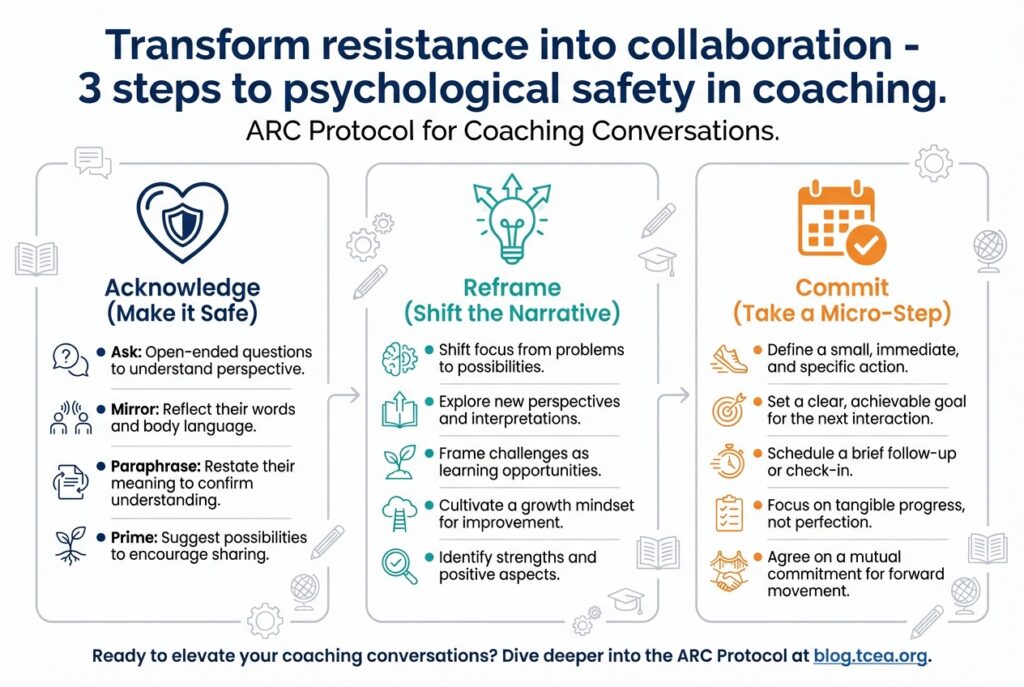
To move past the “crossed arms,” we need a communication framework that prioritizes psychological safety. That’s where the ARC Protocol comes in. It’s a three-step process designed to lower the “affective filter” and get to the work that matters.
A – Acknowledge to Make it Safe
Before you can talk about data or strategies, you must validate the person. When people feel heard, their brain’s amygdala (the “fight or flight” center) calms down.
The AMPP Technique:
- Ask — Open with questions to understand their perspective
- Mirror — Reflect their emotions back to show you’re listening
- Paraphrase — Restate their concerns in your own words to confirm understanding
- Prime — If they’re holding back, offer a guess to get the conversation flowing
What to say: “I hear how exhausted you are,” or “I understand why that feels overwhelming.”
The Goal: Build a “brave space” for dialogue. As the research in Crucial Conversations reminds us, you must lower the emotional temperature first.
R – Reframe the Narrative
Once the teacher feels safe, you shift the perspective. Most resistance comes from a “problem-centered” view. Your job is to pivot to a “growth-oriented” or “solution-focused” view.
The Pivot: Move from “This is a new burden” to “This is a tool to solve the problem you just mentioned.”
The AMPP approach is a Crucial Conversations/Confrontations concept that I’ve relied on often in my own work. Be sure to learn more about it in the book links included in this blog entry.
Example: If they hate the noise of group work, reframe Classroom Discussion (d=0.82) as a way to let students expend that energy productively on the content. Stop arguing about the teacher’s preference and start talking about student data. Connect the strategy to High-Effect Size Instructional Strategies (HESIS) so the conversation shifts from opinion to evidence.
C – Commit to a Micro-Step
This is where many coaching conversations fail: they stay too big. A “Commitment” shouldn’t be a whole new lesson plan. It should be a micro-step.
The Rule: If it takes more than 10 minutes to plan or execute, it’s too big for a first step.
The Goal: Immediate, actionable success. Don’t leave without a date on the calendar. This aligns perfectly with the TCEA EIIR coaching model (Empower & Engage, Investigate & Innovate, Implement & Improve, Reflect & Realize).
Key Idea: Focus on the “Heavy Hitters”
When you use the ARC Protocol, make sure you are leading them toward strategies that actually pay off. Don’t waste your “coaching capital” on low-effect strategies. Refer to the High-Effect Size Instructional Strategies list often. Consider how concepts from Crucial Conversations, Crucial Confrontations are helpful in this.
If you’re going to ask a teacher to take a risk, make sure it’s for a strategy like:
- Reciprocal Teaching (d=0.74)
- Jigsaw (d=0.92)
- Feedback (d=0.92)
- Video-Based Coaching (d=0.99)
- Conceptual Mapping (d=0.64)
Wrapping It Up
Coaching is 20% strategy and 80% relationship. The ARC Protocol ensures that the 80% stays intact so the 20% can actually happen.
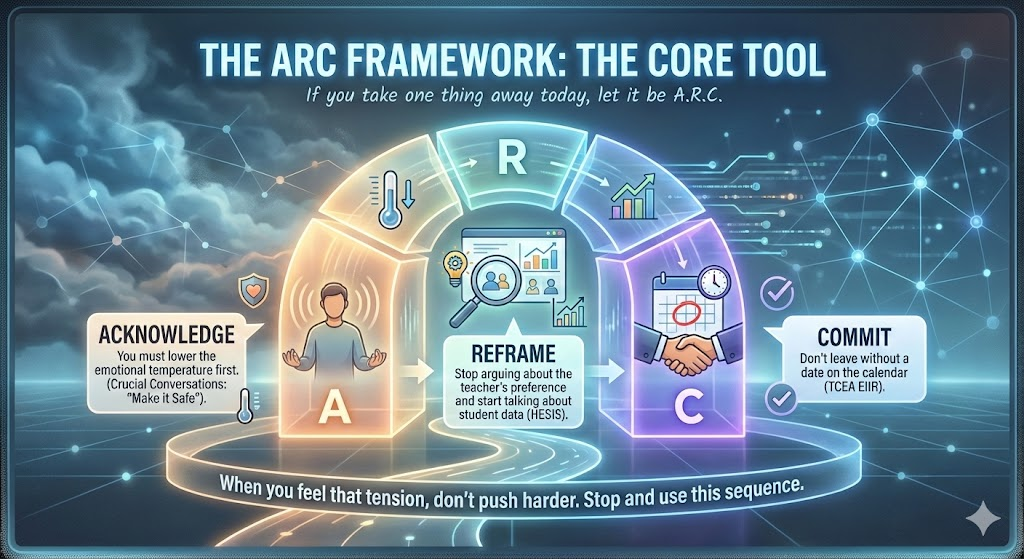
Your Next Step: What’s one conversation you’ve been putting off? Try applying the ARC steps to your planning today. Remember:
- Acknowledge: Lower the emotional temperature first (Crucial Conversations: “Make it Safe”)
- Reframe: Stop arguing about teacher preference and start talking about student data (HESIS)
- Commit: Don’t leave without a date on the calendar (TCEA EIIR)
The tangled strands of resistance can become a smooth, golden braid of collaborative growth. One conversation at a time. In the second part of this blog entry, you will see five scenarios that illustrate the ARC Protocol in action.
Make a Gen AI Connection
To take this further, consider creating a “Coaching Conversation Generator” prompt:
Using the ARC Protocol (Acknowledge with AMPP, Reframe with HESIS, Commit with micro-steps), generate a coaching conversation for the following scenario: [describe teacher resistance]. Include specific effect sizes for recommended strategies and ensure the micro-step takes less than 10 minutes to implement.
Using the ARC Protocol (Acknowledge with AMPP, Reframe with HESIS, Commit with micro-steps), generate a coaching conversation for the following scenario: [describe teacher resistance]. Include specific effect sizes for recommended strategies and ensure the micro-step takes less than 10 minutes to implement.Feel free to use this blog entry to provide context your Gen AI prompt needs to deliver relevant responses. Combine it with part two of this series (to appear soon) to get examples of desired output from your Gen AI tool of choice.