As a son, husband, and father, I am always learning about women who made a difference in the lives of others. This matters because women often get short shrift when it comes to being recognized as leaders due to who is writing the account in the history books. That’s why August 26 is a date that is worth remembering, even if it arrives just as teachers are learning names, sorting schedules, and discovering which classroom procedures need another round of practice. Adding a history observance may feel like one more plate to keep spinning. Women’s Equality Day offers a strong lesson without requiring a week-long unit or a heroic amount of coffee.
Look Beyond the Date
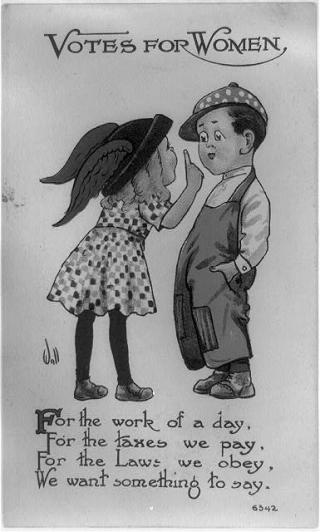
Women’s Equality Day marks the August 26, 1920, certification of the 19th Amendment. The amendment prohibited federal and state governments from denying citizens the vote because of sex. It followed decades of petitions, speeches, organizing, protests, legislative defeats, and state campaigns. The amendment was first introduced in Congress in 1878 and did not clear Congress until 1919. The National Women’s History Museum provides a short history, images, and the following video.
I would resist presenting 1920 as the moment every woman could vote freely. The amendment removed sex as a legal barrier, but other barriers remained.
Black women faced poll taxes, literacy tests, intimidation, and Jim Crow restrictions. Native American, Asian American, Latina, and territorial women encountered citizenship laws and state restrictions.
The Library of Congress describes ratification as a major victory with substantial work still ahead.
The Suffrage Sojourn Online Activity
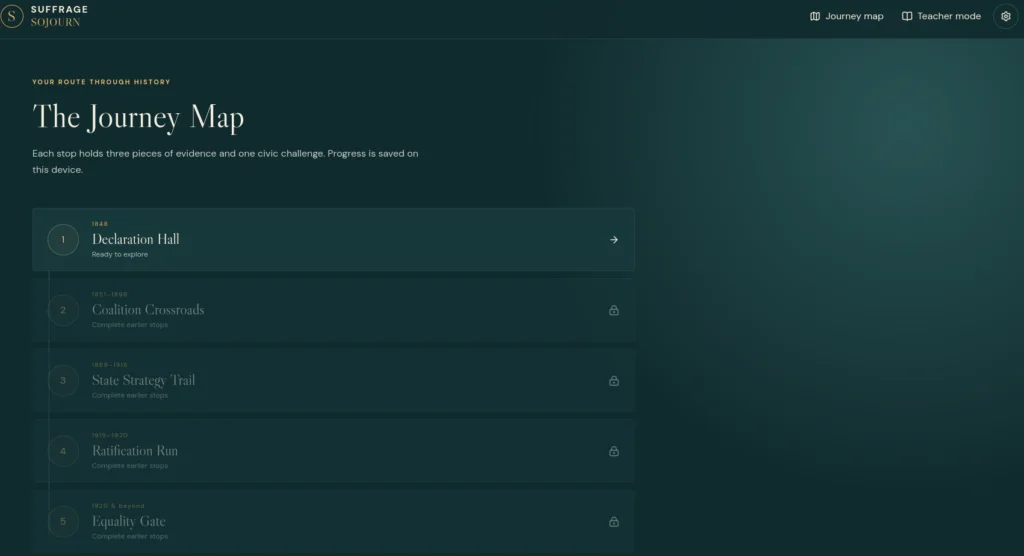
To facilitate student understanding of the Women’s Equality Day journey, explore the Suffrage Sojourn online activity. Aside from being free and usable in K-12 classrooms, it also includes:
- Five complete historical chapters and 15 evidence cards
- Available in English, Spanish, Vietnamese, and Chinese (some of the most common languages spoken in Texas public school classrooms)
- Civic challenges with explanations and consequence-free retries
- Journey map, milestones, saved progress, and finale
- Narration, reduced-motion, keyboard-friendly controls, and responsive layouts
- Teacher mode with TEKS connections, discussion prompts, and primary sources
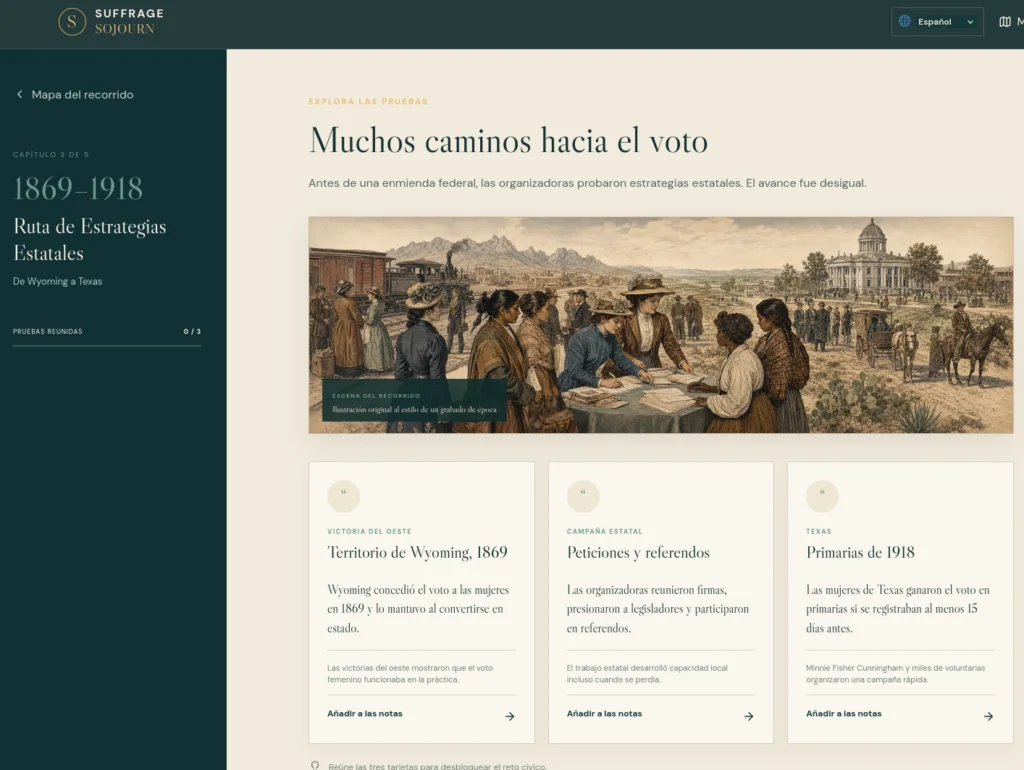
Students “collect” the evidence, adding it to their field notes, then respond to a multiple-choice question. Each area comes with a teacher mode page that offers more information and sources.
Here’s one example:
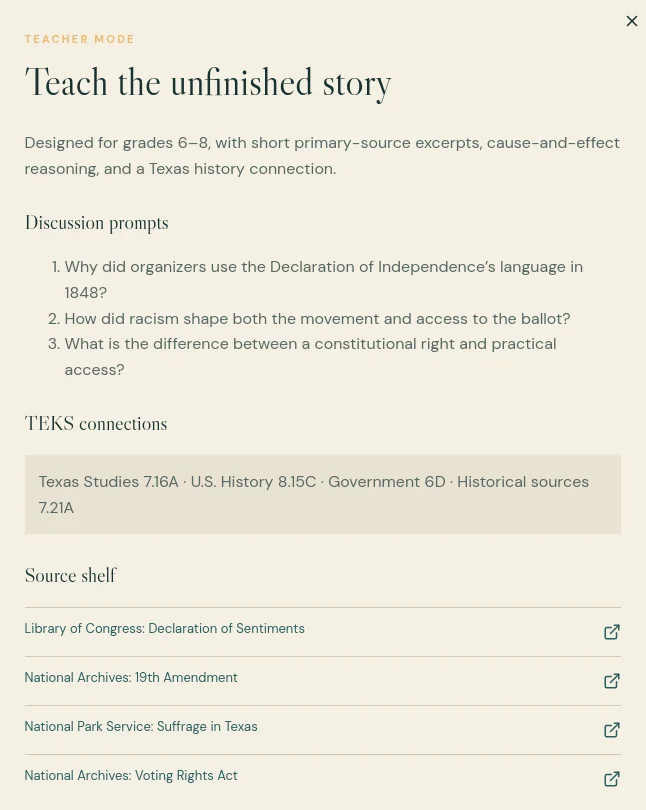
You will notice the TEKS Connections in the Teacher Mode page. Let’s take a closer look at those connections.
Make the TEKS Connection
Women’s Equality Day fits naturally into several Texas social studies standards. Here’s how those line up to moves you can make in the classroom.
| Grade or course | TEKS connection | Classroom move |
|---|---|---|
| Grade 2 | Voting as group decision-making, §113.13(c)(11)(C) | Hold a class vote and discuss who gets a voice |
| Grade 5 | Susan B. Anthony and contributions to women’s rights, §113.16(c)(5)(C) | Build a visual suffrage timeline |
| Grade 7 Texas History | Women’s suffrage and equal-rights movements, §113.19(c)(7)(C-D) | Investigate Jane McCallum and Texas primary voting |
| U.S. History | Civil rights development through the 19th Amendment, §113.41(c)(9)(A-D) | Compare the amendment’s promise with voting barriers |
Texas offers a compelling local connection. In 1918, state lawmakers allowed women to vote in primary elections. More than 386,000 Texas women registered before that year’s election. Texas then became the ninth state to ratify the 19th Amendment in June 1919. Texas Historical Commission
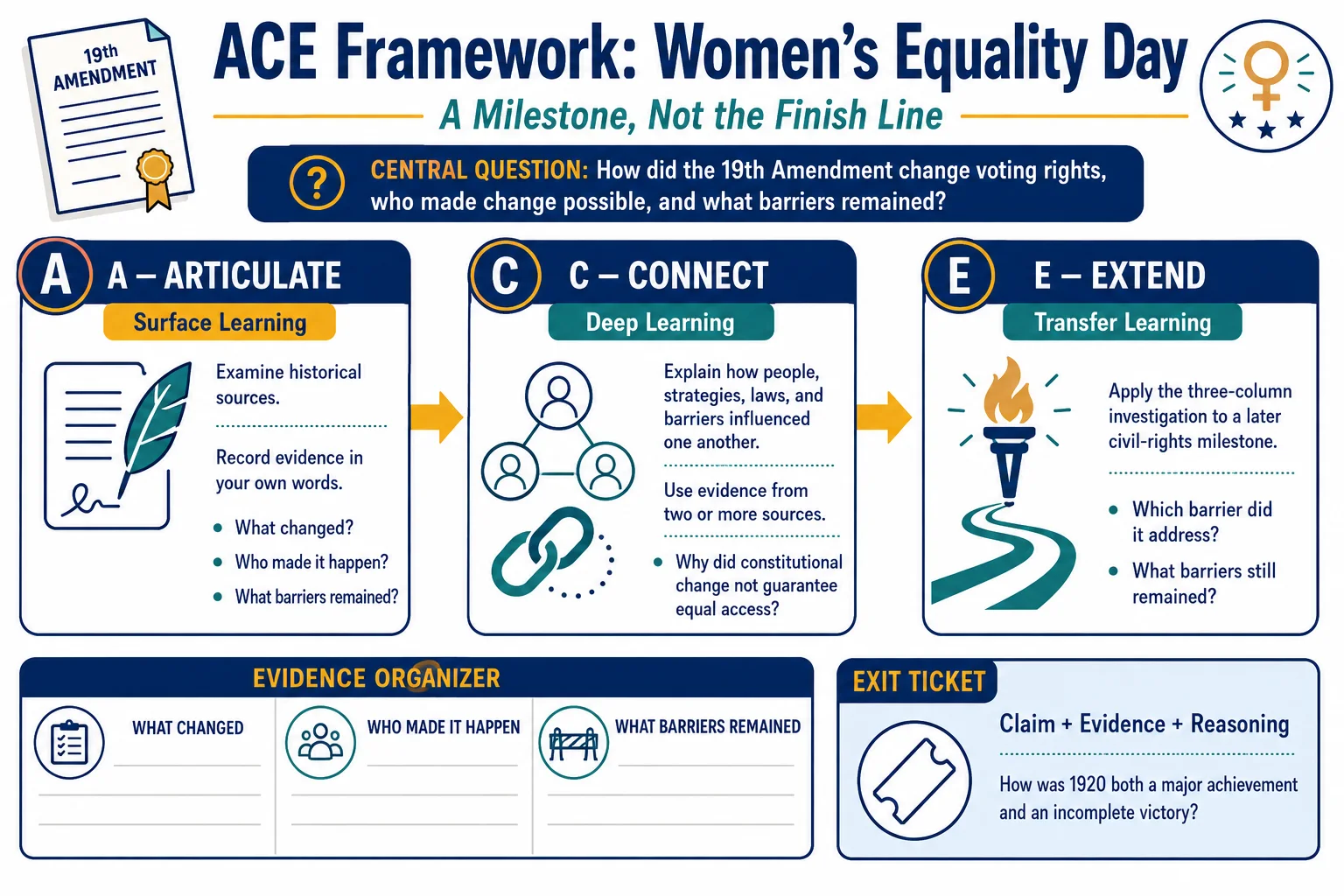
Student Activity: ACE Framework
You can find a Ready-to-Teach Investigation (a lesson plan) that uses the ACE framework. A quick overview appears below:
Ask students to create a three-column page labeled “What Changed,” “Who Made It Happen,” and “What Barriers Remained.” That small shift turns a commemorative date into an evidence-based investigation of citizenship, voting, and equality.