
The short version
Visual Challenges for Science includes 15 illustrated questions for grades six through eight. You can use them on a classroom display, let students work through them in a browser, or print the posters for discussion.
You project a science puzzle, and students begin defending their choices before everyone has read the question. Someone picks the purple block because it “looks heavier.” Apparently, purple makes a convincing scientific argument. I’ve seen this happen in computer lab, too. Kids apply every novel font, change colors, making it unreadable. What grabs them is the novelty, the different from the boring black script on a white background. In science, that can be a problem, right? The goal is to figure out what we observe is telling us, what evidence might support a hypothesis.
Ask that student which evidence supports the answer, and you have a useful starting point for instruction.
As I mentioned in yesterday’s blog post, I created the Science Learning Center to give students a place to investigate science and explain their thinking. Its first collection, Visual Challenges, includes 15 illustrated questions for grades six through eight. You can use them on a classroom display, let students work through them in a browser, or print the posters for discussion. They are aligned to the Texas TEKS, but I suspect any educator could make use of them.
Explore the Interactive Challenges
Open Visual Challenges and select a grade. Each grade has five questions, with topics ranging from density and mutualism to hurricane conditions and conservation of mass.
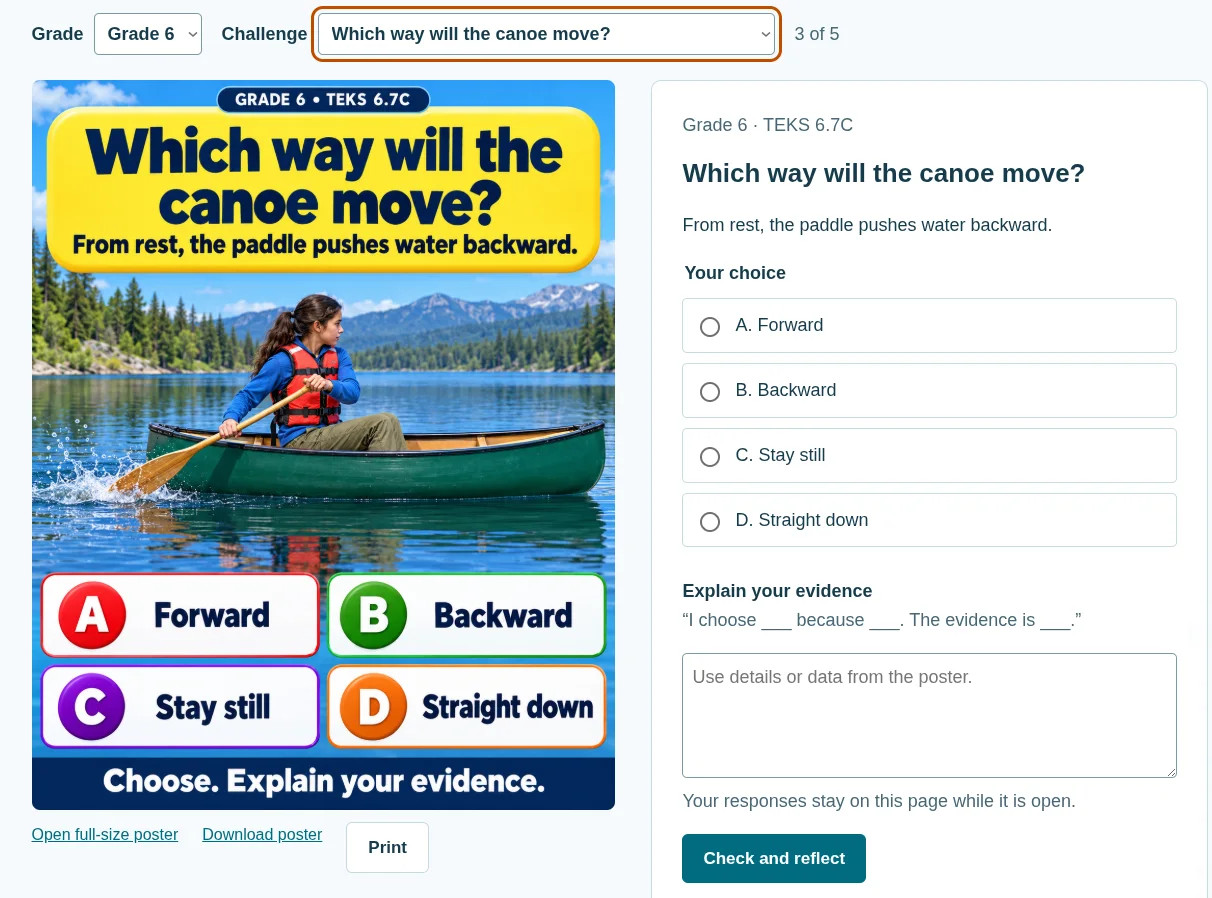
Students see the poster alongside its question, answer choices, and selected Texas Science TEKS code. They choose an answer and type an explanation using this sentence stem:
“I choose ___ because ___. The evidence is ___.”
The Check and reflect button requires both a choice and written evidence before showing feedback. Students then see the supported answer, a science explanation, and a follow-up under “Try a new situation.”
You still assess the quality of their reasoning. The activity checks the selected answer and supplies an explanation for students to consider.
For whole-class instruction, open the full-size poster. Download and print options let you use the same challenge at a station or with students answering on paper. The expandable teacher guidance includes a downloadable answer key with explanations and follow-up questions.
Connect Each Challenge to Your Learning Goal
The collection addresses selected expectations in the Texas science TEKS implemented beginning in the 2024–2025 school year. Each challenge introduces or reviews part of an expectation. Use the displayed code to connect it with your lesson and the broader work students need to complete.
| Grade | Challenges and TEKS |
|---|---|
| Six | Density: 6.6D; gravitational potential energy: 6.8A; Newton’s third law: 6.7C; rock formation: 6.10C; mutualism: 6.12B |
| Seven | Dissolving: 7.6E; average speed: 7.7A; conduction: 7.8A; watershed protection: 7.11A; artificial selection: 7.13D |
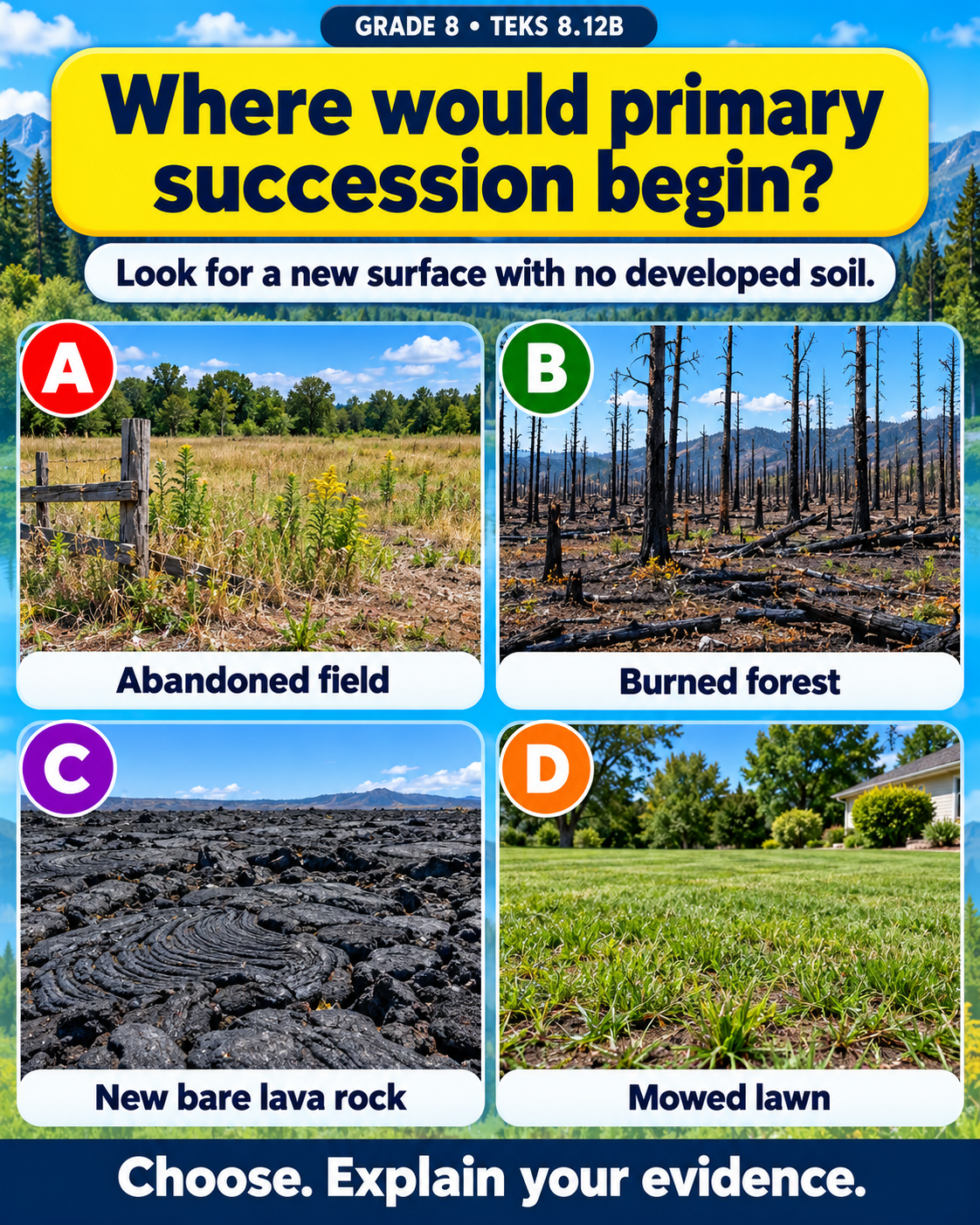
| Eight | Conservation of mass: 8.6E; acceleration: 8.7A; electromagnetic wave applications: 8.8B; hurricane conditions: 8.10C; primary succession: 8.12B |
The discussion can also support the TEKS practices involving evidence-based explanations, communication, and scientific argumentation.
Use the Follow-Up to Check Understanding
Give students a minute to choose independently before they compare explanations with a partner. Ask them to point to the detail or calculation that supports their answer.
In the grade six density challenge, students compare each solid block’s density with water. The follow-up changes the liquid’s density. That gives you a way to see whether students can apply the relationship under different conditions.
For grade seven, the dissolving challenge compares temperature, sugar particle size, and stirring. After students explain their choice, ask them to design a fair test of temperature alone. Have them identify what they would keep constant and what they would measure.
The grade eight mass challenge shows a reaction inside a closed bottle-and-balloon system. Students predict the final scale reading, then consider what could change in an open system.
Guide the Conversation with ACE
You can bring the ACE Framework into any challenge:
- Articulate: State your choice and identify the evidence you used
- Connect: Explain how the science concept supports your answer
- Extend: Apply that explanation to the follow-up situation
Use students’ explanations to decide what comes next. A mistaken answer may call for a demonstration; a correct answer with weak reasoning may need another example.
About Privacy
Student responses remain in the open page session. The site requires no student accounts, and its privacy policy explains that activity responses are not sent to a server. For a lasting record, have students capture their reasoning in a science notebook.
Open the Science Learning Center and choose one challenge that fits your next lesson.