
Textbook File-Sharing?

When your college kid goes away to school, they may be out to save you money pirating textbooks. So alleges an article in eCampusNews Online. Their lead goes as follows:
The high cost of college textbooks has spawned a new battleground in the fight to keep students from downloading copyright-protected materials over the internet: textbook file sharing. Several web sites allow—and, in some cases, encourage—students to make available scanned copies of textbook pages for others to download free of charge, often using the same peer-topeer file-sharing technology that is used to swap music and movies online.
I remember only a short time ago someone shared a web site with me—can’t remember it now—that allows for easy sharing. Peer-to-peer sharing and torrent finding have become increasingly easy. The most insidious question that popular Vuze (formerly Azureus) asks when you enter a query is, “Do you want to include other torrent results?” immediately opening you up to a split-second choice to embrace piracy in all its forms. Yes, and the world is your’s…you can download the latest pop singers’ songs, videos, etc. No, and you are stuck with advertising-laden content, as well as some other stuff.
This factoid was fascinating and frightening for a father about to fund his child as a college freshman in a few years:
According to the National Association of College Stores, the average college student spent between $805 and $1,229 on books and supplies alone during the 2007-08 school year.
The move to open content…can it come soon enough in higher-ed?
An even greater challenge may be the cultural resistance to open educational resources, including the closed-door, “this is mine” mentality and pride of ownership over content that pervades college teaching. Many college faculty members hold on tightly to their syllabi, readings, and lecture notes because this material closely follows a book or article idea that they are in the midst of writing. Or they fear that their ideas will be appropriated by others. Or there may be promotion review on the horizon, and this original scholarship might be their ticket to success. Or they may simply be reluctant to allow people they don’t know and to whom they haven’t given explicit permission to use and share the content of their course materials.
Issues of ownership and intellectual property rights are a related cultural – and legal – challenge. For example, it is unclear in many institutions who really owns faculty-produced content in the first place. Do faculty have the right to give away something that a university has already bought and paid for as part of their salary? Or does intellectual freedom and expression entitle faculty to freely own and license their ideas to others?
Source: Lisa Petrides, Fulfilling the Promise of Open Content, InsideHigherEd.com
Someone has to spend time putting content together, etc. Should we continue to put that in textbooks or move it to the Web? Should content be free and available, open, or should it be safeguarded and exorbitant prices charged? Think of textbooks as expensive, proprietary drugs (e.g. orphan drugs/vaccines) that can cure exotic diseases…should those be free to the underpriviledged, and the cost borne by the organization that develops them? Is it wrong to juxtapose these two?
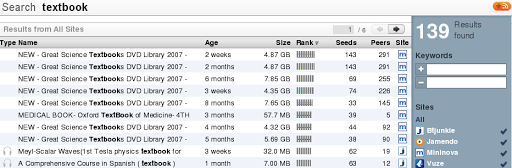
Shouldn’t the resources we use to educate the world be free and openly available? If not, what will textbook publishers do about resources like those shown in this view of what Vuze makes available…139 choices listed and that’ s just a casual look…
 Subscribe to Around the Corner-MGuhlin.net
Be sure to visit the ShareMore! Wiki.