
Over at section, they are doing an amazing job exploring how AI can fit into business. One of their publications, The AI Proficiency Report, is worth checking out. You can download a copy of it online.
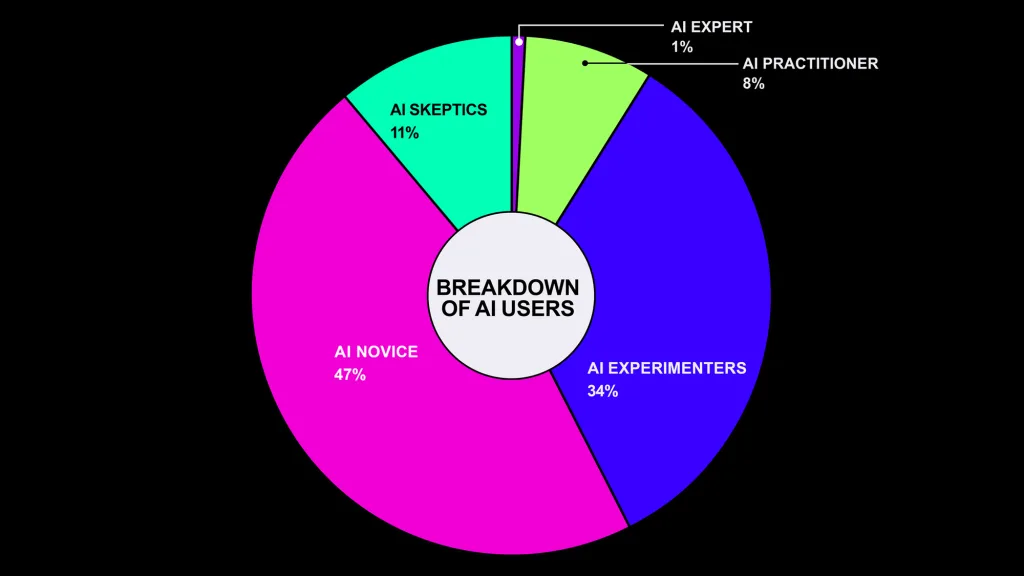
I have shared this diagram with others I work with and in presentations:
https://www.sectionai.com/ai/the-ai-proficiency-report
The accompanying text with that image they post on their website (linked above) asserts the following:
In the last six months, AI companies have accelerated their release schedule – and organizations have accelerated their AI investments. But workers are falling way behind.
90% of the workforce is still not AI-proficient. Employees’ knowledge of AI is decreasing, and their prompting ability is abysmal.
In our latest, bi-annual AI Proficiency Report, we outline why only 10% of the workforce is proficient in AI … and what’s holding everyone else back.
Download the report for free and get the full status of AI proficiency in 2025
They also have great webinars that you can attend, as well as professional learning. I’m not affiliated with them in any way except to say how much I appreciate the report and the webinars.
Reflections
That aside, I’m fascinated by the lack of AI adoption complaints. If you listen to the hype from a lot of AI proponents, it’s evident that there is profound shock about how every field of human endeavor that would benefit from AI adoption is failing to adopt it. Some of the recurring tropes include:
- Should I jump in now or wait until conditions are right?
- The government knows how bad this is going to hit entry level workers and jobs, so that’s why they are doing [put whatever XYZ reason here]
- The people building AI know what AI can really do but it hasn’t YET been released for general use because [XYZ]
- The AI builders know how dangerous AI is, so that’s why they aren’t letting it out yet
- If we were measuring AI by yesteryear’s standards, everyone would say we had achieved AGI already
Almost every AI hype show I listen to is talking about how business/education/whatever needs to make the shift to AI RIGHT NOW.
Some Takeaways via PRISM
| PRISM Element | Key Question | Application to AI Adoption Narratives |
|---|---|---|
| Patterns | What patterns do you see? | Recurring tropes of urgency, secrecy, and government caution; repeated surprise at slow adoption |
| Reasoning | How do things fit together? | Adoption lags due to rational concerns—risk, ethics, infrastructure, and social adaptation |
| Ideas | What different ideas can we mix? | Adoption delay as responsible adaptation; blending tech optimism with caution and ethical foresight |
| Situation | What’s the bigger picture? | Adoption shaped by global, cultural, and regulatory factors; not just technical readiness |
| Methods | How can we check our answers? | Empirical data, case studies, and stakeholder input to validate or challenge hype and narratives |
Finding Empirical Data, Case Studies, etc.
That search for research or evidence may be what’s holding some folks back. Instead of simply jumping in and using AI, they are waiting for evidence. Some of the evidence a la Ethan Mollick can be seen as positive, focusing on the technical aspects of much better AI is getting. In other cases, it’s that the AI is undercutting critical thinking, the economy (e.g. entry-level jobs), and a general sense of urgency that you will be left behind.
In My Own Work
In regards to my own work, crafting emails, reports, organizing complex information has gotten a lot easier. I rely on AI to help me get my work done faster. As I’ve shared previously, this doesn’t mean I finish the job, but that I’m able to get more tasks done. That is, there seems to always be more tasks than can be finished for a job. Let’s say you have three levels of tasks.
Your boss imagines you’ll get to level five of the tasks, but competing priorities, previous projects, life, all conspire to get in the way. You are only able to finish up to Level two or three tasks, which are enough to say, “Job done!” but you wonder, “What if I could have delivered if I had been able to do level 4 or 5 tasks as well?”
To me, that’s the real power of AI. With it, you can often complete MORE tasks than you ever imagined within the bounds of a job. Here’s what I imagine could be the savings depending on use cases. This AI-generated example is about project management for illustration purposes, but I suspect each person would have to put pencil to paper to calculate what they might come up with.
Task Hierarchy Table: Quarterly Business Review Preparation (Project Manager Role)
| Task Level | Description | Time Without AI | AI Tools/Strategies | Time With AI | Time Saved |
|---|---|---|---|---|---|
| Level 1 | Drafting emails, compiling raw data from teams, scheduling update meetings | 8 hours | AI email assistants (e.g., AI chatbot), automated data aggregation, calendar bots | 3 hours | 5 hours |
| Level 2 | Organizing data into spreadsheets, creating basic status reports | 6 hours | AI-powered templates (Notion/ChatGPT), auto-generated charts | 2 hours | 4 hours |
| Level 3 | Analyzing trends, identifying project risks, writing executive summaries | 10 hours | Predictive analytics, risk-assessment LLMs (ChatGPT), summarization tools | 4 hours | 6 hours |
| Level 4 | Strategic recommendations, resource reallocation proposals, stakeholder Q&A prep | 12 hours | Scenario modeling (ChatGPT Advanced Data Analysis), NLP-driven stakeholder sentiment analysis | 5 hours | 7 hours |
| Level 5 | Predictive “what-if” scenarios, innovation roadmaps, long-term impact forecasts | 15 hours | Generative AI for forecasting, simulation tools | 6 hours | 9 hours |
What do you think? Before you scoff at the time-saving, you really should give it a serious try. I’ve met folks who say they have tried, but then find out they haven’t done the lead-in work. Over time, that lead-in work, the prep work, gets easier because you learn the best ways to set up jobs with a hierarchy of tasks for AI acceleration.