
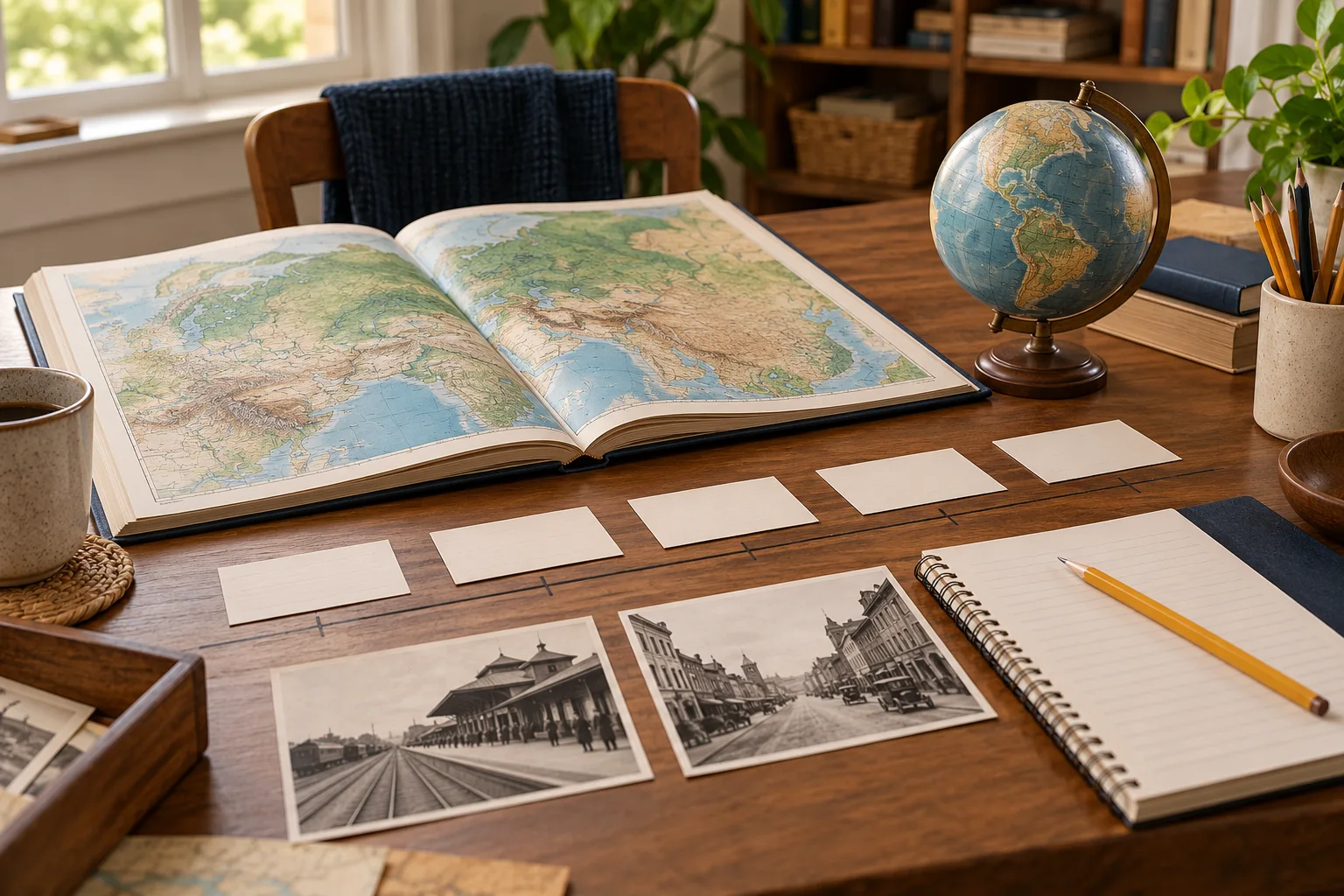
News flash: Texas TEKS are changing
Standards update · Checked September 29, 2026
The State Board of Education (SBOE) adopted major social studies revisions in 2026. Adoption and classroom implementation happen on different schedules. Continue planning with the standards applicable to your grade, course, and school year while preparing for the transition.
This guide uses the 2022-adopted Social Studies TEKS implemented in 2024–2025 for its current content connections and the 2024-adopted ELPS implemented in 2026–2027 for language connections. The examples are suggested instructional alignments, not an official TEA endorsement or a complete curriculum.
Adoption and implementation timeline
| When | What educators need to know |
|---|---|
| 2024–2025 | The 2022-adopted social studies revisions began classroom implementation. These are the current-reference standards used below. |
| June 26, 2026 | SBOE adopted the new elementary and middle school standards and several high school courses. |
| September 4, 2026 | SBOE completed the remaining U.S. History, World History, World Geography, and Government revisions and adopted Applied Personal Financial Literacy. The board announced completion September 8. |
| 2026–2027 | The 2024-adopted ELPS begin classroom implementation: §120.20 for K–3 and §120.21 for Grades 4–12. This language-standards timeline is separate from the Social Studies TEKS transition. |
| 2028–2029 | Applied Personal Financial Literacy begins implementation. This has a separate schedule from the broader history transition. |
| 2030–2031 | New Kindergarten–Grade 5 social studies standards begin implementation. |
| 2031–2032 | New Grade 6 social studies standards begin implementation. |
| 2032–2033 | New Grades 7–8 social studies standards begin implementation. |
| 2033–2034 | New high school history, geography, government, and Foundations of Economics standards begin implementation. |
Timeline sources: current TEA social studies guidance; June 26 board minutes and adopted amendments, PDF; September adoption announcement; September high school implementation text, PDF; TEA’s September 17 financial-literacy update.
Plan for updates. Grade placements, course requirements, and standard numbers change with the revision. Do not carry an old TEKS code into a new lesson without checking its wording. Revisit the SBOE revision hub and TEA’s Chapter 113 standards before each planning cycle. The new sequence includes a Grade 8 Texas history capstone; today’s Grade 7 Texas history resources will need review for their future placement.
Start with a teaching purpose
For ready-to-use activities, explore the History Learning Center (HLC). Its companion, the Science Learning Center (SLC), offers science investigations and visual challenges that ask students to explain their reasoning with evidence.
This collection emphasizes geography, local history, daily life, inventions, chronology, and careful use of evidence. Use teacher-selected sources and the lesson examples below to keep the focus on classroom learning.
- Preservice educators: Pick one student expectation, rehearse a ten-minute lesson, and collect a sample student response. Explain how the response demonstrates the expectation.
- Inservice educators: Choose an upcoming unit, adapt one routine, and use an exit ticket to decide what needs reteaching.
- For every classroom: Match source length and vocabulary to learners. Offer enlarged images, read-alouds, vocabulary previews, sentence starters, and oral or visual response options.
Align content and language
Pair a Social Studies TEKS content expectation with an ELPS language expectation. The content goal identifies the historical or geographic thinking; the language goal identifies how students will listen, speak, read, or write to do that thinking. A strategy or infographic supports instruction—it does not, by itself, demonstrate mastery of a standard.
Use the current ELPS. Beginning in 2026–2027, use §120.20(d) for K–3 and §120.21(d) for Grades 4–12, both adopted in 2024. In each section, (1) is listening, (2) speaking, (3) reading, and (4) writing. Grade 3 uses the K–3 ELPS even though it appears in the Grades 3–5 activity band below. Do not reuse older §74.4 identifiers as if they were the current codes. TEA’s ELPS implementation guidance and the current ELPS rule text, PDF provide the authoritative wording.
One lesson, two goals
Grade 4 example: Use verified records of a Texas library or another local Texas building. The fictional packet below is a rehearsal model; authentic, course-appropriate sources are needed for a historical investigation.
- Content goal — §113.15(c)(19)(C), (G): Compare two records, describe one documented change, and support the claim with evidence.
- Language goal — §120.21(d)(2)(E), (4)(F): Rehearse an oral explanation with a partner, then write an explanation with supporting details. Try: “Before ___, but after ___. Source ___ shows ___. This supports my claim because ___.”
- Evidence to collect: Check the accuracy of the comparison and attribution separately from the student’s oral explanation and written use of supporting details. Record the support provided. A spoken or dictated answer may demonstrate content understanding; it is not interchangeable with independent writing evidence.
Adjust support by language domain
Use the student’s current proficiency in the specific domain you are teaching; listening, speaking, reading, and writing levels can differ. These are classroom support examples, not a replacement for the official proficiency level descriptors. Keep the content thinking challenging while adjusting language access.
| Current proficiency | Possible support for a source comparison |
|---|---|
| Pre-production | Model words with visuals; invite pointing, matching, and meaningful gestures. A student can show which image contains a bridge without being required to deliver an oral explanation yet. |
| Beginning | Offer labeled images, a bilingual glossary when useful, and a short frame such as “Before: ___. After: ___.” Accept emerging words and phrases while modeling the next language move. |
| Intermediate | Provide a word bank, sentence starters, and partner rehearsal; ask for connected ideas using “because” or “but.” |
| High intermediate | Reduce frames, offer prompts as needed, and ask students to clarify a comparison and connect evidence to a claim. |
| Advanced | Invite precise vocabulary, varied sentences, and a qualified explanation; offer targeted support for unfamiliar disciplinary language. |
K–3 proficiency descriptors, including social studies, PDF · Grades 4–12 proficiency descriptors, including social studies, PDF.
The alignment notes inside each worked example identify one grade or course as a starting point. They identify selected skills, not every requirement of a standard. Replace practice records with authentic sources from the required place and period, and select the exact expectations for your students before teaching.
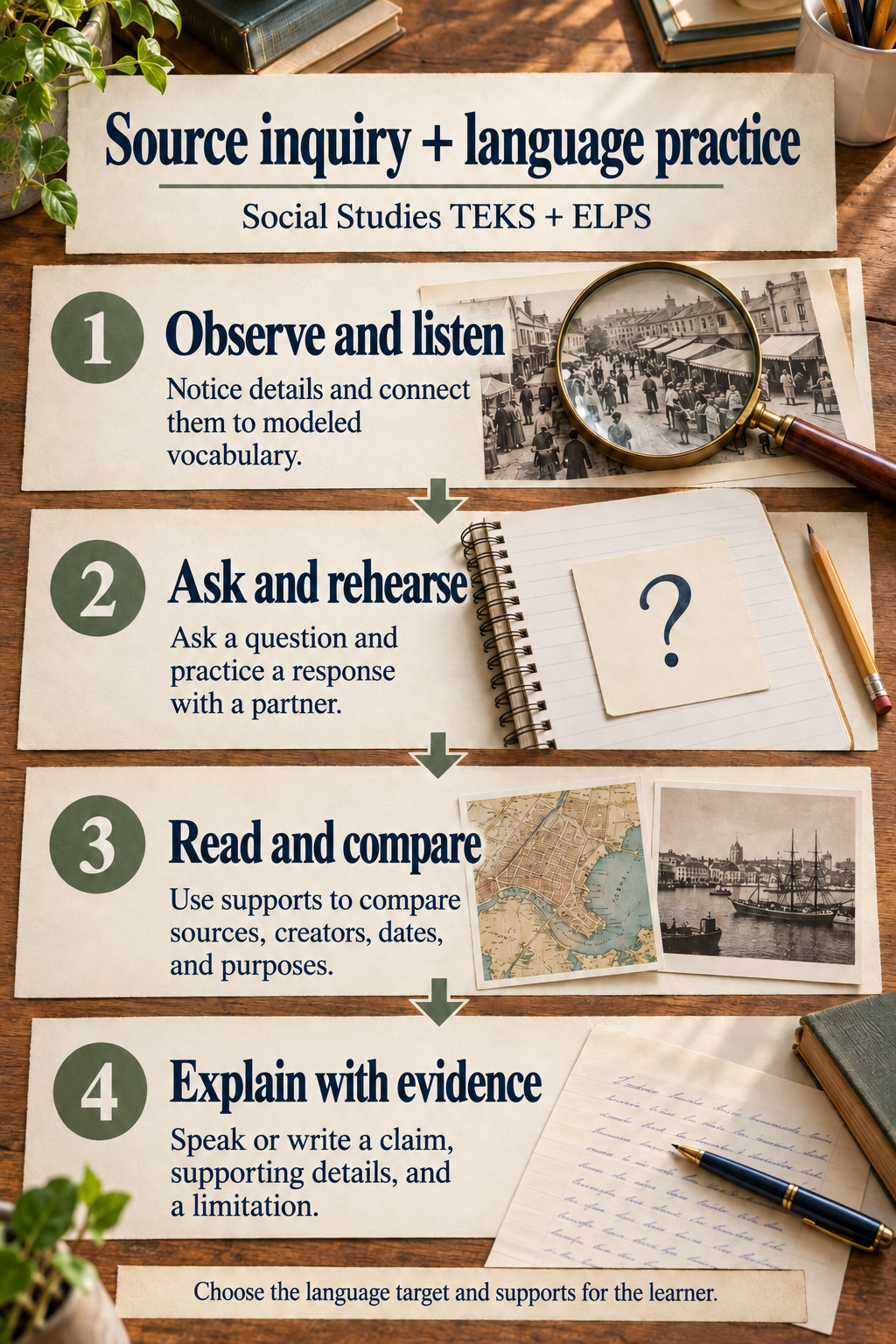
- Observe and listen: Notice visible details and connect them to modeled vocabulary.
- Ask and rehearse: Turn an observation into a question and practice a response with a partner.
- Read and compare: Use visual and language supports to examine creators, dates, purposes, and agreement.
- Explain with evidence: Speak or write a claim with supporting details and a limitation. Choose the target domain first; assess speaking and writing separately when both are taught.
See the activities in action
Thirteen embedded models show the prompt, a sample response, and what to look for. Open an activity below, try its question, then adapt the model to verified sources from your own unit.
K–2: Maps, time, and community
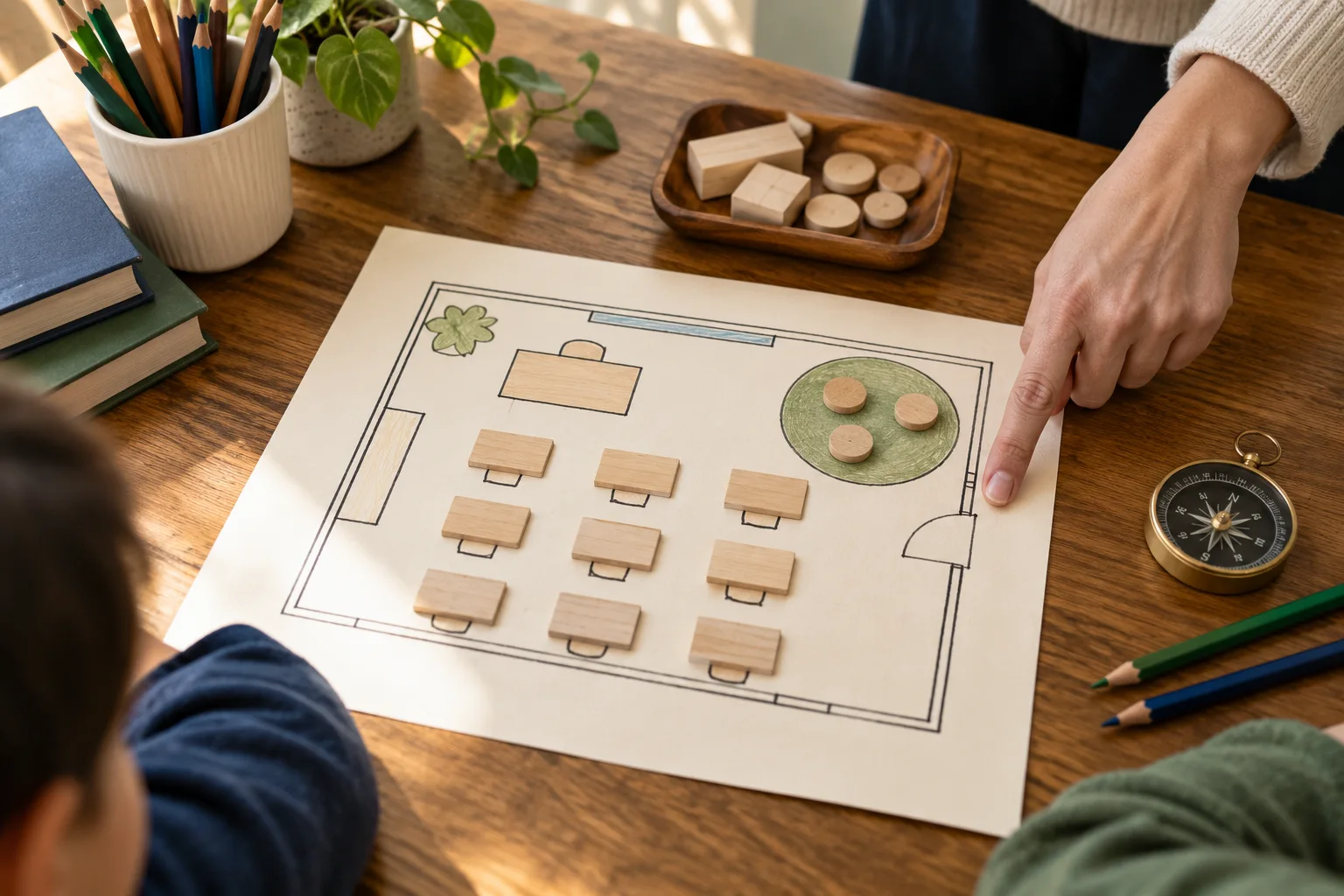
Current TEKS examples: Kindergarten §113.11(c)(3)(C), (13)(B)–(D), (14)(A); Grade 2 §113.13(c)(3)(A)–(B). These connect to maps and globes, historical objects, organizing information, sequencing, and simple mapmaking. Read the elementary TEKS, PDF.
- Observe, explain, and wonder — Select a photograph of a classroom, railway station, or familiar community place. Ask: What do you notice? What makes you think that? What would you like to know? Model the routine orally.
- National Archives document-analysis worksheets — Use the photograph or artifact prompts with teacher-selected material. Students can draw or dictate responses instead of completing a full written sheet.
- Make a classroom map — On paper, mark the door, reading corner, and classroom library. Add a title and key. Grade 2 students add cardinal directions and explain a route; younger students practice relative location. Check understanding by asking a partner to follow the map.
- Build a then-and-now sequence — Use three dated pictures of transportation or a local building. Order them, identify the evidence for the sequence, and name one change. Keep the task focused on observable details.
Worked example · 8 minutes01 · Observe, explain, and wonder
Teacher prompt: Look at the classroom-map photograph above. Describe something you can actually see before making an inference.
“There are blocks on a drawing.”
“The blocks might stand for furniture because they are arranged inside the lines.”
“Which mark shows the door?”
Document-analysis model: Kind: an AI-generated classroom illustration. Creator: generated for this page. Purpose: introduce mapmaking. Limit: it cannot tell us what a real historical classroom looked like. With an authentic photograph, replace these details using its catalog record.
Check for learning: Ask the child to point to the detail supporting “I think.” Accept a spoken response, gesture, drawing, or dictated sentence.
Worked example · 15 minutes02 · Make and follow a classroom map
Try it: Enter through the door, go to a desk, then visit the library. Describe your route using the map.
Key: ★ books · ▭ desk. Practice sketch; not to scale.
Model Grade 2 response: “I enter at the southwest corner. I go north to a desk, then east and north to the library.”
K–1 adjustment: “The library is beside the reading corner and above the desks.” Use relative position before cardinal directions. Have a partner trace the route to check whether the explanation works.
Worked example · 10 minutes03 · Build a then-and-now sequence
Practice cards: These are invented records of one classroom reading corner. In a real history lesson, use dated photographs with source credits.
- 2000One bookcase and two chairs.
- 2010Two bookcases and two chairs.
- 2020Two bookcases, two chairs, and a rug.
Model response: “The dates put the pictures in order. A second bookcase appeared between 2000 and 2010. Two chairs stayed the same.”
Check for learning: Shuffle the cards. Ask students to restore the order and name one change and one thing that stayed the same. The pictures alone would not explain why the changes happened.
Grades 3–5: Local history and evidence
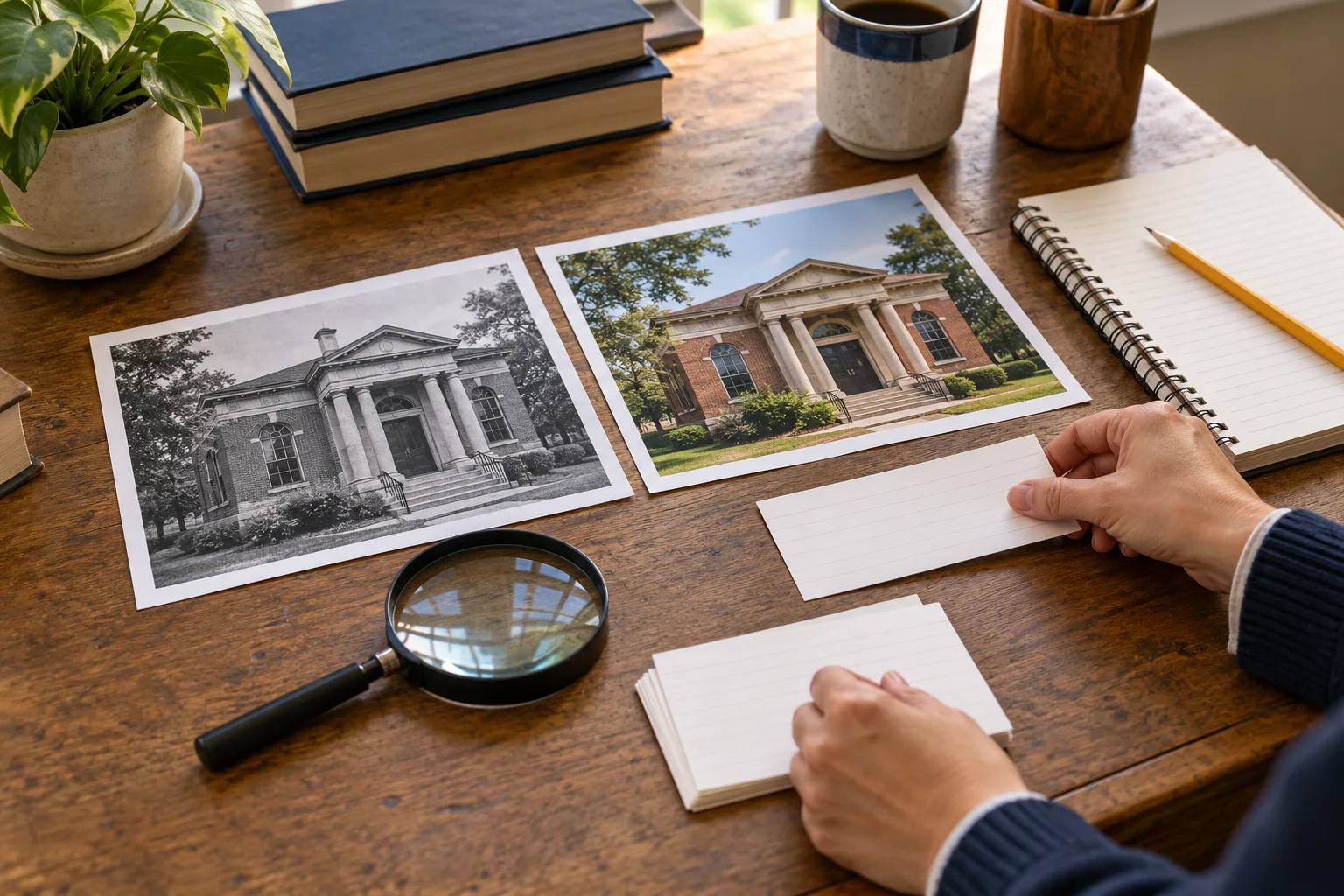
Current TEKS examples: Grade 3 §113.14(c)(14)(B)–(D); Grade 4 §113.15(c)(19)(A)–(D); Grade 5 §113.16(c)(23)(A)–(C). Focus on source comparison, sequence, cause and effect, and visual organization. Check the elementary standards, PDF.
Grade 3 language connection: Use §120.20(d)(3)(F), (4)(F) for supported reading and a written description or explanation. Grades 4–5 use §120.21, as shown in the activity notes. Adjust the reading and writing demands to current proficiency.
- History Event Maps — Choose a reusable organizer for an event, sequence, or cause-and-effect relationship. Start with the history of a local bridge, school, library, or invention. Use two sources and have students label what each source contributes.
- The Portal to Texas History — Find local photographs, maps, newspapers, and other historical materials. Select a small set yourself, record creator and date, and pair a difficult text with an accessible image. The repository is a source collection, not a ready-made lesson.
- USGS historical topographic maps — Prepare two enlarged map excerpts of the same place from different years. Students identify changes in transportation or settlement and explain what the maps show—and what they cannot tell us.
- Try a one-minute evidence ticket — “One change I noticed was ___. My source is ___. One question I still have is ___.” Use the responses to plan the next source or explanation. This adapts the entry/exit-ticket idea from my portfolio for a topic you select.
Worked example · 15 minutes04 · Complete an Event Map
Question: What changed at the library in 1990? This completed organizer models the thinking used in History Event Maps.
- Before
- One reading room; front steps. Source A
- Event
- 1990 library renovation. Source B
- After
- A second reading room and a ramp were added. Source B
- What we cannot conclude
- We do not know how many more people visited or why the renovation was approved.
- Next source
- Look for meeting minutes or visitor counts to investigate those questions.
Check for learning: Students underline a supported change and circle an unanswered question. Avoid turning an inferred cause into a recorded fact.
Worked example · 12 minutes05 · Compare two map excerpts
Fictional map key: ≈ river · ─ road · ■ building · ═ bridge. The two simplified diagrams show the same imaginary area; north is up.
■ Library   ≈ River
──────────  ≈
≈■ Library ≈ River
──────────══╪════
≈Model comparison: “The later map shows a bridge connecting the two banks. The earlier map does not show a bridge. The maps do not tell us the exact opening date or how often people crossed.”
Transfer to real sources: Select matching USGS map extents; read each legend, scale, map date, and revision notes. Pair a Portal to Texas History photograph with its item record to compare what each source can establish.
Worked example · 1 minute06 · Use a one-minute evidence ticket
One change I noticed: a ramp was added to the library entrance.
My source: Source B, the fictional 1990 renovation record.
One question I still have: Did library visits increase?
Teacher response: The student cites relevant evidence and recognizes a limit. Next, introduce visitor records. If the response only says “the library got better,” model a specific observable change before extending the task.
Grades 6–8: Geography and historical reasoning
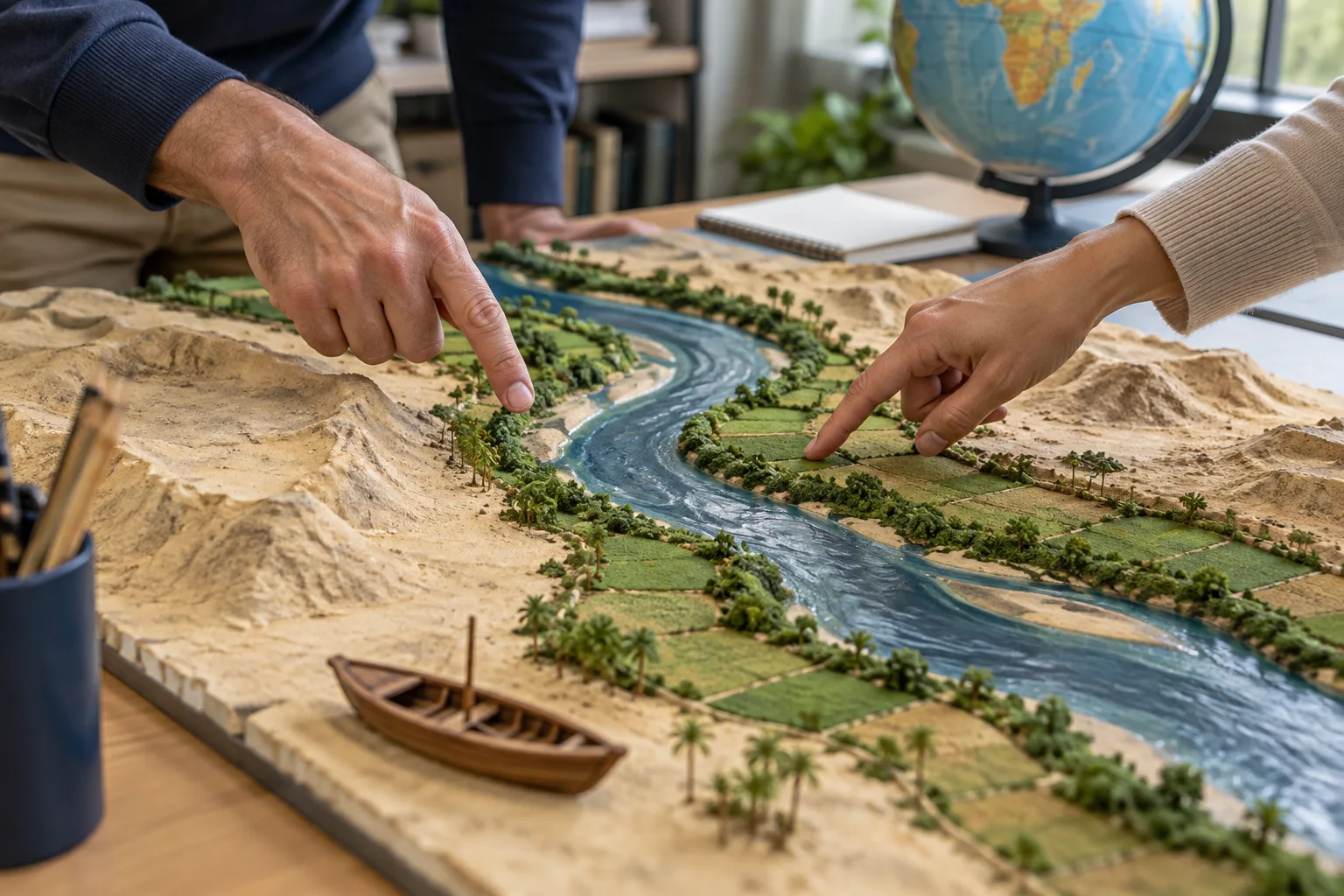
Current TEKS examples: Grade 6 §113.18(c)(19)(C), (20)(A)–(D); Grade 7 §113.19(c)(21)(A); Grade 8 §113.20(c)(29)(A)–(B). Connect map interpretation, geographic questions, primary and secondary sources, and chronological reasoning. Read the middle school TEKS, PDF.
- Expeditione: Ancient Egypt — Use a teacher-selected scene about the Nile, transport, or construction. Students record an observation, consult a historical source, and explain a geographic relationship. Treat the 3D reconstruction as an interpretation to investigate, not a primary source.
- History Event Maps: Event Snapshot — Record who, what, when, where, and supporting evidence. Ask students to distinguish what the source states from an inference they make.
- StoryMapJS — Turn a researched journey, trade route, or history of transportation into a map-based story. Attach a source to each stop. Review the tool’s account and publishing workflow before assigning student work; paper maps work for the same thinking task.
- Compare a map with a photograph — Use the Texas History Portal or USGS collections above. Explain why a settlement developed near a river or railway, then identify evidence that would help test the explanation.
Worked example · 15 minutes07 · Investigate a virtual reconstruction
Inquiry prompt: In a teacher-selected Nile scene in Expeditione, what relationship between water, travel, and land use could you investigate?
- Observation frame
- “In this scene I can see ___ beside the river.” Record only a feature you actually find; do not assume a particular scene includes it.
- Possible hypothesis
- “The river may have influenced where people traveled or cultivated land.” This is a question to test, not a conclusion established by the simulation.
- Evidence to seek
- A dated map, an authenticated object or image with a catalog record, and a reliable historical account of the same place and period.
- Model evaluation
- “The reconstruction helps me ask a question. I need independent evidence before accepting its portrayal of daily life.”
Check for learning: Students mark each note “observed in reconstruction,” “supported by historical source,” or “still uncertain.” Record the actual source title and link beside verified claims.
Worked example · 10 minutes08 · Separate a statement from an inference
Event Snapshot: Return to fictional Source B in the library packet.
Who: the library; individual decision-makers unnamed.
What: added a room and ramp.
When: 1990.
Where: Maple Street Library.
“The ramp may have made entry easier for some visitors.” This is a reasonable possibility; the record does not describe visitors’ experiences.
Next question: “What do visitor accounts say about the entrance?” Use the Event Snapshot organizer to record the statement, inference, and source separately.
Worked example · 20 minutes09 · Turn a route into a sourced story
Embedded storyboard: A fictional walk from a neighborhood to the library. This is a paper-first model for StoryMapJS; place verified coordinates and source links in the published version.
- Stop 1 · West-bank neighborhood
The 1960 practice map shows the library on this side of the river. Evidence: Map A.
- Stop 2 · River crossing
The 1990 practice map shows a bridge. The exact opening year is not supplied. Evidence: Map B.
- Stop 3 · Library entrance
A ramp was added in 1990. The 2020 map also shows a nearby bus stop. Evidence: Sources B and C.
Map + photograph extension: Find an authenticated photograph of the entrance from a known date. Ask whether it corroborates the plan; do not use the generated library photograph above as evidence.
Check for learning: Each stop includes a location, a supported statement, and a source. Students identify what they still need to establish before explaining why a settlement developed in a particular location.
Grades 9–12: Research and explanation
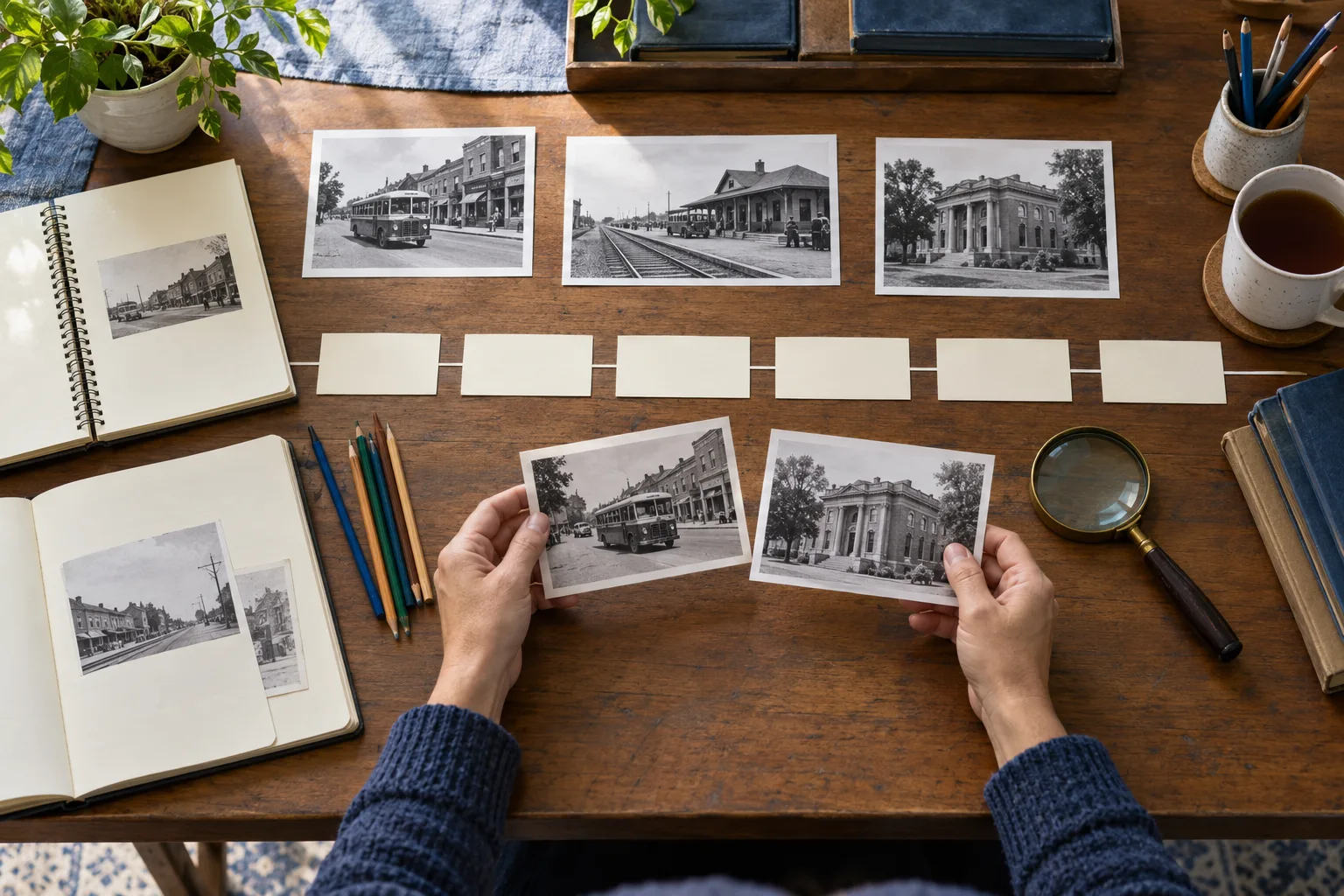
Current TEKS examples: U.S. History §113.41(d)(28)(A)–(D); World Geography §113.43(d)(21)(A), (C). Students investigate historical questions, evaluate sources, organize chronology, and use maps to explain change. Read the high school TEKS, PDF.
- TimelineJS — Build an evidence-based timeline of a technology, transportation system, or local institution. Each entry needs a date, source, and explanation of significance. Chronology alone is not an explanation: require a short synthesis of continuity and change.
- National Archives educator resources — Find documents and analysis routines. Curate a small source set on a course-appropriate topic; ask students to compare provenance, purpose, and what each source can support.
- National Archives cartographic and architectural records — Select digitized railway maps, building plans, or patent drawings to investigate changes in transportation or technology. Record the creator and date, and explain how each item supports a historical claim.
- Plan a source-based explanation — Use an Event Map to connect a question, two pieces of evidence, and a reasoned conclusion. Have students identify one limitation of the evidence and one useful follow-up source.
Worked example · 20 minutes10 · Build a timeline that explains change
Completed model: Use the fictional library packet. These three entries can become rows in a TimelineJS spreadsheet; use verified sources and media credits for a real project.
- 1960 · Original planOne reading room and front steps. Source A.
- 1990 · RenovationA room and entrance ramp added. Source B.
- 2020 · Neighborhood mapA nearby bus stop appears in this record. Source C.
Model synthesis: “The records document changes to the library’s space, entrance, and nearby transportation. They do not establish the date bus service began or prove an increase in library use.”
Check for learning: Require an explanation of change and a limitation, in addition to dates. A source’s date is not automatically the date an event occurred.
Worked example · 15 minutes11 · Compare provenance, purpose, and limits
Source-analysis model: Practice with two fictional records before selecting authentic National Archives documents or architectural records.
Creator: architect, in this teaching scenario.
Purpose: record intended layout.
Supports: what was drawn in the plan.
Limit: does not prove every feature was built exactly as drawn.
Creator: library facilities office, in this scenario.
Purpose: record completed work.
Supports: the reported room and ramp additions.
Limit: does not establish visitor experience or usage.
Model comparison: “The sources have different purposes. I would seek an inspection report or dated photograph to corroborate the physical changes, and visitor data to test claims about use.”
Check for learning: Students identify creator, date, purpose, a supported claim, and a limitation for each real item. Cite the individual catalog record, not just the collection homepage.
Worked example · 20 minutes12 · Write a source-based explanation
Question: What can the practice records establish about changes at Maple Street Library?
Claim: The records describe an expansion of the library and a change to its entrance between 1960 and 1990.
Evidence: Source A shows one reading room and front steps. Source B records a second reading room and a ramp in 1990.
Reasoning: Comparing these records supports a specific claim about the building’s documented space and entrance.
Limit and next step: These records do not establish changes in attendance. I would compare visitor counts before and after the renovation to investigate that question.
Check for learning: Look for a precise claim, two attributed pieces of evidence, a connection between them, and an acknowledged limitation. Have students revise any claim that goes beyond their sources.
More teaching ideas
These readings explain the teaching ideas behind this collection. The direct resource links and classroom adaptations on this page are the starting points for current use.
- Walk Through Ancient Egypt with Expeditione — Use observation, evidence, and questions to structure a brief virtual exploration. Suggested classroom focus: geography, engineering, and daily life.
- Organize Historical Events with Printable Event Maps — A practical introduction to reusable organizers, multilingual options, and printable or editable formats. Its TEKS references describe the current 2022-adopted standards, not the future 2026 sequence.
- Meet ALDO, Amazing Lesson Design Outline — Plan relationships, pre-assessment, teaching, post-assessment, and reflection. Apply the cycle to one history question and one observable student product.
Plan one lesson with TEKS
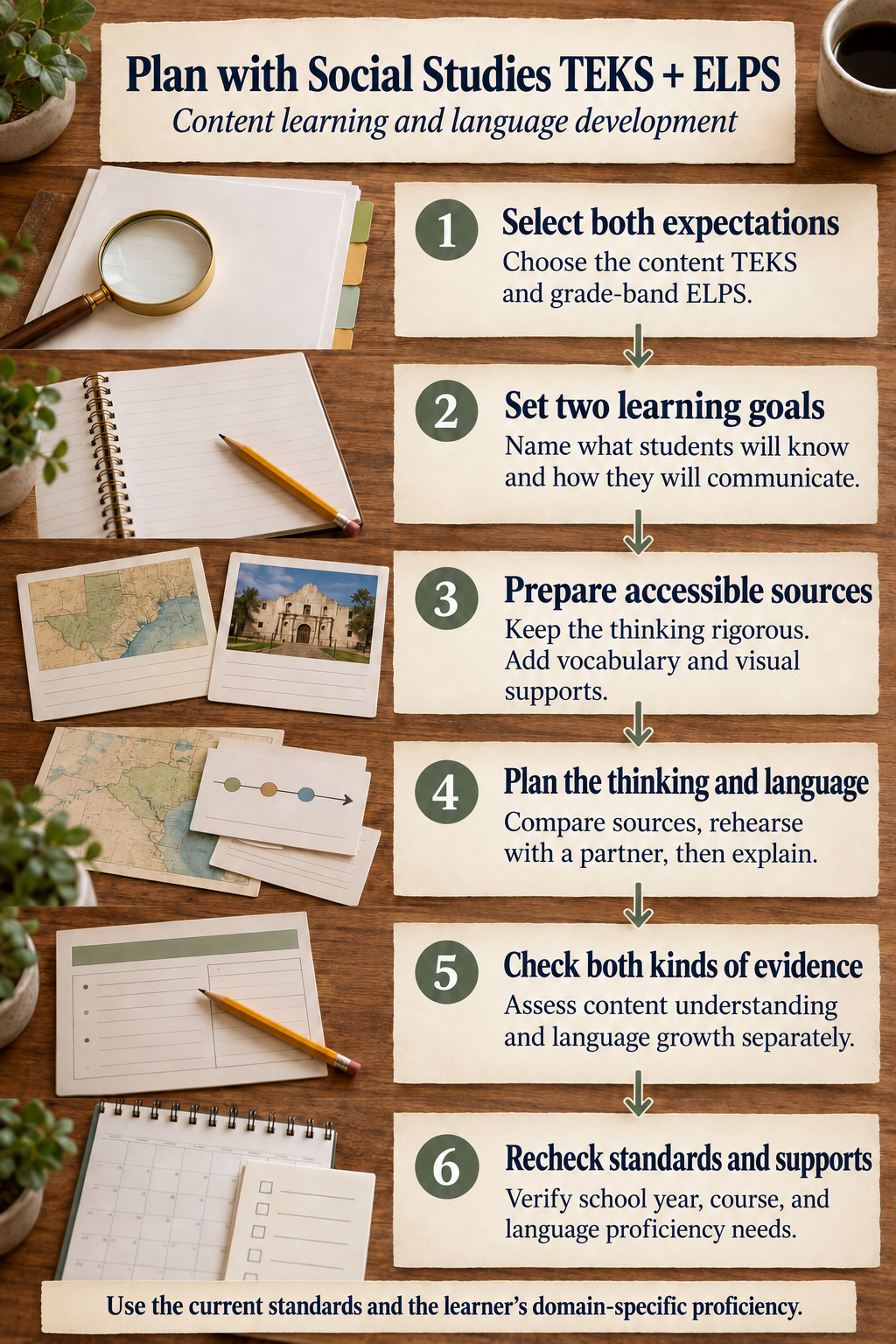
- Select both expectations. Open the current Social Studies grade or course document and the applicable ELPS grade band. Record the content expectation, the language expectation, adoption years, and school year.
- Set two learning goals. Name the thinking: “I can compare two maps and use evidence to explain one change.” Name the language: “I can explain my comparison using ‘before,’ ‘after,’ and ‘because,’ with a source detail.” Select the listening, speaking, reading, or writing evidence you need.
- Prepare accessible sources. Record creator, date, source link, and a short vocabulary list. Add labeled visuals, relevant cognates, read-alouds, or chunked excerpts according to current domain-specific proficiency. Keep the source-analysis task intellectually challenging.
- Plan the thinking and language. Match a sketch map, sequence, comparison, Event Map, or explanation to the content expectation. Model the language move, provide partner rehearsal, and plan the oral or written response that demonstrates the selected ELPS.
- Check both kinds of evidence. Look separately at content understanding and language development. Note supports used; do not mistake limited English output for limited historical thinking, or count an oral response as independent writing evidence. Use the results to model, practice, or extend.
- Recheck standards and supports. Review course placement, exact wording, and implementation year before reuse. Social Studies TEKS and ELPS follow different implementation schedules. Revisit proficiency evidence and adjust the language support for the next lesson.
Worked example · 25-minute lesson13 · Put the activities into an ALDO lesson
Grade 4 model: Compare two sources about a familiar building. Confirm the exact wording of your selected current TEKS expectation before using this plan.
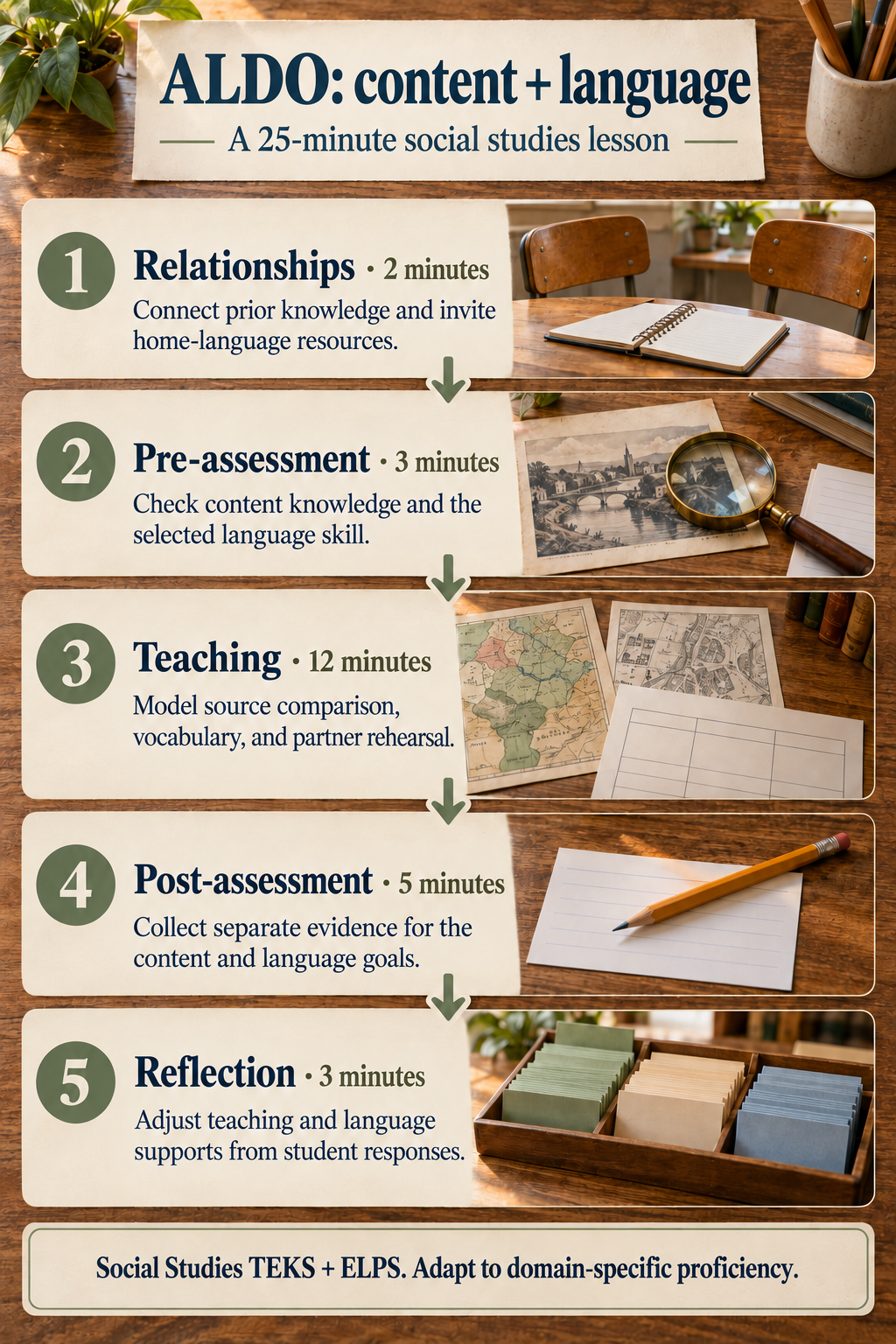
- Relationships · 2 minutes
- Connect to a familiar library space; invite a drawing, partner response, or relevant home-language resources.
- Pre-assessment · 3 minutes
- Show Source A. Check the source observation and the student’s current ability to describe it; note the support used.
- Teaching · 12 minutes
- Model one observation and a comparison sentence; read supported versions of Sources A and B, complete the Event Map, and rehearse an explanation with a partner. Provide a word bank: plan, renovation, evidence, inference.
- Post-assessment · 5 minutes
- Collect an oral rehearsal and a written evidence ticket: one change, supporting source details, and one remaining question. Record content accuracy, oral explanation, and writing separately; document any dictation support.
- Reflection · 3 minutes
- Review the content comparison and the selected language skills separately. Reteach the specific gap, adjust scaffolds, or extend with a corroborating source.
Preservice rehearsal: Teach the first ten minutes to a partner and explain what student response would demonstrate the selected expectation. Inservice adaptation: Substitute two verified local records and retain the same assessment routine.
A quick planning record: Grade/course · school year · Social Studies TEKS code and wording · ELPS code and target domain · content goal · language goal · current proficiency and supports · source links · student task · separate content/language evidence · next instructional step.
Resources and direct links reviewed September 29, 2026. This is a selected teaching collection; educators still need their district’s complete curriculum and current implementation guidance.