
The short version
Give an agent a clear goal, the resources it can use, a check-in schedule, and boundaries for actions that need your approval. Review the results before relying on them.
This quote by Ethan Mollick, writing about agents in The Dot and the Swarm, caught my eye. And, it should catch yours. So much of management in an organization is about mitigating the problems people have in working together. Get your boss mad at you, you may as well start looking for another job. Even with the benefit of Crucial Conversations as a way to handle issues, it’s near impossible to build mutual trust and purpose when one of the parties is lying or not fully disclosing. His blog post was about personal agents. He makes a fascinating point at the start that provides some insight, right?
Management
In his piece, Ethan writes:
A lot of what we call management exists to solve problems that come from organizations being made of people. People have their own goals, and those aren’t always the goals of organizations. We call this the principal-agent problem and a lot of the machinery of organizations, from bonuses to management structures, is based around solving it. And there are other very human problems as well. Information is scattered across people’s heads, and people are often reluctant to share it, or forget to. Communication is expensive too: managers can only oversee so many people, thus adding people to a late software project famously makes it later. Management is, in part, built around human limitations.
Making Sense of Agents
On my desk, I have a stack of handwritten notes about agents. I wrote them from a Section webinar I watched only a few months ago. Much of the information, especially about the products to use to organize agents, is obsolete. The only thing that remains is a pretty clear idea that we set agents up to do work, turn them loose to work autonomously, and have them check in periodically. Simple, right? The execution, as Mollick points out, has gotten faster, quicker, and easier.
Now, when I write a prompt in Codex or Code, I’m simply describing the end result in natural language. If I want a specific look or result, then I describe that. The results are almost always mind-blowing. I’m not worried about cognitive offloading or missing out on productive struggle. What I am focused on is being clear about what I want to describe, on “thinking different” in such a way that the result is going to reflect what I need to get at the end of the process.
Personal Agents Are Here
The personal agents are here, and I suspect, many aren’t even using Codex, Code, Cowork, etc. to their full potential. Instead, they are arguing about how Gen AI use is going to lead to fear and people are going to withhold their trust. As someone who uses Gen AI every day, I’m no longer worried about these things. I am worried that I’m not going to learn enough to leverage Gen AI well enough to get work done at a level I couldn’t have imagined a few months ago.
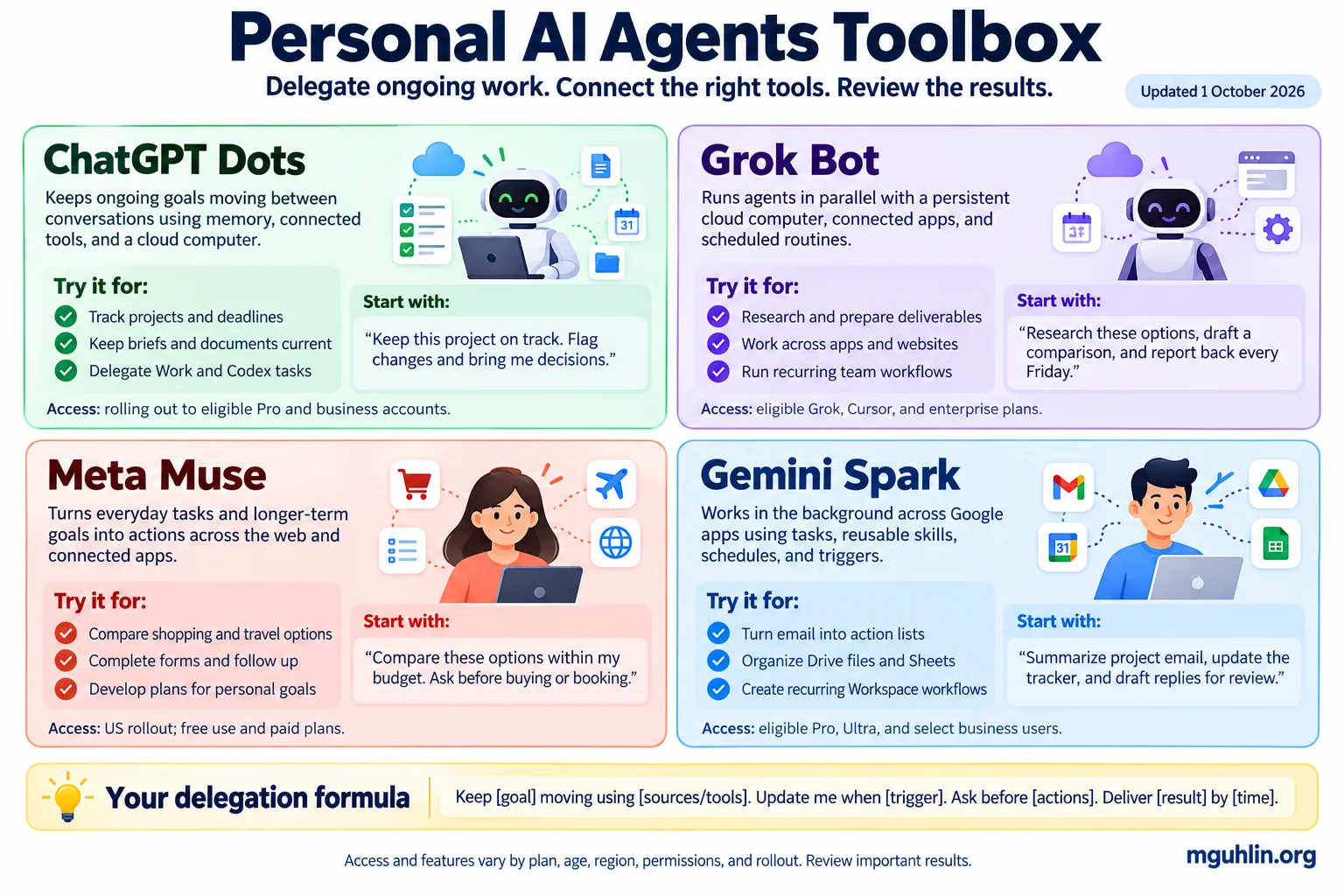
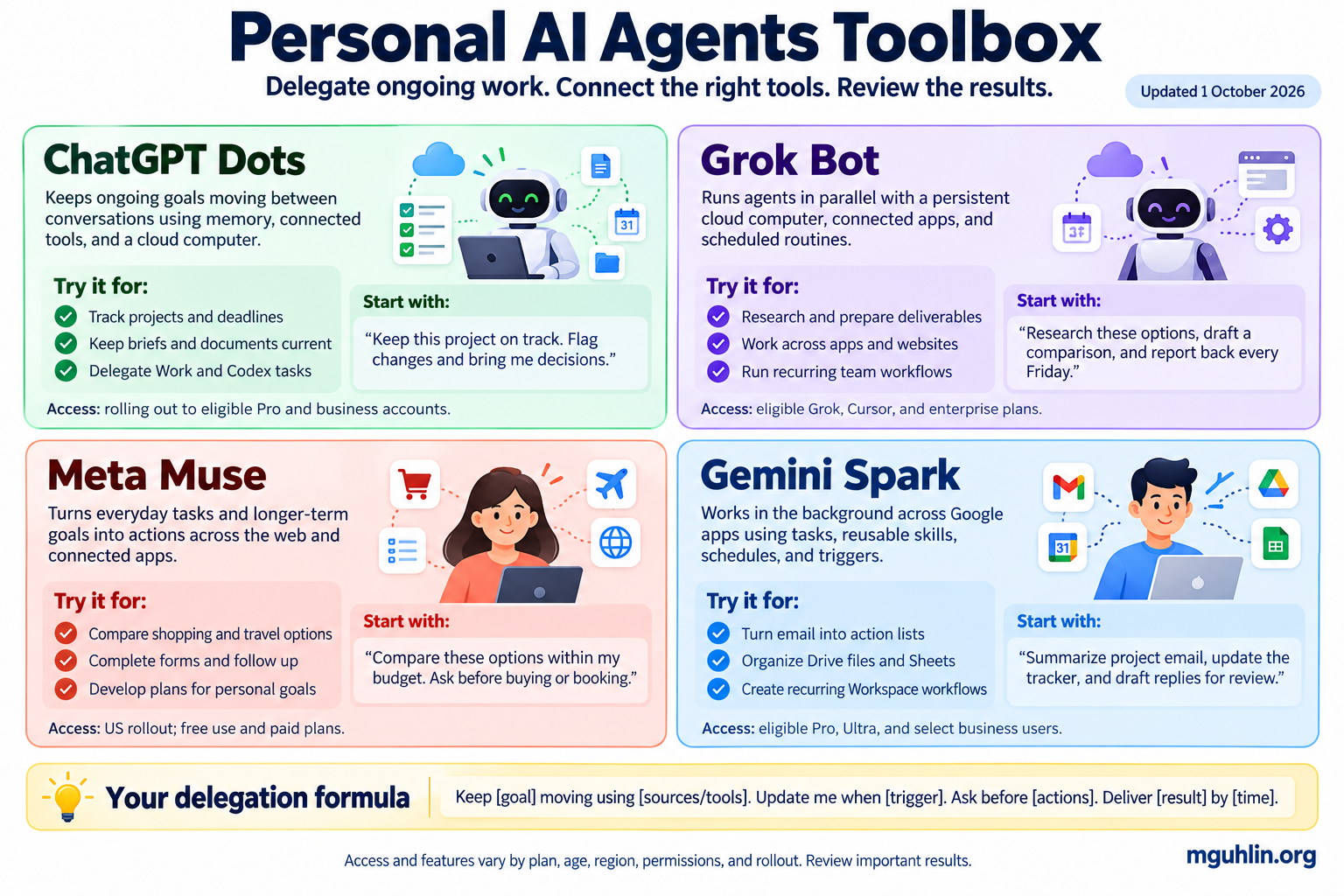
In the meantime, here’s an infographic I had ChatGPT cook up to capture the dynamic of Gen AI:
Are you using any of these personal AI agents?
Personal AI Agents Toolbox: text version
This is a text equivalent of the infographic dated October 1, 2026. The product names and access notes describe the image; they are not a guarantee of current availability. Access and features vary by plan, age, region, permissions, and rollout. Review important results.
ChatGPT Dots
Keeps ongoing goals moving between conversations using memory, connected tools, and a cloud computer.
Try it for:
- Tracking projects and deadlines.
- Keeping briefs and documents current.
- Delegating Work and Codex tasks.
Example starting prompt: “Keep this project on track. Flag changes and bring me decisions.”
Access note in the image: rolling out to eligible Pro and business accounts.
Grok Bot
Runs agents in parallel with a persistent cloud computer, connected apps, and scheduled routines.
Try it for:
- Researching and preparing deliverables.
- Working across apps and websites.
- Running recurring team workflows.
Example starting prompt: “Research these options, draft a comparison, and report back every Friday.”
Access note in the image: eligible Grok, Cursor, and enterprise plans.
Meta Muse
Turns everyday tasks and longer-term goals into actions across the web and connected apps.
Try it for:
- Comparing shopping and travel options.
- Completing forms and following up.
- Developing plans for personal goals.
Example starting prompt: “Compare these options within my budget. Ask before buying or booking.”
Access note in the image: US rollout; free use and paid plans.
Gemini Spark
Works in the background across Google apps using tasks, reusable skills, schedules, and triggers.
Try it for:
- Turning email into action lists.
- Organizing Drive files and Sheets.
- Creating recurring Workspace workflows.
Example starting prompt: “Summarize project email, update the tracker, and draft replies for review.”
Access note in the image: eligible Pro, Ultra, and select business users.
Your delegation formula
Keep [goal] moving using [sources/tools]. Update me when [trigger]. Ask before [actions]. Deliver [result] by [time].