
The short version
Dr. Glenda Horner’s advice—“Don’t try to do too much”—brought back years of lessons about professional learning. Here’s how I connected her emphasis on conversation, relationships, and reflection to ACE/SOLO, and more.
Listening to Dr. Glenda Horner, I had a bit of a “trip down memory lane” experience. You know, all the advice you get from folks over the years standing up in your head to say, “See? What we told you wasn’t bad advice, you just needed to hear it one more time.” That’s why I loved the podcast insights from Dr. Horner in this conversation via Learning Forward podcast episode, Designing Professional Learning That Makes a Difference.
About the Podcast
Here’s a little blurb about the podcast itself:
In Episode 5 of the Forward Thinking Podcast, Dr. Glenda Horner, Director of Professional Learning for Cypress-Fairbanks ISD and Past President of Learning Forward Texas, joins us to explore what makes professional learning meaningful for adult learners. From understanding your audience to creating opportunities for connection, conversation, and reflection, Glenda shares practical ideas for moving beyond simply presenting information to designing learning that makes a difference. And her BEST TIP for facilitators? Don’t try to do too much.
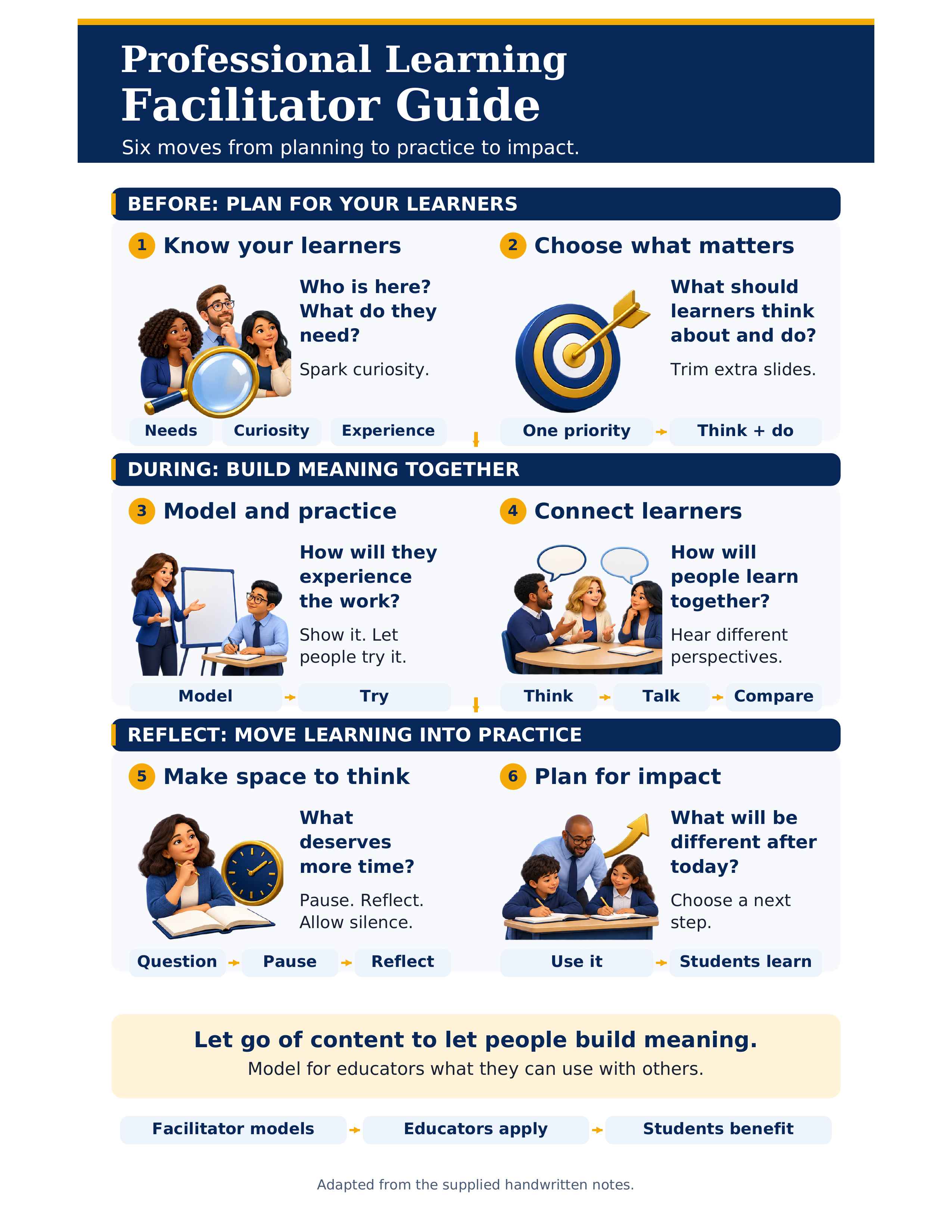
Infographic Summarizing My Notes
Strategize a Bit
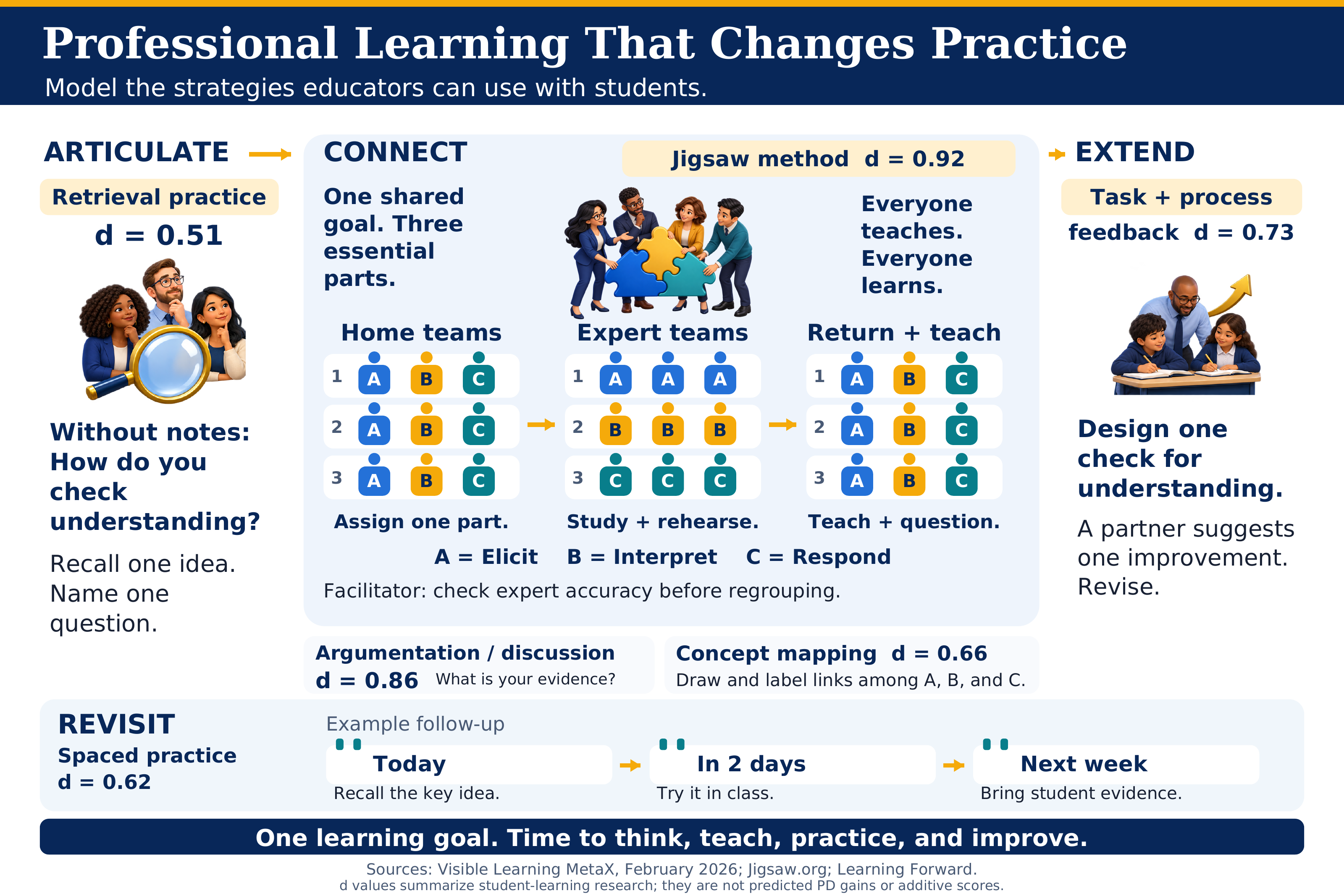
As I listened to Dr. Horner, I couldn’t help but make a connection to Hattie’s Visible Learning high-effect strategies and the ACE framework. This infographic attempts to capture the connection and is based off my notes, rather than the transcribed text of the podcast.
Of course, the Jigsaw Approach isn’t the only strategy you could use. I was curious what approach my Gen AI chatbot would recommend based on our past conversations. Surprisingly, it went with Concept Mapping:
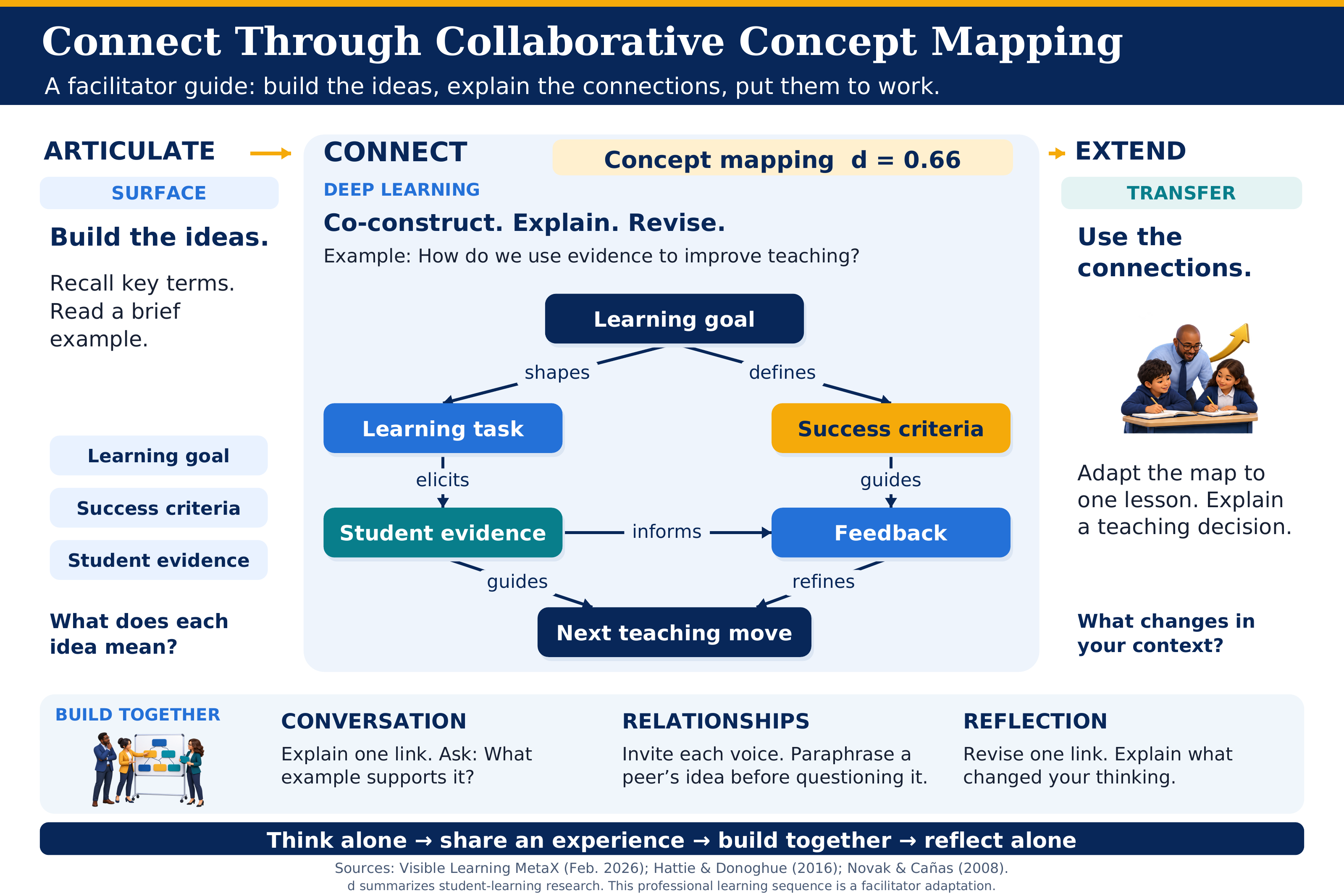
Which strategy—Jigsaw or Concept Mapping—would YOU rely on? As much as I find Jigsaw useful, it can take a full class period to allow for the 3-step jigsaw. It’s also important to assess what phase of learning students are currently in. That’s why this chart may be helpful.
Strategy Table
This table organizes different strategies that really explore the practitioner side of things, the “how” that Dr. Horner alludes to but doesn’t go into much detail about in the podcast. What strategies are your go to ones to use?
| Time | Strategy | Explanation for facilitators | ACE / Learning phase | SOLO target |
|---|---|---|---|---|
| 3–5 min | Retrieval practice — d = 0.51 (www.visiblelearningmetax.com) | Recall key ideas without notes; compare answers and correct errors. | Articulate — Surface, especially consolidation | Unistructural: identify one relevant idea. Multistructural: recall several relevant ideas. |
| 3–5 min per revisit | Spaced vs. mass practice — d = 0.62 (www.visiblelearningmetax.com) | Revisit learning through brief practice over several days. Space explanations and applications as understanding develops. | Articulate — Surface consolidation; also supports retention during Connect | Unistructural / Multistructural initially; depends on what is practiced. |
| 30–45 min | Jigsaw method — d = 0.92 (www.visiblelearningmetax.com) | Expert groups learn assigned content; home groups teach each other. Add a synthesis question requiring connections among the parts. | Articulate → Connect — Surface → Deep | Multistructural → Relational: move from knowing the parts to explaining the whole. |
| 8–12 min | Elaboration and organization — d = 0.72 (www.visiblelearningmetax.com) | Connect new learning to prior experience. Explain why the connection matters and organize related ideas. | Connect — Deep acquisition | Relational: integrate ideas into a coherent explanation. |
| 10–15 min | Peer tutoring — d = 0.55 (www.visiblelearningmetax.com) | A prepared tutor explains how and why a process works; the partner practices, explains their reasoning, and receives feedback. | Connect — Deep consolidation; basic skill tutoring can also serve Articulate | Relational when explanations connect actions, reasons, and outcomes. |
| 10–20 min | Argumentation / Classroom discussion — d = 0.86 (www.visiblelearningmetax.com) | Discuss a case, support claims with evidence, consider alternatives, and revise conclusions. | Connect — Deep | Relational: connect claims, evidence, and reasoning. |
| 15–25 min | Concept mapping — d = 0.66 (www.visiblelearningmetax.com) | Build labeled relationships among concepts. Explain, question, and revise the links after foundational ideas are established. | Connect — Deep acquisition | Relational: explain how concepts form an interconnected whole. |
| 20–30 min | Reciprocal teaching — d = 0.74 (www.visiblelearningmetax.com) | Model summarizing, questioning, clarifying, and predicting. Participants lead the dialogue, then independently use the routine with unfamiliar text. | Connect → Extend — Deep → Transfer, when independently applied in a new context | Relational → Extended abstract when participants generalize when and why the approach works. |
| 5–10 min | Feedback (Tasks & Processes) — d = 0.73 (www.visiblelearningmetax.com) | Give specific information against success criteria, then allow revision: correct an idea, strengthen reasoning, or improve an adaptation. | Across ACE — Surface, Deep, or Transfer | Any level, according to the understanding targeted by the feedback. |
Transcription Notes
I took notes on the podcast by hand, then asked Gen AI to transcribe the photos of my handwritten notes (I’m shocked it recognized my terrible scrawl!). These are the results, as is the infographic it put together to summarize the key points. I captured the ideas I thought were most important.
Professional Learning Facilitation Notes
Page 1
- Who are my learners, and what do they need?
- Asking students what I want them to think about and do.
- Who’s in the room? What do they need? What do I want them to be curious about?
- What experience will they get from this?
- We are wired to be social. We make sense through conversation, relationships, and reflection… hearing different perspectives.
- Can I stretch and challenge your thinking a little bit?
- Structured conversations:
- Strategy can change.
- How am I helping people connect to content and each other?
- How do we get people to learn from each other?
What deserves our time? What does not?
Need time to show and do something.
PD can be focused on content delivery or checking a box.
Purpose of Adult Learning: Growth that leads to impact or change… gain a new skill, try something new, improve practice.
Page 2
We are building capacity and modeling for others what they need to do for others.
→ Better outcomes for kids.
What do we hope will be different because of what we shared today?
One piece of advice:
- Don’t try to do too much. Too much content, too many slides.
- Identify what really matters most, then build around that.
- Build around questions, reflections, and silence.
- Let go of content to let people build meaning.